
The 'Colored' Pages: The news was separate, but hardly equal
On Feb. 9, 1930, Marian Anderson sang at the Woodland Park Auditorium.
Just 33, Anderson was already famous as one of the greatest contraltos in the United States.
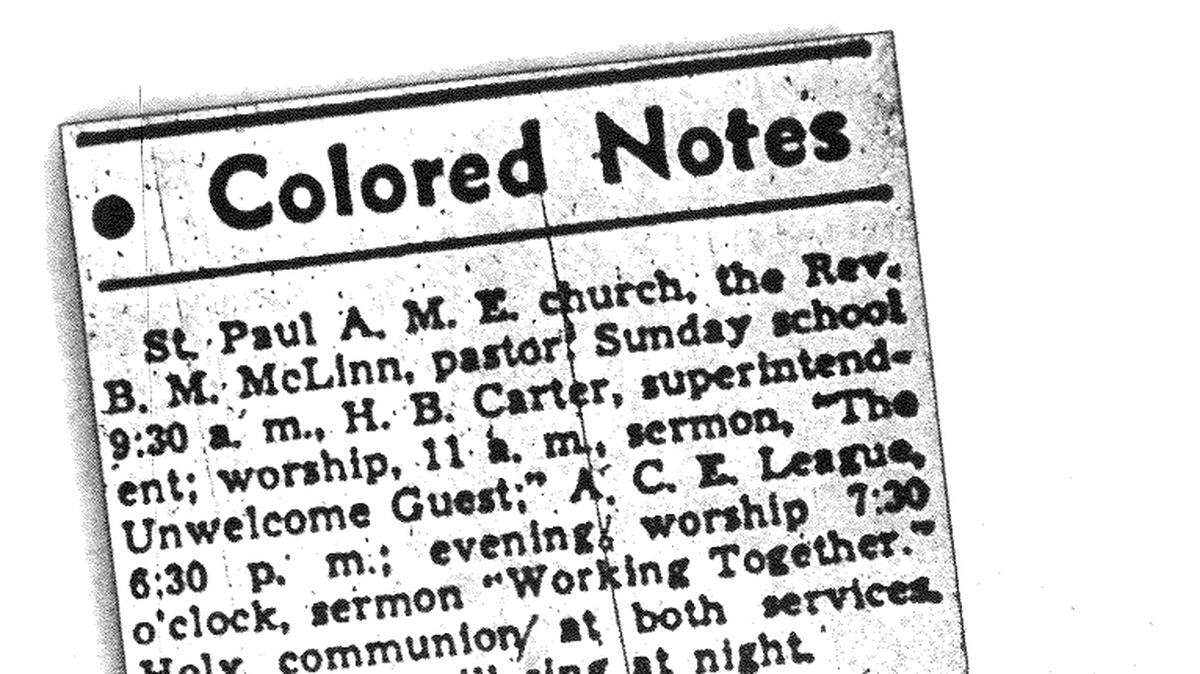
But that didn't matter to the editors of the Lexington Leader and the Herald. She was black. Therefore, any unpaid notice of her concert would appear only in Colored Notes, a column of news items about the black community that appeared in the back pages of both papers.Lexington was like most of the South, a segregated society where blacks and whites lived in separate neighborhoods, went to separate schools and ate in different restaurants.
Most newspapers were segregated too, said Robert J. Norrell, a civil rights expert and history professor at the University of Tennessee.
Sections like Lexington's Colored Notes were "fairly typical," he said. "Sometimes it had been done to try to attract black readership."
Most of Colored Notes was confined to births, weddings, deaths and social events. Unlike Louisville, Lexington didn't have a black newspaper.
"Of course, it was terribly racist," said Audrey Grevious, who led the local NAACP. "But that was really all the news we had. Without that, we wouldn't have known anything that was going on."
Black citizens would only make news outside of Colored Notes if they were involved in a crime big enough for the front pages, recalled Ralph Derickson, who worked as a reporter at the Leader from 1964 to 1970.
"If it was a story about anything but crime, the editors would say, 'We have Colored Notes for that,'" Derickson said. "It was an ours/theirs world. That's all there was to it."
The Colored Notes archives show a bustling community of church meetings and social clubs, consigned to the back pages of the newspaper and the north side of town. The notes describe a rich array of details about day-to-day life rarely seen in any newspaper today.
Here are a few selections from April 3, 1939:
"The monthly clinic of the Maternal Health Clinic will be held from 7 to 9 o'clock Monday night at the Good Samaritan Hospital."
"The Andetts Club of the Pleasant Green Baptist Church will give a "Java Sip" this afternoon at the residence of Miss Joanna Offutt, 439 Georgetown Street, celebrating their third anniversary. A program of the best local talent will be presented."
"Mrs. Willie Mae Whiting is ill at her home, 561 South Upper Street."
"In memory of Rev. John W. Toles who passed April 2, 1938.
Sleep on dear one,
Your name we love to hear;
No Saint; on earth its worth can tell
No heart; conceive how dear.
Sleep on.
Sadly missed by Wife and Children."
'Agitators' ended it
Gertrude Morbley, who started at the papers in 1937 as the elevator operator, was the last author of Colored Notes. She died in 1988.
She was the newsroom's only black employee; as Derickson recalls, she typed up all the notices at home and delivered them to a wicker basket on top of an old file cabinet.
Once the civil rights movement got under way in Lexington, protesters focused on doing away with segregation, including segregated news stories in the papers. On Aug. 31, 1963, more than 250 protesters marched down Main Street to the old Herald and Leader building on Short Street.
The march got a notice of less than 5 inches on page 37, below a review of a local production of Cole Porter's Anything Goes. Colored Notes ran on page 38.
The editors did not end Colored Notes until 1969, just four years before Knight Ridder bought the two papers.
The editor's note ran on page 22: "Complaints, harassments, charges, anonymous telephone calls and unpleasant accusations from a few White and Negro agitators have brought this about."
News researcher Linda Minch contributed to this story.
This story was originally published July 4, 2004 at 12:00 AM with the headline "The 'Colored' Pages: The news was separate, but hardly equal."