Others like her haven’t survived. ‘Little queen’ to celebrate 1st Christmas in Kentucky.
Kyndall Covington is in elite company.
The smallest surviving baby ever born at the University of Kentucky Chandler Hospital, Kyndall weighed just 360 grams, or 12.6 ounces, when she was born.
The University of Iowa, which tracks the tiniest surviving babies born around the world, has just 206 infants on its registry of surviving babies with birth weights under 400 grams.
Kyndall, who is now 8 months old and celebrating her first Christmas at home with her family, is on that list.
“She’s just a miracle,” said her mother, Tabitha Covington. “She’s just a true miracle from God.”
Kyndall was delivered by C-section at 24 weeks’ gestation because she was not getting adequate blood flow from the placenta.
“She wasn’t able to get the nutrients that she needed to grow,” Covington said.
At the same time, Covington was suffering from severe preeclampsia, a pregnancy complication that can be serious for both mother and baby.
Covington is a labor and delivery nurse herself, so she understood the dire situation facing her tiny newborn.
“When she was born, it was kind of like I knew too much,” she said. “I have so many friends that are NICU nurses. They knew the risks.”
But, she said, Kyndall had two things going for her: first, she was a girl, which gave her an edge statistically in her development, and second, Covington said, “she came out feisty.”
“Anytime they said, ‘preemie babies can’t do this,’ ... she proved them wrong,” Covington said.
Dr. Mina Hanna, medical director of the Neonatal Intensive Care Unit at UK, said the first few days are the most critical for such tiny babies.
“Babies who are born at that gestational age and that are severely growth-restricted like that, the chance of survival is small,” she said in a news story about Kyndall posted on UK’s website. “When you have babies that small, you don’t know if they’re going to make it.”
Dr. Aparna Patra, who treated Kyndall in the NICU, said in the article that some of the medical equipment for preemies was too big for Kyndall, so the medical team made adaptations.
“We had to think outside the box for a lot of the things for her,” Patra said.
Kyndall has been home from the hospital since Sept. 20 and is doing well, her mother said.
At her last checkup, Covington said, she weighed 12 pounds, 3 ounces.
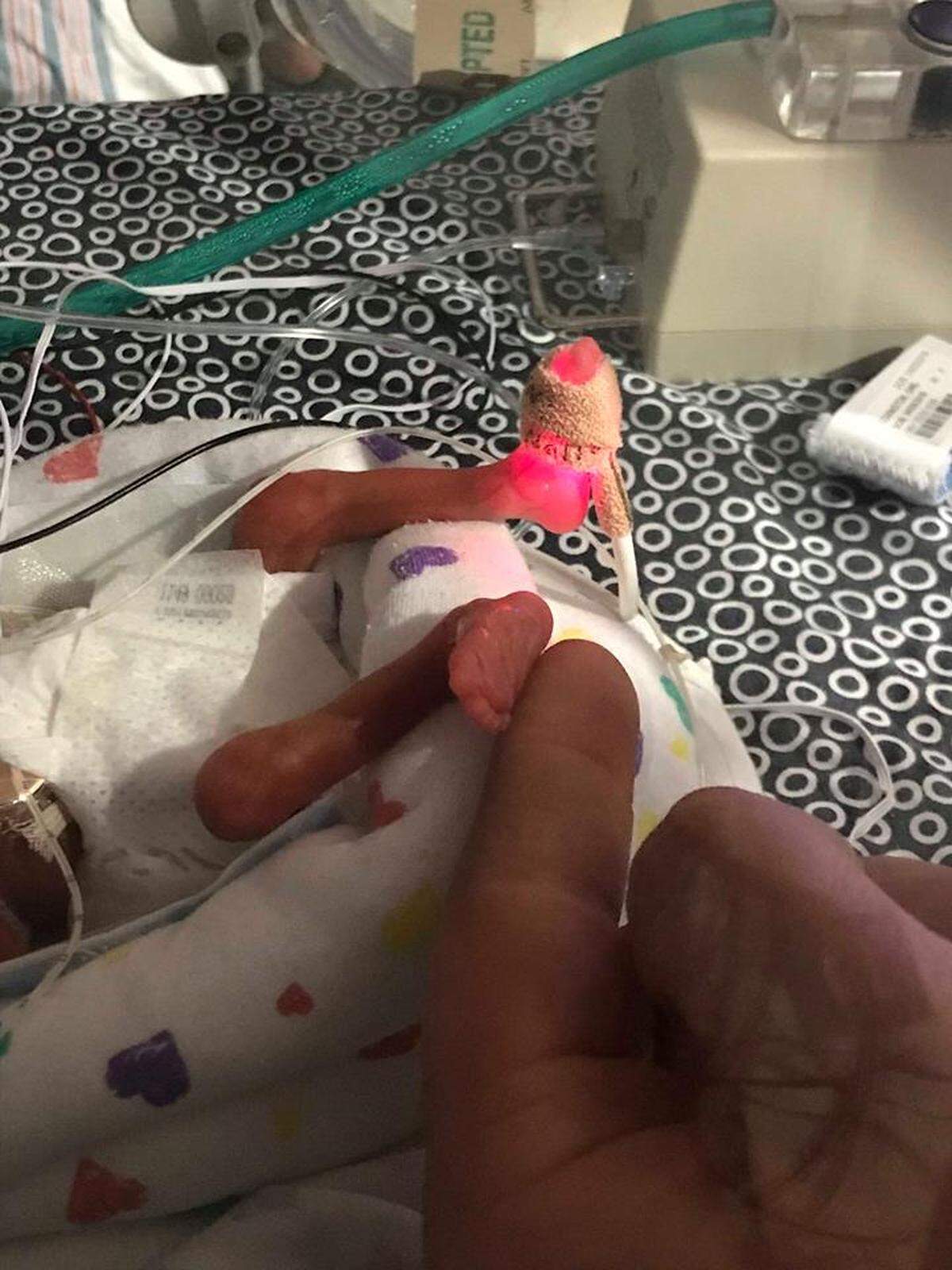
Kyndall will likely wear glasses and may have little or no peripheral vision as a result of laser treatments that were needed to treat retinopathy of prematurity, a condition common to babies born very early.
She is still on oxygen at home, but Covington hopes she will be off that in another month or two.
“She’s very spoiled,” Covington said. “She loves to be held and talked to.”
Covington and her husband, Bobby, have four other children who all dote on the baby.
“She’s our little queen, and she knows it,” Covington said.
Though Kyndall is the smallest surviving baby ever born at UK, her birth marks the second time Kentucky has made the tiny baby list.
A baby boy born in Lexington in 2016 at 27 weeks gestation weighed 395 grams and survived, according to the University of Iowa registry.
The University of Iowa says it hopes the registry will help parents and doctors as they make decisions about care for such small patients. In some cases, follow-up information is available about the health conditions the babies experienced.
The information comes from health care providers, medical journals and the media. Sometimes families provide the information with verification by their doctors.
“The survival of these tiny babies illustrates the well-known fact that gestational age is a more important factor than birth weight in determining the prognosis of an extremely premature baby,” the website states.
The university’s list also illustrates how far medical care has come for premature infants in recent decades.
The second baby on the list was born in Canada in 1937 and weighed 397 grams. The notes say the baby boy was “bathed in warm olive oil, wrapped in cotton, and placed in a basket in a warm oven; fed brandy in warm water by eye dropper; weighed the day after birth on a grocery scale.”
With so many advances in neonatal medicine, doctors can give parents hope, Patra said.
“Every baby is different,” Patra said of Kyndall in the UK article. “She did great, but another baby born at the same weight or gestation may not do as well and may succumb to the complications of prematurity. We don’t want to give parents unrealistic expectations, but at the same time, I think there is hope.”
Covington said that’s why she wants to share Kyndall’s story with as many families as possible.
“No matter how small,” she said, “they have a chance.”
This story was originally published December 22, 2018 at 10:50 AM.