How Donald Trump’s trade war is hurting one of Eastern Kentucky’s key industries
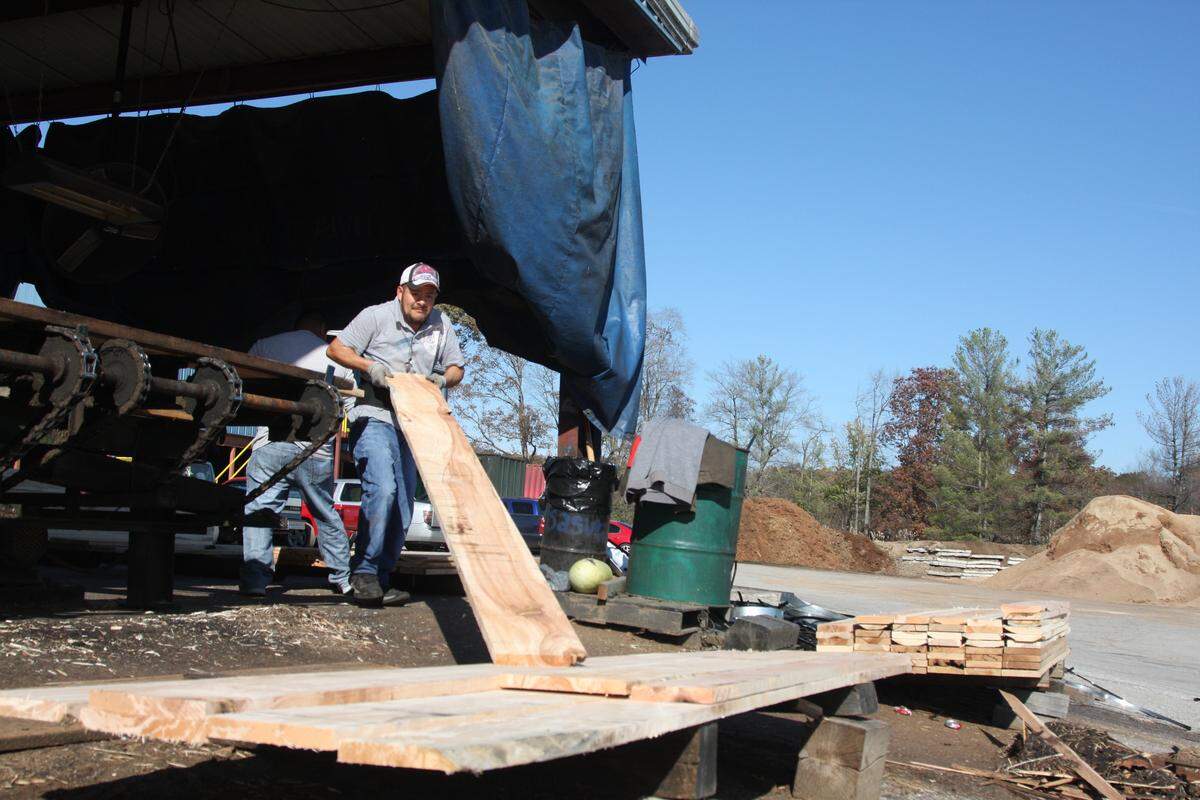
Inside the walls of Harold White Lumber near Morehead, huge machines at the sawmill lift tree trunks with ease, throw them onto conveyor belts and slice them into boards like butter.
Employees wait outside to judge the grade of the wood, taking notes as the boards slide past, then stack them at the end of the line.
Recently, CEO Ray White has spent a lot of time worrying about those workers.
Trade tariffs implemented by President Donald Trump have hurt Kentucky’s wood-products industry in serious ways, including White’s business. Production at his mill is down 20 percent this year. Multiple employees have taken voluntary layoffs. Others have retired, and White has decided not to replace them.
For more than 100 years, White’s family has been ingrained in Rowan County’s timber industry. More than 50 years ago, his father split from his grandfather and started his own business, Harold White Lumber, which White runs today.
But now, the future of his multi-generational legacy in uncertain.
Perceived trade imbalances and disagreements over China’s use — some would say theft — of intellectual property from U.S. companies, among other things, led Trump to implement 25 percent tariffs on hundreds of billions of dollars’ worth of Chinese goods. China, in return, levied heavy tariffs on American products, including hardwoods. .
Rather than pay the extra costs, many Chinese customers opted to buy their wood elsewhere: largely from Russia, Europe and tropical countries.
U.S. wood exports to China are down 43 percent nationwide since the tariffs on wood products were imposed, said Dana Lee Cole, executive director of The Hardwood Federation.
That figure doesn’t account for a potential further drop in the third quarter of the year.
“As soon as the 25 percent tariff went in place, it just dropped,” Cole said. “We’re a huge exporting industry that’s being hammered by these trade negotiations.”
The losses in Kentucky exports likely mirror the national figure, said Bob Bauer, head of the Kentucky Forest Industries Association.
The tariffs haven’t just driven down sales of Kentucky wood products to China. The levies also have forced producers to cut prices in order to prop up their remaining sales, meaning the tariffs are hurting their profit margin.
White plans to survive. He’s diversified and shifted his business model from focusing on high-grade wood for the Chinese furniture markets to products for industrial purposes, such as railroad ties and pallets.
“We’ve never experienced an event like this,” White said. “What we’re going through right now makes the recession of 2008 look like a cakewalk. This industry has never faced this type of crisis in anybody’s memory, and we don’t have the ability as the owners of our businesses to have control over it.”
There are examples around the state of the economic impact of the wood tariffs.
In Trigg County, Little River Dry Kiln, which dried wood, closed down because of the tariffs. Between 40 and 50 people lost their jobs, according to Mark Lindsey, head of the Southwestern Kentucky Economic Development Council.
Somerset Wood Products has seen a 48 percent drop in its hardwood lumber sales to China in 2019 compared to 2018, said CEO Steve Merrick.
Those sales are not the company’s only business, but were significant enough that the company has lost a quarter of its business directly as a result of the tariffs, Merrick said.
“It’s hurt the industry,” he said of the tariff fight.
The company has not laid off any employees, but has reassigned some and cut hours in the lumber department.
Northland Corp., in La Grange, which dries green wood and sells directly to China, has lost sales and profit margins and laid off employees, said CEO Orn Gudmundsson.
If the tariffs continue another six months or a year, Gudmundsson said, he expects conditions to worsen.
“I think we’re gonna see a lot of companies go out of business,” he said.
Kentucky could lose infrastructure, such as processing facilities, that wouldn’t come back even if the U.S. and China reach a deal to end the tariffs, costing the state those jobs for good, Gudmundsson said.
‘I wish I could be more optimistic’
Many in the wood-products industry agreed that something needed to be done about China’s trade practices. They don’t like being caught in the crossfire, however, and many are upset that the Trump Administration provided billions in aid for farmers who lost sales of soybeans and other commodities, but nothing comparable so far for the wood industry even as sawmills close and prices for once-popular species fall.
“There definitely is some grumbling about that,” Cole said.
The 2008 recession took a massive toll on the timber industry, slashing the total amount of national production in half over the course of three years.
Chinese markets played a major role in the industry’s recovery from the recession. Many domestic furniture manufacturers folded during the recession, but as purchasing power went up among Chinese consumers, U.S. sales of wood to make furniture in China helped American producers recoup some of the domestic losses.
“They had become a really good user of American hardwood lumber,” Merrick said.
Red oak, which is one of the most prolific trees in Kentucky, became popular in China. That was a benefit to Kentucky because red oak makes up a big chunk of the state’s timber output, and there is less domestic demand for that species.
With China buying “huge amounts” of wood products from the U.S., mills like White’s moved to meet the demand.
“And so, not necessarily by choice but out of reality, we all gravitated to that market.,” White said.
Now that market is down, and even if Trump and China came to an agreement and decreased or ended the tariffs, many Chinese customers may be hesitant to return to their American suppliers, White said.
“I wish I could be more optimistic, but we’ve been dealt a very bad hand of cards, and it’s very hard to play this game with the hand that’s been dealt to us,” he said.
First coal, now timber declines
The timber industry directly contributed $8.4 billion to Kentucky’s economy in 2017 and employed 26,068 people at more than 1,200 facilities in 110 counties stretching from Appalachia to the Mississippi River, according to Jeffery W. Stringer, a professor at the University of Kentucky’s Division of Forestry and Natural Resources.
In Eastern Kentucky, the impacts from tariffs could hurt worse than elsewhere.
According to a new report from the Appalachian Regional Commission, the farming and forestry sectors provided 6.8 percent of all jobs in Appalachian Kentucky from 2007-17. In non-Appalachian Kentucky counties, the figure was just 3.2 percent in 2017.
Timber’s decline comes after coal production has dropped dramatically over the past decade. Layoffs and bankruptcies left thousands of coal miners out of a job, and while many left the region all together, others found work in the limited number of other industries that persisted in Appalachian Kentucky, including logging.
“I’m sure there are miners that have gotten involved in the logging business since coal has declined,” said Menifee County Judge-Executive Rick Stiltner. “There’s no question that if we lose logging jobs in our communities that it’s gonna have a financial impact on us.”
In 2009, there were 16,100 coal jobs across Eastern Kentucky that generated more than $1 billion in wages. In four counties — Harlan, Knott, Letcher and Martin — coal accounted for more than 40 percent of all wages in the county. The latest figures from the Kentucky Energy and Environment Cabinet showed 3,367 jobs.
“I do know that of a lot of miners began logging because they lost their main income,” White said. “Coal was the lifeblood of Eastern Kentucky, and for all intents and purposes, we lost that. A lot of those jobs were picked up in the forest sector, and now that this industry is in such a cataclysmic situation — now those loggers are having great difficulty finding markets for their timber.”
Like coal, the timber industry provides revenue for a number of small businesses in addition to logging operations and sawmills. Auto parts stores provide new parts for logging trucks; trucking companies move mulch from the sawmills; and restaurants cater to loggers or millworkers who make enough to take their families to dinner.
“We are affected from things you wouldn’t even think about, you know: tire stores that replaces tires for logging trucks. A lot of their living is based on loggers,” said Rowan County Judge-Executive Harry Clark. “It’s a huge impact on our county.”
Stringer, the UK professor, said he is working on the latest analysis of the economic impact of the state’s wood industry. That analysis isn’t completed, but he thinks it will show a significant loss of wood-products businesses.
“We do know that there are businesses that have softened up or gone away,” Stringer said. “It’s hurting us.”
This story was originally published November 15, 2019 at 10:54 AM.