
Manufacturing institute is training workers but struggling to lure industry to E. KY.
Kathy Walker has an ambitious goal of bringing advanced manufacturing to Eastern Kentucky.
She is the founder and CEO of HAAS eKentucky Advanced Manufacturing Institute in Paintsville. Since opening the doors in November 2017, she has churned out more than 100 graduates trained in automation and robotics, even teaching the students about life skills to make them more attractive to employers.
Though her graduates have been successful in finding jobs in Kentucky, she still hasn’t reached her milestone of bringing industry to the Appalachian region.
“We’re really trying to create jobs here in Eastern Kentucky,” Walker said. “I see eKAMI as the seed and ultimately the magnet to make that happen. Typically where these HAAS centers are across the country industry follows because they’re following the trained labor force.”
So far, promised employers haven’t panned out as planned. Enerblu, a startup that promised to employ 875 and make advanced batteries in Pikeville, went belly up, and AppHarvest is building massive greenhouse near Morehead instead of Pikeville.
Like other education facilities across the nation, the institute closed due to COVID-19, moved its classes online and extended the course until students could return to classrooms to get essential hands-on learning. eKAMI reopened and was deemed essential after staff proposed to use their 3D printers to make face shields.
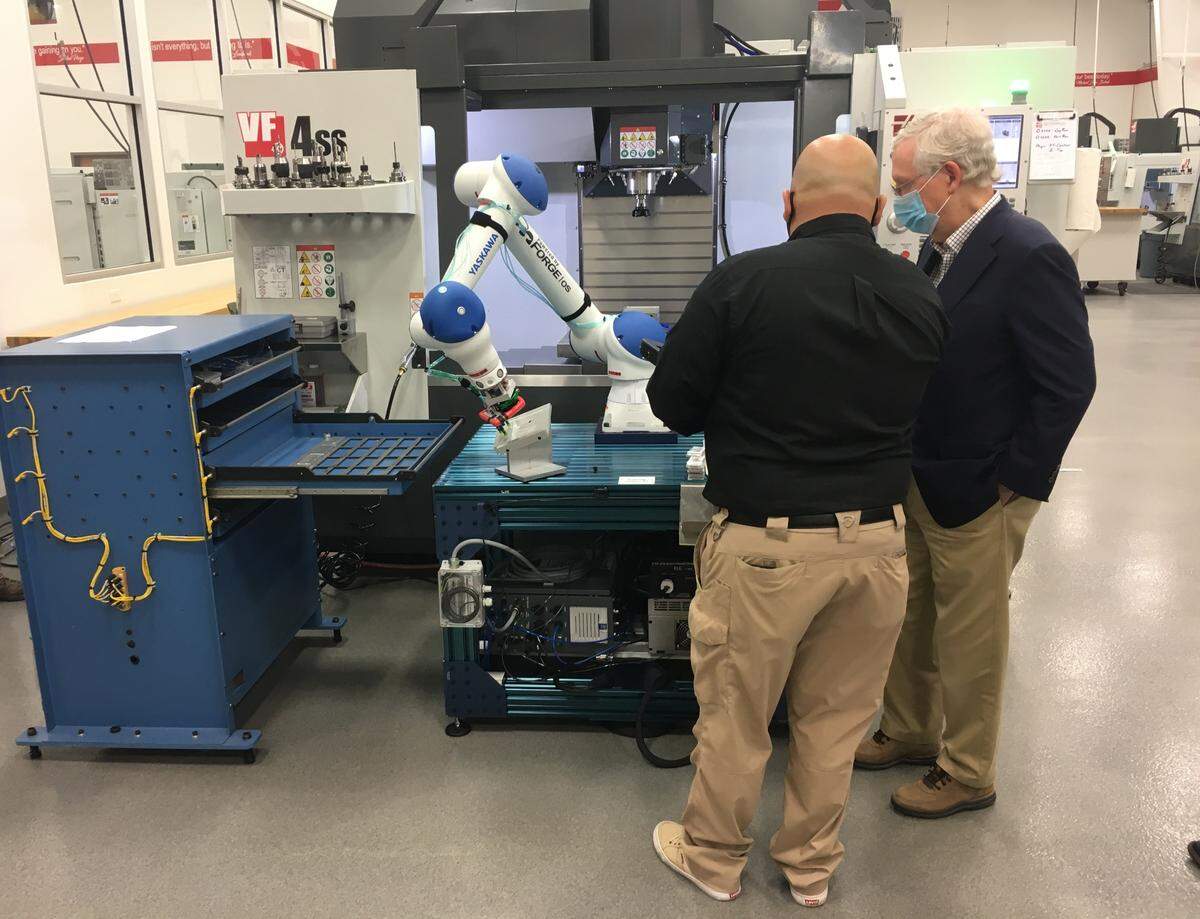
Sen. Mitch McConnell, R-Kentucky, visited the 40,000 square-foot facility for the first time Thursday afternoon, to thank the institute for donating personal protective equipment for frontline workers in the coronavirus pandemic.
McConnell said it’s been a joy to watch businesses adapt to the needs of the pandemic by making face shields, hand sanitizer or masks.
eKAMI made thousands, giving them to local hospitals, nursing homes, fire departments, doctors offices and more.
eKAMI was designed to train former coal miners, but word quickly got out, expanding to Eastern Kentuckians who are unemployed or underemployed from other industries. The institute has a waiting list.
Walker, who worked previously in the coal mining industry, saw the decline of jobs in the region and wanted to be proactive by diversifying the economy, but she understands the concerns of manufacturing employers coming into a region that was dominated by coal.
“Locally, of course, we have no manufacturing, because for years it’s been a mining economy, and really and truly I think that if you were a manufacturer why would you consider going into an area where you had to compete with a life-long industry,” Walker said. “I think that is one of the reasons that the perception was we didn’t need to diversify the economy beforehand.”
There is a need for high skilled workers globally, Walker said.
“Even before COVID, their No. 1 challenge was lack of high skilled workforce,” she said. “COVID exacerbated the need for automation in production. Their business has gone out the roof. It is the future, but the future is here.”
In Eastern Kentucky, advanced manufacturing is a good fit, she said. The residents “know a little bit about a lot of things” because they had to learn out of necessity to fix their tractor if it broke down or their refrigerator if it quit, she said.
“Those are skills that have been passed down for generations and born out of survival rather that choice,” Walker said.
When students graduate from eKAMI, they typically have to commute hours or move. The largest employer of eKAMI graduates is Heartland Automation in Georgetown.
Walker said it’s a chicken and egg situation.
“You can’t attract manufacturing until you have a skilled workforce,” Walker said.
McConnell said “one of the things that we’re hoping for in the future is that we’ll have more opportunities for different kinds of employment in Eastern Kentucky than we have now.”
He deferred to Walker to when asked how many Eastern Kentuckians who have been trained “end up staying here.”
“The ultimate goal is to employ our people into the workforce to eventually get the attention of the employers so they will come to East Kentucky and look around and they may decide this is a good home,” she replied.