Did you hear the one about a bear that crashed through a restaurant window in KY?
It’s not hard to find a bear story in Harlan County these days.
Like the one about the bear that crashed through a plate-glass window and into the dining room at the Dairy Hut restaurant in Cumberland early one morning last May.
The bear was looking for food scraps in a trash can when it apparently got startled by a passing truck and bolted, running through one window, across the dining room and out through a glass door on the other side, said restaurant owner Rosanne Ross.
There was an estimated $1,000 in damage, Ross said.
She’s also had to replace the lid on her large metal trash bin after bears tore it off.
Bear cubs are cute, Ross said, “But you keep thinking, ‘Oh my God, they’re gonna get big.’ “
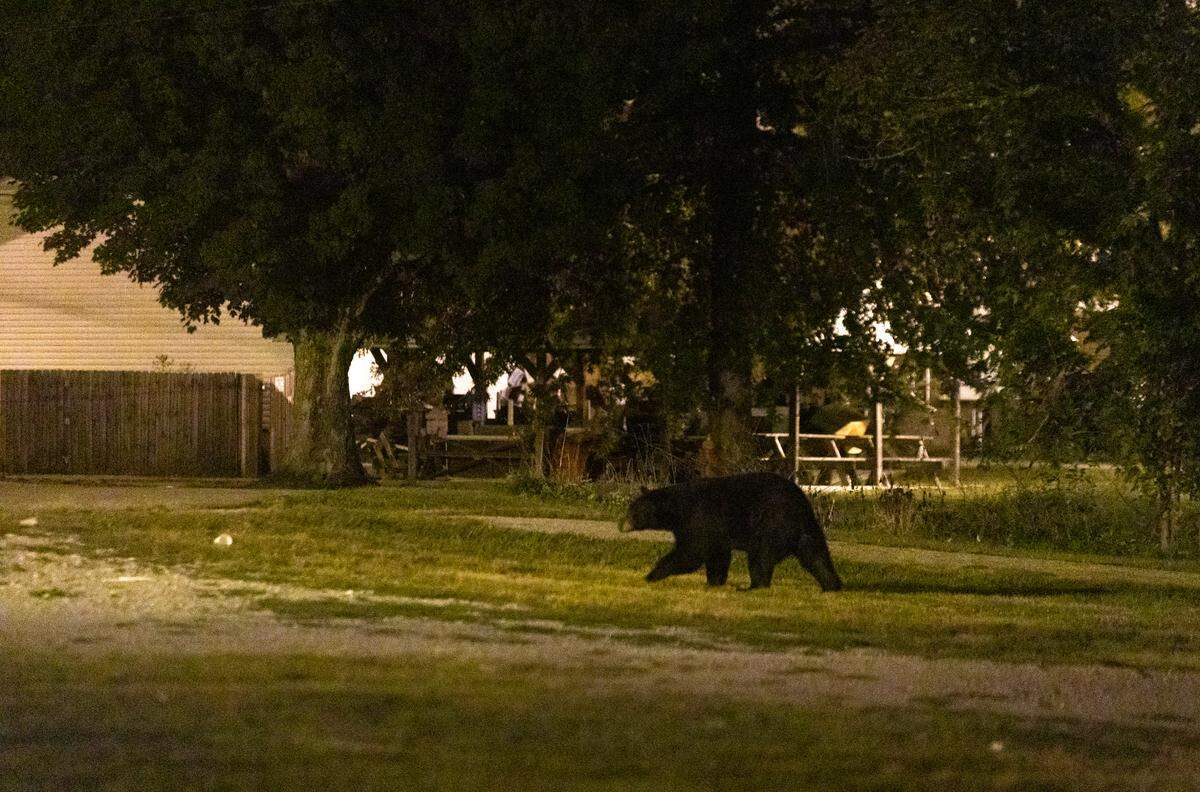
There are pluses and minuses in being the black bear capital of Kentucky, as Cumberland bills itself. It has become common to see them in and around Cumberland and in the adjacent, historic coal towns of Benham and Lynch, as well as at Kingdom Come State Park, on Pine Mountain above the towns.
Tracy Bailey, director of tourism for Cumberland, said the bears are interesting and fun to watch, and visitors come hoping to see one.
“The visitors, they love it,” Bailey said. “When a tourist comes in and gets to see a bear, it’s the ultimate.”
There is good habitat for the bears in the steep mountains overlooking the towns in a valley near the state’s highest peak, with thick woods to provide cover and food, and rocky dens for shelter in the winter.
There is a downside, though.
Garbage strewn by bears scrounging in dumpsters and trash cans. Damage to outbuildings, fences and trash enclosures from bears looking for a meal. Raids on grapevines, apple trees, bird feeders and pet food.
In August, Stephanie Naillieux, a nurse who lives in Lynch, let her dogs out about 3 a.m. and was sitting on the stoop, looking at something on her phone, when she felt breath on her legs.
“I looked up and it was just a huge bear standing there,” Naillieux said, perhaps attracted by a cookie her 4-year-old daughter Lily had left on the step. “I don’t remember getting back in the house.”
Naillieux has had a bear turn over her chicken coop to get the eggs, and another time a bear tore the cover off the bed of her pickup truck to get into some garbage.
“We’ve had several unpleasant learning experiences with the bears,” she said.
Naillieux said having bears close to her house is a bit of a worry, but she still lets her kids play outside.
“I just try to be cautious,” she said.

Tyler Blair, who operates Homeowner’s Hardware in Cumberland with his mother, Gwen, said he routinely sees bears when he runs on a trail from Cumberland to Lynch.
It’s a little unsettling.
“I don’t like anything that’s big enough to tackle me and eat me,” Blair said.
Blair said bears get into the trash in town every day. He sells a good number of hasps to replace ones ripped from trash enclosures and outbuildings by bears, and has to keep an electric fence around his 70 beehives to keep bears out of them.
It has also become common to see bears in neighborhoods in the city of Harlan, and they’ve been seen in downtown as well.
‘They can pop up anywhere’
Harlan County is in one of two core areas in the state for black bears, said John Hast, a biologist who heads the bear program for the Kentucky Department of Fish and Wildlife Resources.
One area includes Harlan, Bell and Letcher counties in the southeast corner of Kentucky. The other is in McCreary and Wayne counties on the southern border, Hast said.
But bears have wandered from those core areas to other parts of the state. There are about 40 counties with a “somewhat resident” bear population, and they’ve been spotted in other counties, including in Central Kentucky, Hast said.
“They can pop up anywhere,” he said.
Police reported that a bear was hit and killed on Interstate 65 south of Louisville earlier this month.
Bears also have been hit and killed on roads in several counties in Eastern and Southern Kentucky.
Hast said there are an estimated 400 to 500 black bears in the two core areas. The statewide total is less than 1,000, he said.
Bear population expanding
Bears were once common in Kentucky. Daniel Boone wrote in his journal about killing bears in the state in the 1700s, and hunters used their skins for clothing and grease from their fat to waterproof items, Hast said.
Black bears ultimately disappeared from the state because of excessive hunting and loss of habitat from activities such as logging, Hast said.
Bears wandered back into Kentucky after wildlife officials moved bears to nearby areas of Virginia and Tennessee, making homes in forests that grew up on areas logged earlier.
The first confirmed sighting in Kentucky was in Knott County in 1985, Hast said.
The population has seen significant growth since.
Tristan Curry, a state bear biologist who lives in Harlan County, said he keeps track of one mother who has four cubs every other year.
“The population’s definitely expanding,” Curry said.
Young male bears can travel great distances. State biologists put a GPS device on one for research purposes; it traveled through 13 counties in Kentucky, Virginia and Tennessee, Curry said.
The state has short bear-hunting seasons in October and December.
There is no limit on the number of people allowed to buy tags, but hunters can only kill one bear a year, and the state shuts down the hunt after a pre-determined number of females are killed in each zone, even if the season isn’t over.
Hunting is the best tool the state has to keep bears from becoming over-populated, Hast said.
Hunters took 60 bears in Kentucky last year.
‘Generally, they’ll run away’
Biologists said black bears generally are shy, docile animals. They don’t want to have contact with humans and are rarely a danger to people, biologists said.
Attacks on humans are rare, with only one documented in Kentucky since bears returned. That was at attack on a hiker in the Red River Gorge in 2010.
The hiker survived with injuries to his leg.
“There’s not many bears that we consider a public safety issue,” said Curry.
Harlan County treasurer Ryan Creech, who lives in Benham, said he’s seen bears several times. One pulled three boards off his fence a couple of years ago, and recently he saw a 300-pound bear just outside the fence.
He tossed some pieces of wood at it and it left.
“Generally, they’ll run away from you,” he said.
Still, bears are wild animals, and increased exposure means increased risk.
One thing that ups that potential exposure is feeding bears or not properly securing garbage. People should never deliberately feed bears, Hast said. In addition to being illegal, it increases the danger to people and bears.
Hast said the Department of Fish and Wildlife Resources typically has to trap and euthanize fewer than 10 bears a year, but when that happens, it’s generally not because the bears have been aggressive.
Rather, it’s because of their food habits. They’ve gotten used to being fed or having easy access to garbage or pet food, and become conditioned to return to that source.
That can cause bears to lose their natural fear of humans. That’s called habituation, and it can lead to concerning behavior such as approaching people to get food.
“That’s the behavior we don’t want to see,” Hast said.
Those are the cases that can require euthanizing a bear. People create those conditions, Hast said.
The state used to trap bears and relocate them, but that proved ineffective because the bears would return.
‘A bear’s always hungry’
Bears are curious, and that curiosity shouldn’t be confused with aggression, according to the Department of Fish and Wildlife Resources.
Wildlife officials advise that if a bear approaches, people should stay calm, stand their ground, raise their arms to appear larger and yell at the bear. If it won’t leave, throw rocks or sticks at it.
People should not run because that could trigger the bears instinct to give chase. If the bear gets close, slowly back away while facing the bear.
If a bear does attack, fight back, officials say.
Most of the nuisance calls the state gets about bears is about them getting into garbage. Those calls rise and fall based on the availability of natural food sources such as nuts, berries, bugs and grubs.
Officials said people shouldn’t leave pet food outside in areas with bears and shouldn’t store garbage outside, not even in a screened porch because bears can tear open the screen.
“Bears are opportunistic,” Curry said. “The only thing on their mind is to put on weight for winter.”
Their activity goes down beginning around mid-December. The bears don’t hibernate, but the females mostly stay in their dens, giving birth around the first of February before coming out in mid-March, Curry said.
Nuisance calls go up in the spring when bears come out of their dens and their natural food sources are limited.
“They’re coming out of their dens hungry,” Curry said. “A bear’s always hungry.”
Bailey, the tourism director in Cumberland, said there has been an increase in the number of bears coming into town the last three or four years.
That bring opportunities and problems, but people need to figure out how to deal with the bears because they aren’t going away and neither are the people, Bailey said.
“It is something that we have to learn to live with,” she said.