Brown spots in your yard? What you need to know about armyworms invading Kentucky.
.jpg "Fall armyworms are causing damage to lawns and pastures in Central Kentucky this year.")
One recent Monday night, Seth Hillenmyer looked out into his backyard and noticed some small brown patches.
The next morning, about a quarter of his back lawn was brown.
“It kept getting bigger and bigger,” he said.
Hillenmeyer, who owns Weed Man Lawn Care, had already been hearing from his customers about the culprit: fall armyworms.
The caterpillars can eat up to a football field-sized area of grass in 48 hours, he said.
“That’s how quickly they move,” he said.
And this year, the insects have invaded Kentucky in a major way.
“It’s unlike anything we’ve ever seen before,” he said.
Hillenmeyer estimated that his business, which offers residential lawn care services in the Lexington, Cincinnati and Nashville areas, has fielded 1,800 calls over the past week from people concerned about armyworm damage.
“This is the largest outbreak we’ve seen in 40 years,” said University of Kentucky extension entomologist Jonathan Larson.
Larson said the fall armyworm is a pest known to farmers in Kentucky, since they feed on crops.
“Fall armyworm is a migratory pest,” he said. “We see it every year.”
He said fall armyworm moths overwinter in South Texas and are either blown up into Kentucky by winds or fly up.
What’s different this year is how many of them there are.
Because there are so many more this year, they’re showing up in more places and damaging more areas like lawns, golf courses and pastures, Larson said.
The first frost will kill them, he said.
But until then, homeowners may want to be on the lookout.
Larson and Hillenmeyer said the first thing many people will notice are brown patches on their lawns. To find out if the damage is caused by fall armyworms, they suggested mixing about a tablespoon of dish soap into a gallon of water and pouring it along the borders between healthy green grass and the brown spots. If armyworms are the culprit, they’ll begin to come up to the surface.
“See what pops up,” Larson said.
He said armyworms can be controlled by treating the yard with an insecticide product containing bifenthrin or lambda-cyhalothrin.
Homeowners can either apply the products themselves or call a lawn care company.
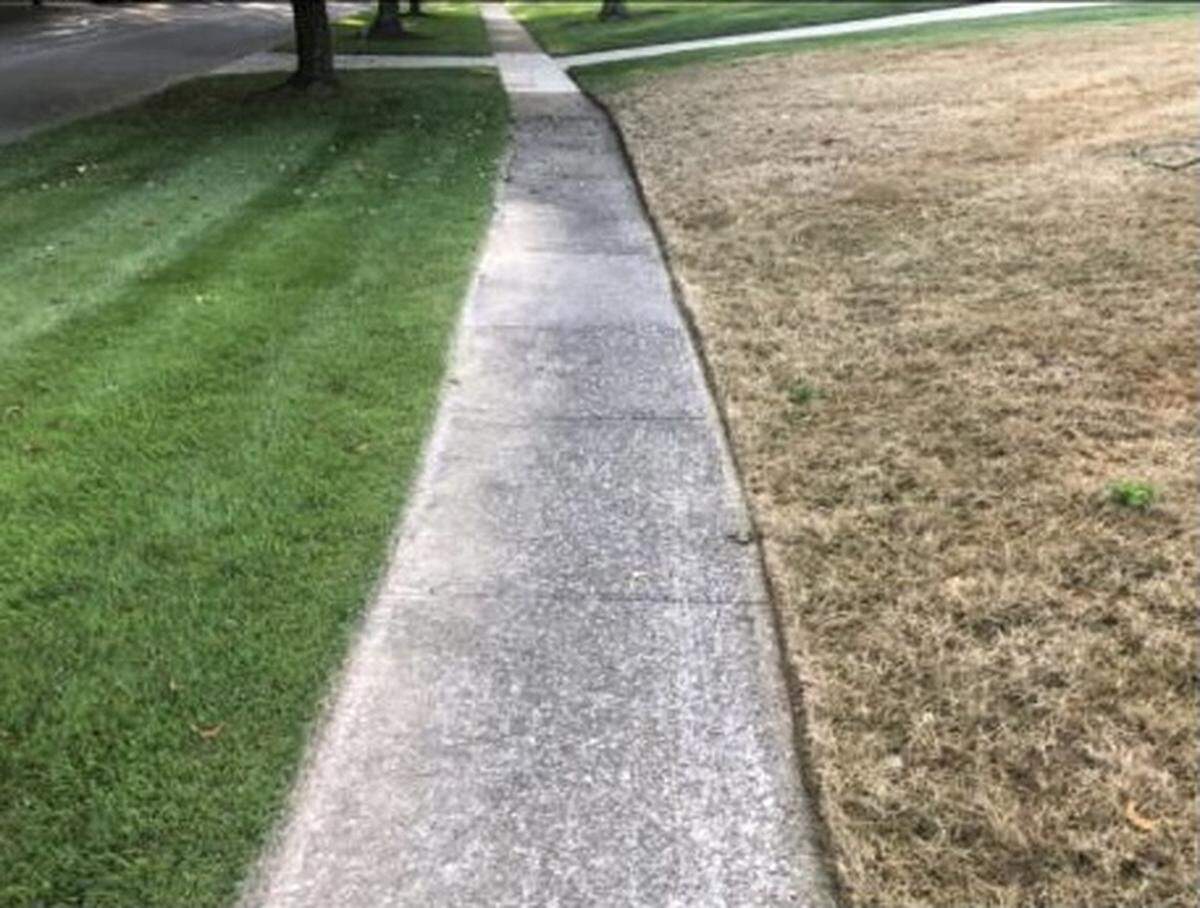
Homeowner Neal McFarland said he decided to try to treat his yard himself when he noticed “a big round brown spot” in his previously green yard several days ago.
“I thought, ‘Wow. They’re here,’” he said. “I just decided I’d see if I could do something about it myself.”
He said he paid about $15 for a granular insecticide product at a home improvement store. So far, he thinks it’s working.
Two days after application, he said the brown spots are not getting bigger.
Larson said that once the worms are gone, areas that have already been damaged by them may not “bounce back” on their own.
“You need to prepare to renovate,” he said.
To restore the lawn to its original state, Hillenmeyer recommends overseeding and aeration, though he said he expects that some of the grass may come back on its own.
“Mother Nature can heal this naturally,” he said.
McFarland said he hopes that will be the case with his lawn.
“In the end, if it doesn’t, it’s just grass,” he said.
Larson suggested waiting to reseed, since Kentucky likely has another generation of fall armyworms coming.
The caterpillars eating grass now still have time to develop into moths and reproduce before the first frost comes.
The caterpillars hatch from eggs, which Larson said are “whitish brown” and “look kind of like a fuzzy patch” on surfaces where the moths have laid them.
Larson said those eggs were the first clue that Kentucky was going to have a problem.. He said on a Friday about two weeks ago, the entomologists at UK were “completely overwhelmed” with calls about egg masses.
“It was very clear that a bunch of moths had ended up in Kentucky,” he said.
Larson said that after the caterpillars hatch, they’ll go on to form pupae, and finally, adult moths will emerge. The Ohio State University says the life cycle takes about 50 to 60 days to complete.
The adults are “very indistinct” brown moths with mottled wings, Larson said.
He said it’s not clear exactly why Kentucky has such an infestation of fall armyworm moths this year.
He said warmer temperatures might have allowed them to overwinter farther north than they usually do, allowing the moths a shorter trip into Kentucky, or maybe more of them survived a mild winter than usual. They also thrive in hot conditions, so maybe the hot spell Kentucky had recently has added to their larger numbers, he suggested.
Regardless, Larson said he doesn’t think people should feel badly about killing them.
“This is considered one of the worst insect pests that we deal with,” he said. “We’re not talking about a beneficial pollinator or a contributor to the ecosystem.”
This story was originally published September 1, 2021 at 7:17 AM.