
Will we see giant, parachuting spiders in Kentucky? Bug expert weighs in on Joro spider
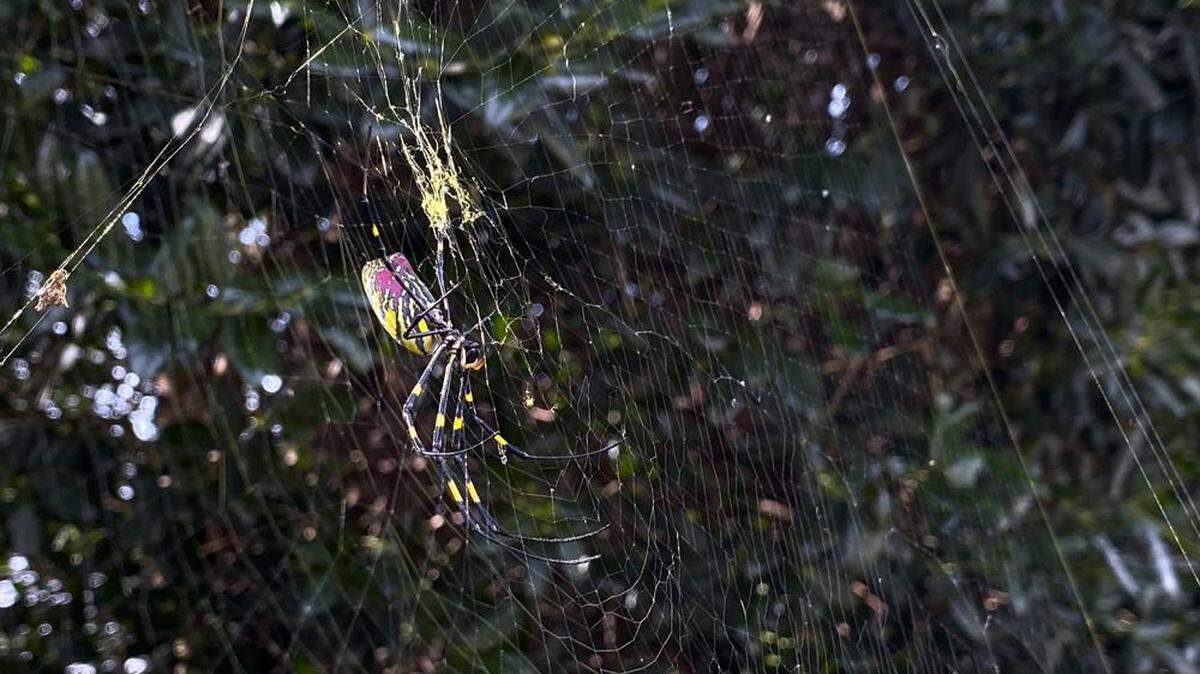
After taking over yards and front porches all over north Georgia last year – leaving residents sputtering and swatting the air after wandering into webs – the giant Joro spiders are back.
This time, researchers say the spiders could spread throughout much of the East Coast this spring and summer.
The female of the species, notable for its beautiful blue, yellow and red markings, can measure 4 inches across when its spindly legs are fully extended.
While they may be annoying down South, there’s nothing to be afraid of since they pose no threat to humans, according to University of Kentucky entomologist Jonathan Larson.
Here’s everything you need to know about the Joro spider that bug scientists say could spread throughout the southeastern U.S. – or even further – since these particular creepy crawlers can tolerate cold temperatures.
Are Joro spiders poisonous?
Technically, they’re venomous and not poisonous since the method of delivery is via injection by a bite. However, Joro spiders’ fangs are too small to break human skin and they’re only really a threat to their prey, in this case, pests.
“Spiders are a good thing,” said Larson, who adds that spiders, in general, help control pests, including disease-spreading mosquitoes, with their webbing.
In Kentucky, typically only the brown recluse and black widow spiders are dangerous to humans, but their bites can be quickly and easily treated by medical professionals, Larson said.
Running into a Joro spider might be startling or spectacular, depending on your attitude, but Larson said there’s nothing to fear.
“They’re not looking for people. They’re trying to keep to themselves, usually,” he said.
Can Joro spiders fly?
Sort of. It may be more accurate to say they fall in slow motion.
Spiderlings “balloon” by ejecting strands of gossamer web to catch currents of air and ride the breeze as a way to disperse. Their journey is perilous and can cover long distances, particularly if they’re picked up and hurled by hurricanes, Larson said.
Where do Joro spiders come from?
Japan, originally.
Joro spiders take their name from the Jorogumo, a creature out of Japanese legend that can shapeshift between a spider and beautiful young woman to lure and devour men.
It’s unclear how exactly the Joro spider colonized the U.S., but Larson said their range in East Asia spans as far as southern China up to the Korean peninsula.
Will we see Joro spiders in Kentucky?
It’s not likely, but not impossible, according to Larson.
The spiders have been found in Alabama and Tennessee, he said, but “it doesn’t seem like they’re going to get here anytime soon.”
Their range covers much of eastern Asia, which could be attributable to their increased tolerance of cold temperatures.
According to a recent Physiological Entomology article that touched on the Joro’s suitability to cooler climes, the Joro matures faster and has a much higher metabolism – including a heart rate 77% higher when exposed to low temperatures – than its cousin.
“These findings suggest the joro spider can exist in a colder climatic region than the southeastern USA which can be useful information for management or planning purposes,” the article’s authors wrote.
Are Joro spiders harming the environment?
When they took over north Georgia last year, gardeners worried they might harm local spiders and pollinators with their webs, the Associated Press reported.
Quoting spider scientists, the AP reported Joros are probably big enough to take on large pollinators caught in their webs, but those insects may be an insignificant part of their diet. On the other hand, they could also help native spiders who use the Joro’s web as a source of scavenged food. But there’s also some evidence they compete with other native orb weaving spiders, the AP reported.
The takeaway here is the jury is out and more research is needed to understand the ecological impact Joro spiders are having.
“We don’t really have answers to that yet,” Larson said.
What should you do if you find a Joro spider?
If it’s alive, stop to marvel at its intricate web woven with golden silk. You can also snap a picture with your phone and send it over to Larson via the Kentucky Bugs Facebook page.
If it’s dead, you can mail it preserved in white vinegar to Larson for study. Check with your local agriculture extension office for help. Just make sure you find the spider already dead – Larson got live bed bugs in the mail once, something he’s not eager to relive with giant spiders.