
Found a tick? Mail it to this UK professor to see if it carries disease
It’s a feeling any outdoorsy person knows: You’re taking in the gorgeous sights around Red River Gorge or maybe even just digging in your garden when you get that tingling sensation, reach down and pluck a dog tick off your leg.
The next time this happens to you, don’t flush it down a toilet or light a match to pop it.
Instead, you can mail it to Professor Reddy Palli, who chairs the University of Kentucky’s Entomology Department and serves as state entomologist.
Along with the tips Palli shares to avoid bites from the bloodthirsty buggers, Palli also asks those who find a tick on themselves or their pets to remove it with fine-tipped tweezers, place it in alcohol in a sealed container or bag and mail it to the department. There, scientists can identify the tick and determine what pathogens it may carry.
According to a university spokesperson, to mail a specimen for study, check with your local UK Extension office. The mailing address for the Fayette County Extension Office is 1140 Harry Sykes Way, Lexington, KY 40504.
Palli asked collectors to also fill out the following form and mail it with their tick specimen:
“We will contact the person who submits the specimen if we detect pathogens in the tick and encourage them to contact their physician,” Palli told the Herald-Leader in an email Wednesday.
As a leader in his field, Palli is overseeing several researchers who are studying tick populations in Kentucky, monitoring the diseases they spread and potentially engineering ways to repel them or even stop them from searching for blood in the first place.
Read on for a state entomologist’s tips about how to avoid ticks and more details about how UK’s Entomology Department is aiming to slow the tick spread in Kentucky.

Infectious diseases – including those spread by ticks and mosquitoes – are spreading across the world, Palli said in a recent news brief summarizing the department’s research efforts in this arena.
Kentucky’s lush, humid forests and large deer population make it a feeding ground for ticks, but until recently, according to the brief, no one knew much about the population here or the diseases that could be circulating within it.
Enter Anna Pasternak, a graduate student of Palli’s, who is leading the Kentucky Tick Surveillance Program.
This program, made possible by a partnership with the Kentucky Department for Public Health, seeks to give entomologists (bug scientists) the actionable data they need to inform public health experts, government officials and others about ticks and the public health threats they may pose.
As part of her work, Pasternak collects ticks from across the Bluegrass State, receiving them from veterinary clinics and other sources. She then pulverizes them, analyzes their genetic material and susses out any sinister pathogens that may be hiding within.
According to Palli, her research has uncovered a troubling finding.
“Preliminary results show that the greatest number of ticks exist in wooded areas of the state and at Land Between the Lakes, and 10% of them carry a pathogen that causes diseases like Lyme disease, Rocky Mountain spotted fever, alpha-gal and others,” Palli said in the research brief.
“We really did not expect pathogen presences in these ticks to be that high,” Palli said.
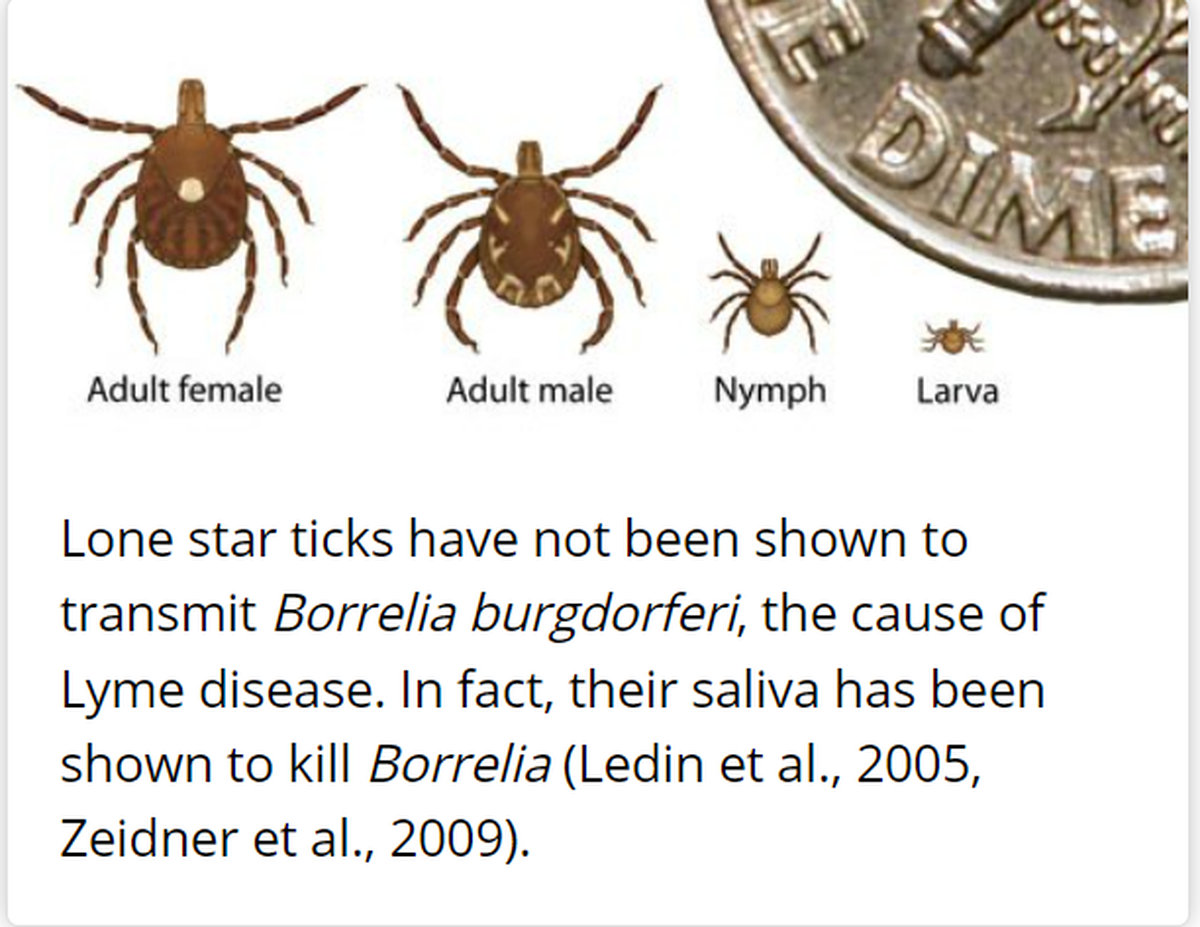
According to Pasternak’s research, the most common kind of tick found in Kentucky is the lone star tick, named for the white dot the adult female of the species exhibits on its back.
The lone star tick doesn’t spread Lyme disease (in fact their saliva kills the bacteria that causes it), but their bites can cause alpha-gal syndrome, also known as the red-meat allergy.
“Our goal is to take Anna’s data and educate farmers, loggers, physicians and health care workers about the ticks in the state and ways to minimize their effects,” Palli described in the brief.
Blacklegged ticks, otherwise known as the tiny deer tick, are the main transmitter of Lyme disease, the top insect vector-borne disease in America, according to the brief. Over the last 20 years, the range of these tiny ticks has exploded from New England to the eastern half of the country.
Cases of Lyme disease are growing right along with the expansion.
Lyme disease, an inflammatory disease, can start as a painless rash, a fever or headache and fatigue, but it soon spreads to the joints, heart and nervous system. The telltale sign is a bullseye pattern rash.
The disease can cause cardiac or neurological problems if left untreated, but it can ultimately be rendered harmless if a person knows what to watch for and acts quickly enough.
“For example, if someone gets bitten by a tick carrying the Lyme disease pathogen and they get an antibiotic within 72 hours, it is likely the antibiotic will kill the bacteria that causes Lyme disease,” Palli said in the brief. “Not many people know that, and by the time symptoms appear, it’s often too late.”
Tips for avoiding tick bites
Use protective clothing, tick repellents and avoid walking on potential areas of tick habitats (e.g. leaf litter).
If you do have a tick bite, clean the bite area and your hands with soap and water.
If you develop a rash or fever, contact your physician
The key to controlling the spread of Lyme disease may lie in the behavior of the bacteria that spreads it.
That’s according to Professor Brian Stevenson, who holds a dual appointment in the UK College of Medicine and Department of Entomology. Stevenson is leading studies to examine the bacterial pathogen that triggers Lyme disease, Borrelia burgdorferi.
“The pathogen behaves differently inside ticks and humans,” Stevenson said in the brief. “It cannot make the tick sick, or the tick would not feed on humans, but once the pathogen gets inside a person, it triggers immune system responses where immune cells begin to attack the healthy tissues.”
If Stevenson can learn how to fool the pathogen into thinking it’s still inside the tick – where it lies dormant – he could stop the disease from spreading.
“This technology really could be adaptable to a lot of diseases,” Stevenson said.
.jpg "unnamed (1).jpg")
Another avenue may lie in exploiting a tick’s most important attribute: its keen sense of smell.
Ticks follow their nose to human hosts, or in this case, their noses – both of which are located on their forelegs.
University of Kentucky entomologist Zainulabeuddin Syed is studying how to use that keen sense of smell, particularly which odors ticks are averse to and which ones they adore.
“Ticks have large olfactory lobes, which are the brain centers that receive odor information and process,” Syed said in the brief. “Smell is extremely important for ticks as it helps them find their next host and meal.”
While still in the early stages, his lab is finding encouraging results that include potential repellents, according to the brief.
Syed is also studying how to disrupt the questing behavior of blacklegged ticks – the behavior that causes them to climb up a blade of grass or other object in hopes of latching onto a warm body.
Syed’s graduate student, Kenny O’Dell Jr., is studying favorable conditions for questing and how scientists can prevent this behavior.
“We know that Blacklegged ticks will not quest when it is really dry. We also know that they are the most active at dawn and dusk,” Syed said. “Kenny is studying their questing behavior and environment to see if we might be able to interrupt the questing behavior.”
Do you have a question about research, bugs or other wildlife in Kentucky? We’d like to hear from you. Fill out the form below or email ask@herald-leader.com.
This story was originally published April 20, 2022 at 4:34 PM.