
Hundreds of free-roaming horses call Eastern Kentucky home. These people protect them
Lunch time on this scenic stretch of reclaimed mine land starts with a loud whistle and a little encouragement.
“Come on!” shouted Bernice Amburgey while she distributed chunks of hay on the ground and beckoned toward a pair of horses, the only two visible.
The horses were the foreground of an idyllic Kentucky scene, flanked on both sides by lines of young trees with the region’s iconic forested hills rising in the background. Attracted by the hay, the pair ambled forward.
As if on cue, the treeline came to life. A band of black, chestnut, bay and palomino-colored horses appeared from behind rocks, trees and bushes to enjoy a mountaintop meal. Within a couple minutes, Amburgey had a mixture of nearly 20 horses and mules munching hay around her pickup. A couple of cows joined, too.
“It’s something that I love,” said Amburgey, the welfare manager for the non-profit Appalachian Horse Project. “Love to be around them. They’re beautiful, as you can see.”
The horses that Amburgey and a team of dedicated volunteers help to feed, monitor and care for, live a much different life than many of the horses seen in barns and paddocks across central Kentucky. These horses spend much of their days grazing on former mine sites that have been covered over and reseeded as pasture land.
The Appalachian Horse Project was established in 2017 to help solve some of the perceived issues surrounding the region’s growing free-roaming horse population, Amburgey said.
What are free-roaming horses?
Though rarely penned up, the free-roaming horses aren’t exactly wild. Many are owned and comfortable near people, Amburgey said. Some, but not all, horse owners throughout Eastern Kentucky have engaged in the practice of free-roaming their horses for decades.
They were seen as a nuisance by coal companies trying to plant grass on former strip mines. The horses would eat all the young grass and prevent the companies from getting their bonds back, Amburgey said. At the same time many of the local public enjoyed coming up and feeding the horses.
“We thought, why should it be a problem?” Amburgey said. “Why can’t we turn this around and make something positive out of it? So we thought of, you know, using them for tourism for jobs, just giving the horses more of a useful purpose.”
In and around Breathitt County’s Southfork Elk View Recreational Area, there’s close to 400 horses, Amburgey estimated.
In 2022, the project gave 65 tours and attracted about 145 people to the area. The fees for the tours go to pay the tour guides, creating some jobs in the process, while the rest goes toward feeding the horses.
According to the Appalachian Horse Project, herds of free-roaming horses can be found in nine different Eastern Kentucky counties. The project is supportive of responsible free-roaming, meaning owners return to their horses to check on their health and needs, not simply abandoning them on the mine, Amburgey noted.
Many of the free-roaming horses are adapted to their environment and lifestyle, said Fernanda Camargo, an equine extension specialist with the University of Kentucky and a member of the project’s board. They’re sturdy, sure-footed and generally smaller in size, requiring less resources to feed them, she said.
“Our horses in central Kentucky, they see a rock, they go lame for a week. You know what I mean?” Camargo said with a laugh.
A population explosion
Since about 2008, the herds have been going through a bit of a population boom. The practice of free roaming gave locals the ability to raise horses without having to feed or house them for several months at a time as the horses could find food on their own on the much flatter mine-land-turned-pasture — a luxury that a horse owner living near a steep hillside or creek might not have.
According to Amburgey, for much of the practice’s history there was a “gentlemen’s agreement” that only mares — female horses — and their young would be allowed to roam. However, economic downturns attributable to the 2008 recession and the decline of coal caused some horse owners, unable to afford to keep up their animals, to release their stallions — uncastrated males — into the herds.
Nature took its course, much to the detriment of the mares. A horses’ gestation period is about 11 months and they can become pregnant again not long after giving birth. The whole cycle can be a tough draw on a pregnant mare that is also nursing and having to find its own food, Amburgey said.
That’s where much of the welfare management comes in. In the winter time when grass might be more scarce on the old mineland, volunteers come often to lay out hay plus salt and mineral blocks for the horses to lick.
While it’s hard to get an exact count of the total number of horses, Amburgey said the 400-or-so horses in Breathitt County could’ve been as high as 600.
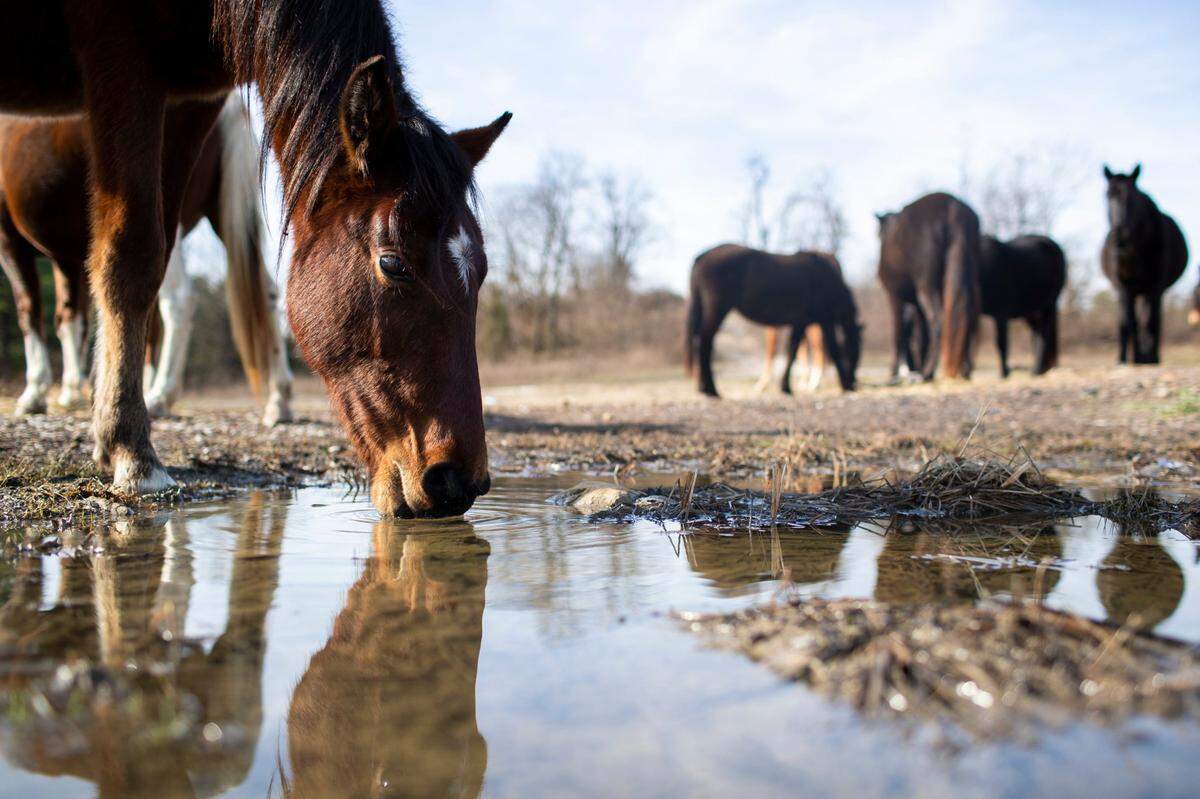
The Elk View Recreational area has multiple popular off-roading trails and drivers often come armed with apples for the horses. Those visiting should know that since many of the horses are owned, someone encountering them can’t simply take a horse as their own without risking a charge of horse theft.
“These horses just are used to everything and everybody, not all of them will let you pet them but they’re friendly enough,” Amburgey said.
The Appalachian Horse Project, Kentucky Humane Society and other rescue groups have been working in the area for years to geld, or castrate, owned stallions.
The horses are known to cause a few issues locally with many coming off the mine land in the winter time in search of the fresh grass growing along creeks, Amburgey said. In turn they might end up wandering through yards where they’re not welcome or licking the salt off roads where they might be a danger to motorists.
When deadly flooding devastated multiple southeastern counties this summer, the project also served as a source of aid for local horse owners who might’ve lost necessary supplies in the disaster.
Coordinating with Amburgey, the Kentucky Horse Council and University of Kentucky extension agents were able to source hay, vaccines and other horse-care supplies for horse owners in the flooded areas.
Outside of near-monthly public supply drops of hay, much of that work has since wrapped up and the project is focusing on its main winter goal of making sure the horses get through winter, Amburgey said.
The group one day hopes to be able to build a barn facility to house some horses. The Appalachian Horse Project does help facilitate the adoption of some of the horses that the county deems to be injured or underweight and a barn would be a good place to house those horses, Amburgey said.
The Appalachian Horse Project does accept donations on their website via PayPal. Amburgey said those interested can also contact the project via their Facebook page.
“The horse has always been a part of Eastern Kentucky culture,” Amburgey said. “And we want to preserve that, protect it.”
This story was originally published February 2, 2023 at 10:00 AM.