
Partial solar eclipse to darken Kentucky skies Saturday. Here’s when you can see it
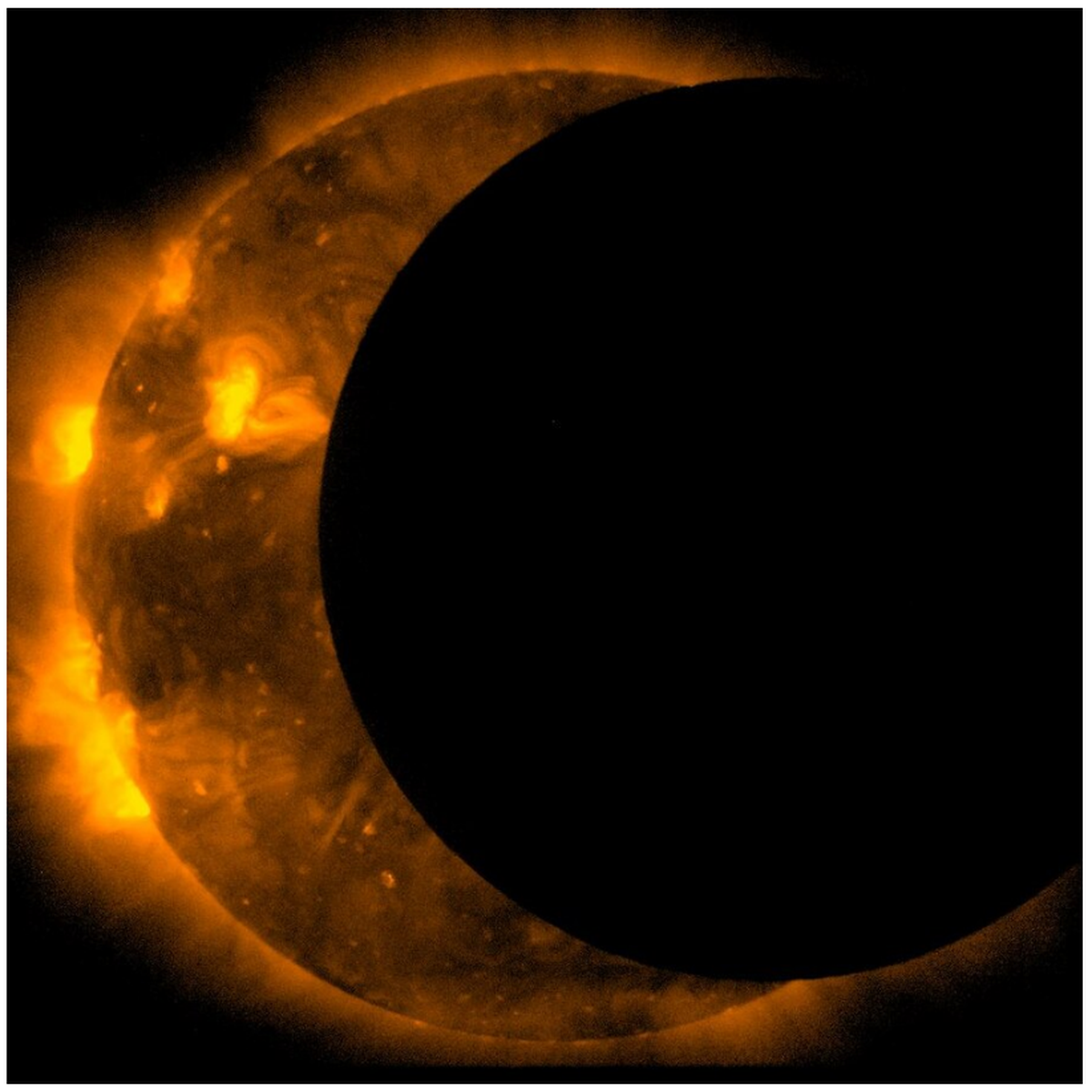
.jpg "The joint JAXA/NASA Hinode mission captured these images of an annular eclipse of the Sun on May 20, 2012. During an annular eclipse the moon does not block the entirety of the sun, but leaves a bright ring of light visible at the edges. For the May eclipse, the moon was at the furthest distance from Earth that it ever achieves – meaning that it blocked the smallest possible portion of the sun, and leaves the largest possible bright ring around the outside. Scientists often use an eclipse to help calibrate the instruments on the telescope by focusing in on the edge of the moon as it crosses the sun and measuring how sharp it appears in the images. Photo shared via Wikimedia Commons.")
If you’re outside Saturday and notice the day darkening around noon — only to look up and see the moon taking a big bite out of the sun — it’s not some cataclysmic event but a solar eclipse.
The “ring of fire” annular eclipse will be visible in the western half of the country, cutting a path from Oregon, to Nevada and Utah, over the Four Corners area of the Southwest and then through New Mexico and Texas.
Kentuckians can still get a partial look at the eclipse. About 40-60% of the sun’s face will be covered depending on where you are in the Bluegrass State.
Here’s what to know about the eclipse, where you can get the best views of it in Kentucky and how to observe this uncommon astrological event safely.
What is a solar eclipse?
As explained by NASA, a solar eclipse occurs when the sun, moon and Earth align, either fully or partially. Depending on how they line up, eclipses provide a rare and unique look at either the sun or the moon.
In the case of a solar eclipse, the moon passes between the Earth and the sun, projecting a shadow onto the Earth’s surface that can partially or completely block out the sun’s rays in some areas. The path of totality is the track of that shadow across the Earth’s surface during an eclipse.
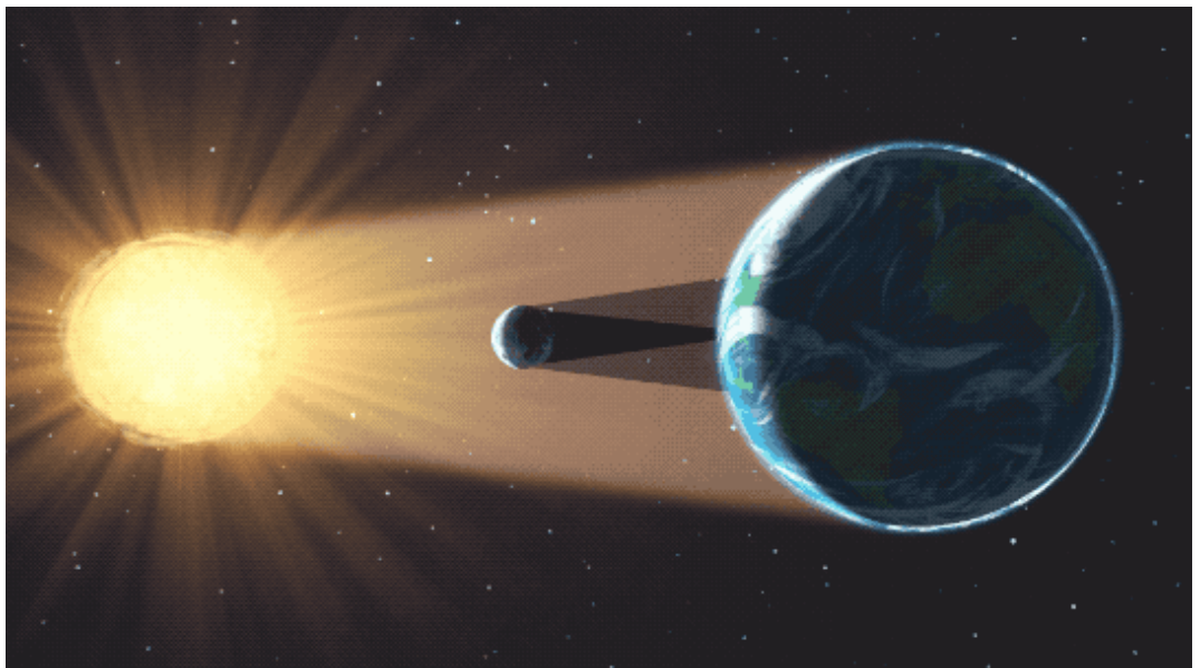
There are several different types of solar eclipses, including partial, total, annular and hybrid eclipses. The eclipse happening Saturday is an annular eclipse, which occurs when the moon passes between the sun and the Earth while the moon is further away from the Earth.
Because the moon is on the farther end of its elliptical path, it will appear smaller and unable to completely cover the sun. Instead of seeing the sun’s shimmering outer atmosphere — called the corona — like you would during a total solar eclipse, viewers in the eclipse’s path of totality will see a solid ring of fire, which is why it’s called an annular solar eclipse.
Where and when is the best eclipse viewing in Kentucky Saturday?
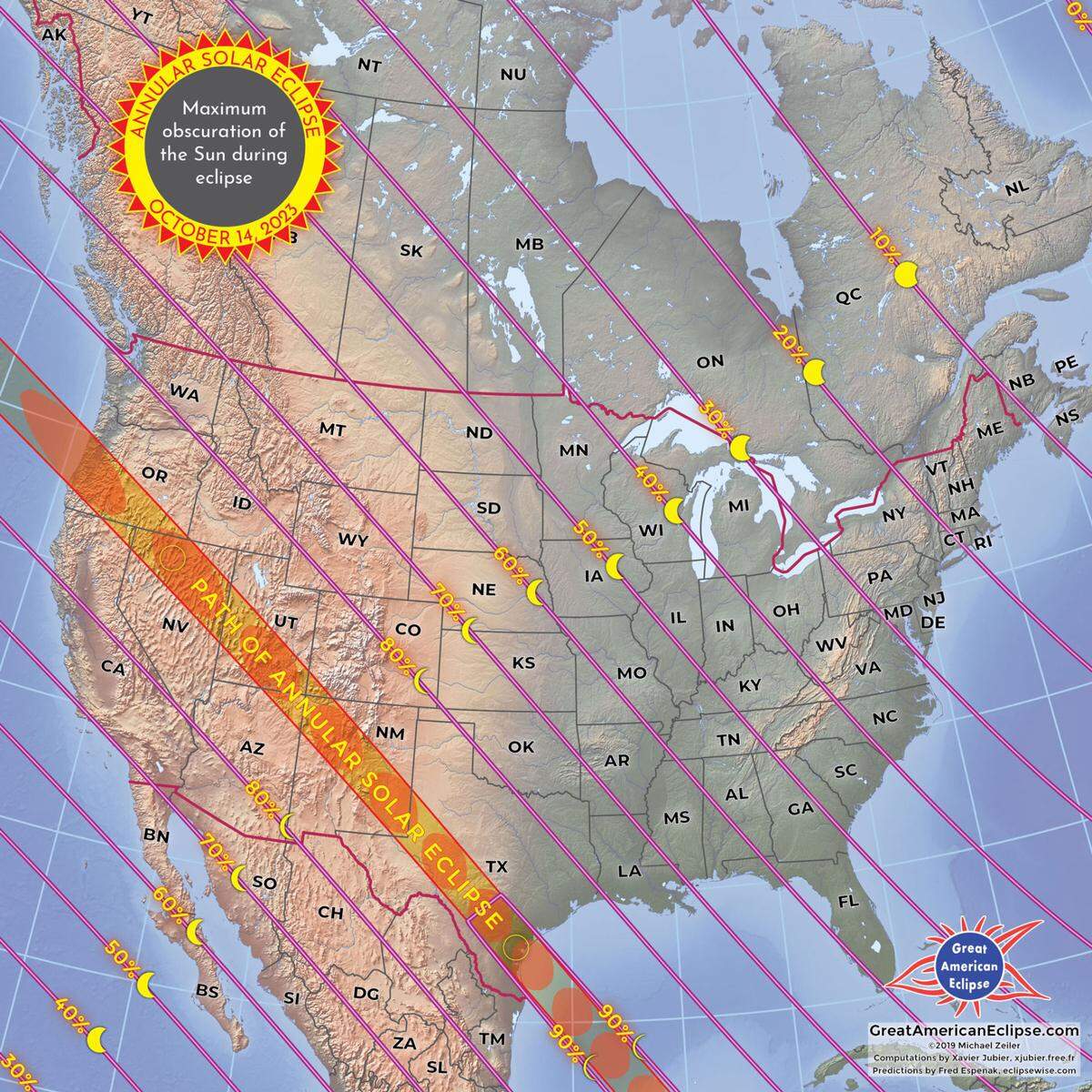
Eclipse viewers in Kentucky will generally have a better view from the farthest southwest corner of the state.
In Lexington, weather permitting, the eclipse here will appear as a partial solar eclipse, as explained by University of Kentucky astrophysics and astronomy professor Thomas Troland, who wrote in response Monday to a Herald-Leader query via email.
“The eclipse will be a partial eclipse seen in Lexington, that is, at mid eclipse (1:06 p.m. in Lexington) about half of the sun’s disk will be covered by the moon. The eclipse begins at 11:42 a.m. (moon begins to move in front of the sun), and it ends at 2:34 p.m. (moon moves completely away from the sun),” Troland told the Herald-Leader.
Farther south, in Bowling Green, up to 60% of the sun’s visible surface will be covered during the eclipse, according to Chris Chandler, with Western Kentucky University’s Hardin Planetarium.
“A partial eclipse will begin in Bowling Green at 10:38 a.m. (central) and will continue until 1:34 p.m. The moon will reach maximum coverage at 12:04 p.m., but will only cover 60% of the sun’s apparent surface,” Chandler told the Herald-Leader in an email Monday.
“If you want to see the moon completely line up with the sun on that day, you’ll have to go far southwest of Kentucky. But even if you did go there, the moon would not appear to totally cover the sun; it would look like it fits inside the disc of the sun, leaving a bright ring of light around the moon,” Chandler wrote.
Saturday’s eclipse also presents an opportunity for WKU students representing the Ogden College of Science and Engineering, the Potter College of Arts and Letters and the WKU XR Lab, who will test an app they designed to sketch the shape of the sun. To do this, they will travel to Odessa, Texas.
According to Gordon Emslie, a professor of physics and astronomy at WKU, the students’ project could have broader scientific implications.
“The app is programmed to take pictures of the eclipsed sun when the moon’s limb is nearly coincident with that of the sun. This will reveal flashes of light known as Baily’s Beads, formed when the sunlight passes through valleys between the lunar mountains. Precise timing of the Baily Bead flashes from phones at different locations along the eclipse path, combined with knowledge of the lunar profile during the eclipse, will allow the shape of the sun to be very precisely determined, with implications for understanding of interior flows and perhaps even different theories of gravity,” Emslie told the Herald-Leader in an email Monday.
How to watch the eclipse safely
In Lexington, the eclipse will begin Saturday at 11:42 a.m., reach its peak at 1:06 p.m. and end at 2:34 p.m., according to Date and Time, an online world clock. The entire event will last for almost three hours.
However, to observe the eclipse safely without damaging your eyes, you need to use true solar protective film or solar glasses, which you can buy online.
Alternatively, you can make one at home with materials from around the house, such as aluminum foil and cardboard. The video below offers instructions for how to do it.
What other astronomical events are coming up?
April 8, 2024, will bring a much anticipated total solar eclipse visible across the U.S., with the path of totality passing through Kentucky’s far western corner. Totality for this upcoming eclipse will last for four minutes and 27 seconds, which is almost double that of the Great American Eclipse in August of 2017 witnessed by 20 million people.
Next year, there will also be a penumbral lunar eclipse visible from Lexington.