
Can you spot a card skimmer on a Kentucky gas pump or ATM? Use these tips to avoid theft
Swiping your debit card offers a convenient payment method, especially at places where you’re likely to be on the go and in a hurry, like the gas station where you regularly fill up or your ATM.
Unfortunately, that’s also what fraudsters who use credit card skimmers are counting on, and the practice is becoming increasingly common. FICO, the company that offers a common type of credit score, reported last year a dramatic jump in the number of debit cards involved in card skimming.
Friday, the Lexington Police Department announced the arrests of two men for allegedly placing several skimming devices on local ATMs. Using local traffic cameras and a tip from University of Kentucky Police, officers arrested the men, who were observed trying to manipulate the ATM at the Kroger on Euclid Avenue.
Further investigation led to the discovery of skimming devices at four other Kroger locations, including on the Hartland Parkway, Richmond Road, Tates Creek Road and Leestown Road. Police said the extent of the data breach was unknown.
To understand more about this issue we spoke with Detective Michael Painter with the Lexington Police Department. Painter works in the department’s Financial Crimes Unit, which investigates fraud and similar types of crime.
Asked about the scope of the issue in Lexington, Painter said the city is fortunate in that it doesn’t have significant problem with rampant credit card skimmers. Police have previously warned about skimmers in Central Kentucky.
How do credit card skimmers work?
First, it’s important to establish there are two types of credit card skimmers: external and internal.
External skimmers work as covers that are placed over the card reader and closely mimic what you’d expect it to typically look like on the outside. Painter describes these types of skimmers as “a fake overlay that goes over either the keypad or the device that you slide your card into.”
With this type of skimmer, once you swipe your card, its details are copied and stolen through its magnetic strip. As long as the skimmer is well-placed and hidden, it can continue to accumulate lists of credit card numbers, cardholder names and other valuable information.
This data can be sold anonymously online to the highest bidder, as explained by financial company Capital One. Given that the first six to eight digits of your credit card number tell the fraudster what institution and specific bank issued the card, high-limit credit cards can be sold online at even higher amounts.
The second type of skimmer, the internal one, is called a “shimmer,” and it works a bit differently.
Shimmers are thin devices that are inserted directly inside chip-reading slots on card readers. Shimmers are difficult to detect from the outside, if not impossible, and they steal the data from your card’s EMV chip, not just its magnetic strip.
While you may be able to detect an external skimmer, perhaps by tugging or pulling it loose, you’d likely never know a shimmer was there. Fortunately, shimmers are the less common of the two.
What does a credit card skimmer look like and how do you spot one?
According to Painter, when it comes to filling up your tank, it’s best to avoid pumps that seem out of the way and shielded from view. Stick to using pumps that are more visible if you can.
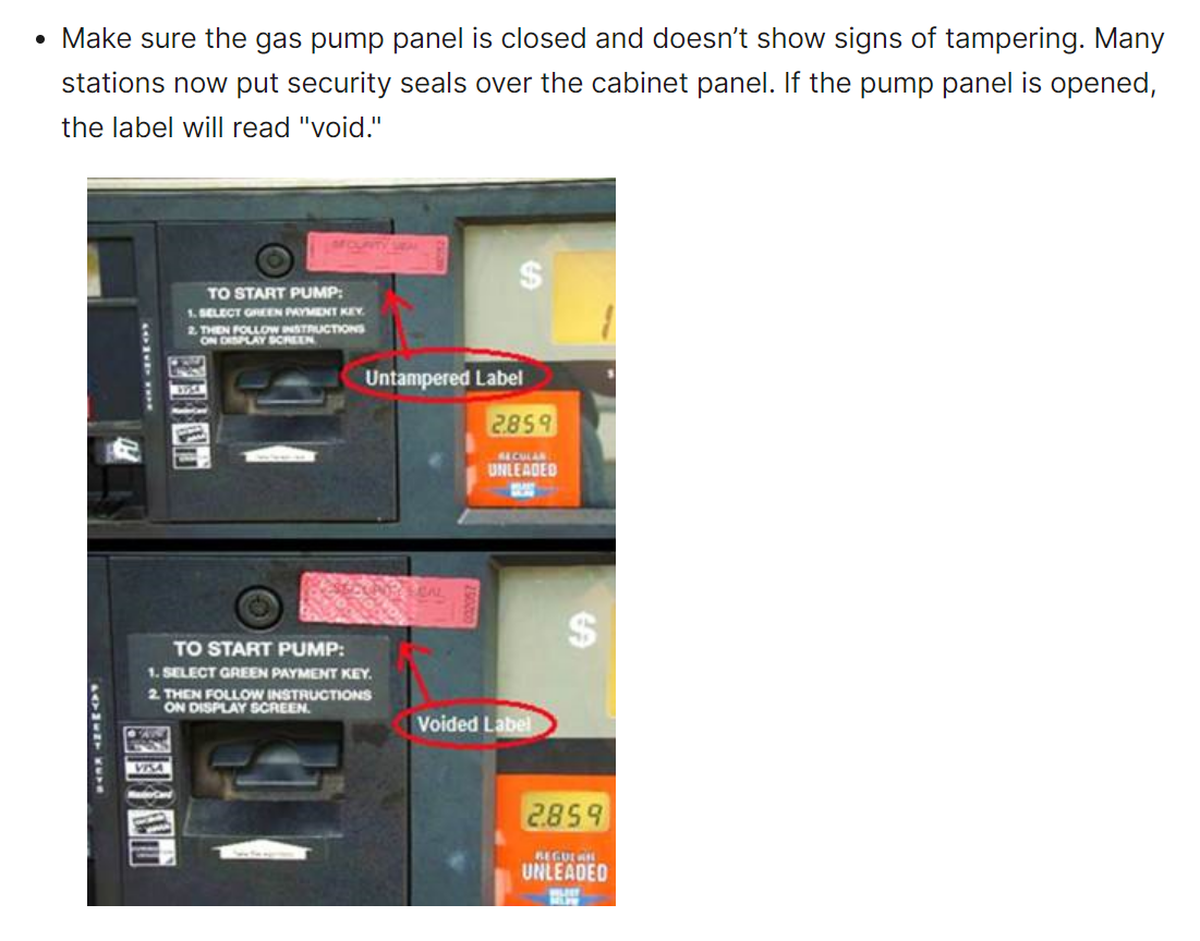
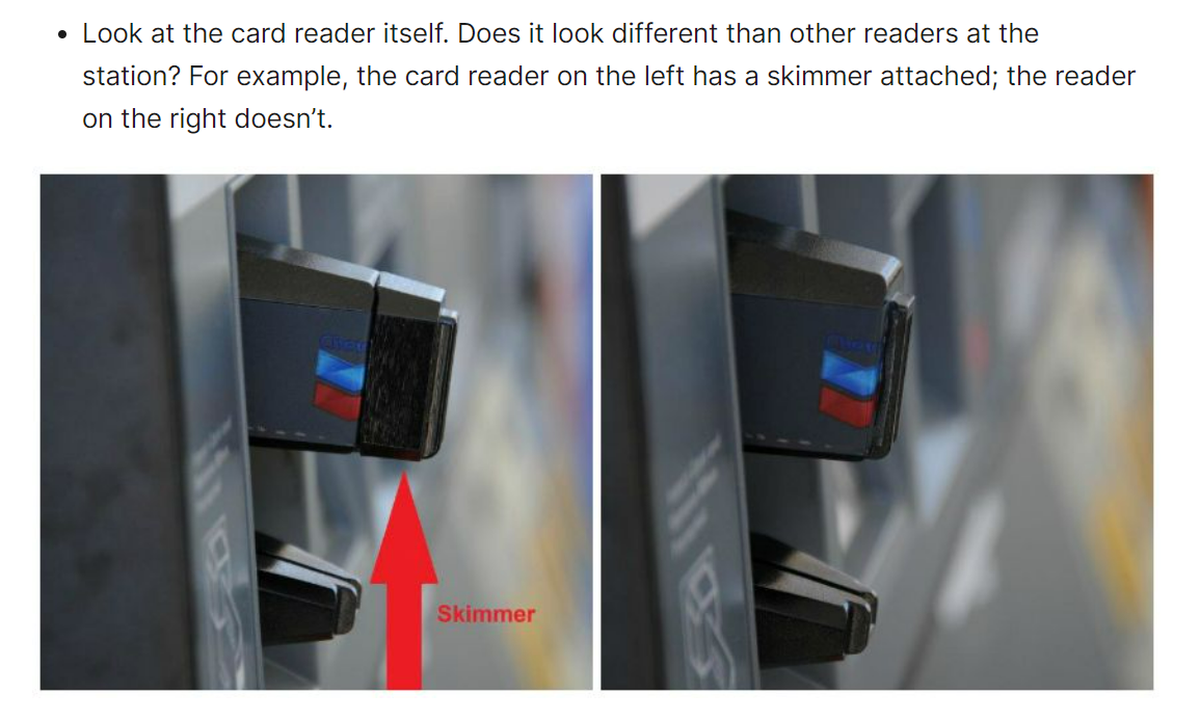
It can also be helpful to know what to look for when it comes to spotting skimmers. Capital One offers the following tips:
Take a closer look at the card reader. Does it look out of place or unaligned with the rest of the machine in places that it shouldn’t be?
Feel around the card reader. If the machine feels like it’s coming apart in some places or like one particular piece is flimsy, that could be a skimmer. Give the card reader a little wiggle or tug to see if anything comes loose.
Look at the security seal. At a gas pump, there should be an intact security seal. If the pump panel has been opened or has a broken seal, it should read as void.
Compare the pump with other gas pumps and machines. Take a quick look at the pump next to you and maybe another. Do they look the same as yours? If anything looks like it’s bulging out of place, that could be a clue.
Watch out for hidden cameras. Look for tiny holes that appear to point down at the PIN pad to record your PIN number.
How can you protect yourself from credit card skimmers?
It’s worth remembering technology generally tends to grow more sophisticated over time. Given this, there’s a good chance credit card skimmers themselves could become even harder to detect. The best way to protect yourself is to avoid becoming a victim in the first place with some common sense tips.
“Unfortunately there’s no way to 100 percent prevent it,” Painter said, adding that you can do “damage control” to manage your risk level.
Perhaps the easiest thing to do is to use a credit card, rather than a debit card. If you’re in the habit of swiping your debit card everywhere, try to break it. Credit cards generally offer a more secure payment method because it acts as a line of credit and doesn’t directly come out of your bank account, like a check card.
Painter also recommends setting up purchase alerts so you can be alerted to purchases that seem out of character for you.
If all else fails, pay with cash at known hot spots for skimmers.
Do you have questions about fraud in Kentucky for our service journalism team? Reach out to us through the Know Your Kentucky form below or email us at ask@herald-leader.com.
This story was originally published February 1, 2024 at 11:15 AM.