
This highly toxic plant can now be found in most Kentucky counties. How to spot it
%20copy.jpg "The flower of the poison hemlock plant resembles Queen Anne’s lace. It is toxic to pets and can be found in most Kentucky counties.")
The plant looks innocent enough with its pretty, white flowers. In all likelihood, you’d probably drive past it on a roadside and not give the fast-spreading weed much thought at all.
Make no mistake, the plant is a killer, so much so one University of Kentucky plant scientist calls it “one of the most toxic plants in the world.”
Poison hemlock, as it’s known, can be found in most Kentucky counties. Every part of the plant is highly toxic — roots, stems, leaves and seeds. It was famously used in the execution of the Greek philosopher Socrates in 399 B.C.E.
If you live in a rural area in Kentucky, there’s a good chance you can find it growing near your home, but invasive poison hemlock is turning up in urban areas, too. If that’s the case, here’s what to do about it, with tips for safely removing it and how you can protect your pets.
How to spot poison hemlock
J.D. Green, an extension weed scientist with UK, notes poison hemlock is spreading in Kentucky. Where it was once found along roadways, abandoned lots and fence rows, “it has expanded out into grazed pasture lands and hay fields.”
The non-native plant was relatively rare until about 30 years ago, according to Ohio Department of Natural Resources chief botanist Richard Gardner. Now, it can be found in almost every state.
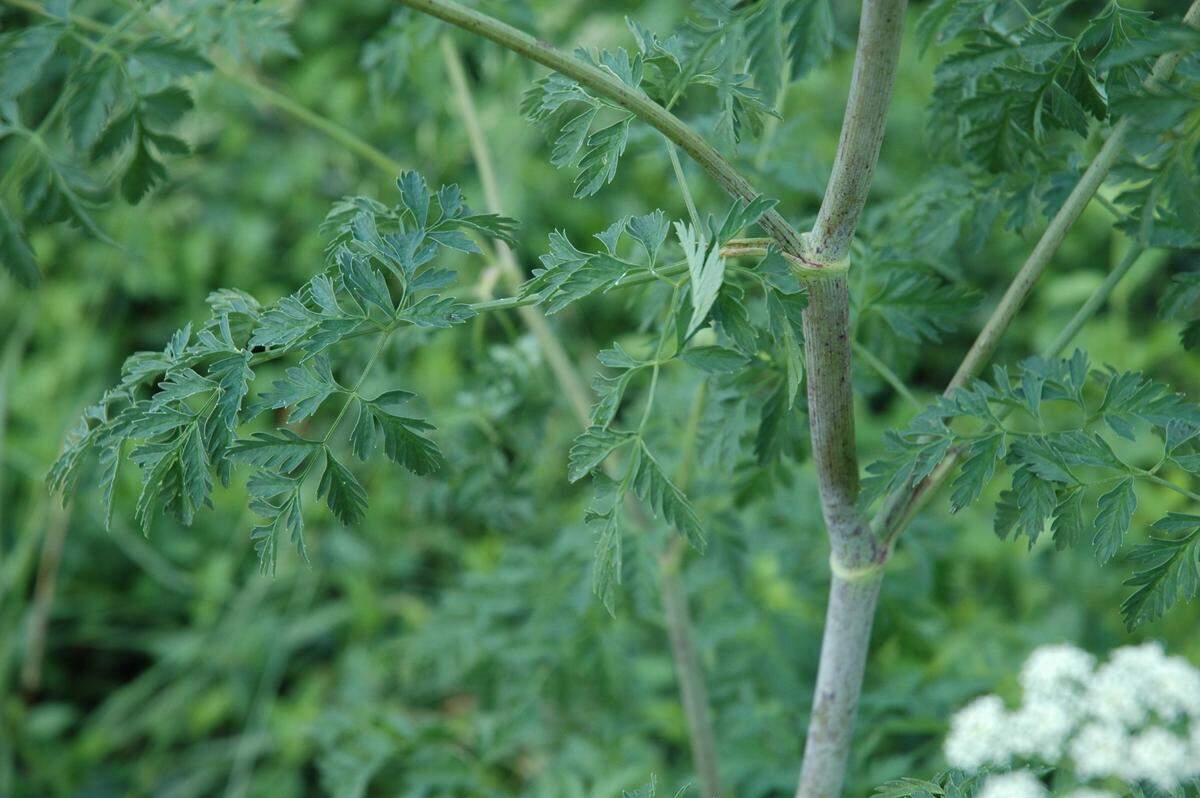
Green describes poison hemlock as having white, umbrella-shaped flowers that mature on stalks emerging from the plant’s main stem. As a biennial plant, it generally takes two years to complete its life cycle, but in Kentucky, it is capable of completing its life cycle in a single winter if it germinates in early fall.
In its short life, it can grow to be 8 feet tall, but early on it keeps a low profile as a rosette with fern-like leaves.
One of the reasons poison hemlock is so sneaky is because it looks like several other plants. One way to spot the difference, according to Green, is to notice its stalk, which is smooth with purple spots patterned along the lower part of the stem.
Lookalike plants include:
Queen Anne’s lace (wild carrot) - While both plants have similar looking flowers and fern-like leaves, Queen Anne’s lace has hairy stems and leaves. It lacks the purple spots found on poison hemlock stems.
Yarrow - Yarrow has medicinal properties and has been used to stop bleeding from cuts and wounds and as a poultice for burns, along with other ailments. It can also closely resemble poison hemlock. However, its flowers aren’t arranged like the poison hemlock’s umbrella-shaped blooms. Yarrow also has a lighter, more feathery structure and is generally a much smaller plant only a few feet tall.
Hogweed (cow parsnip) - Both plants grow tall and have clusters of white flowers, but hogweed’s leaves are not lacy like poison hemlock’s. Additionally, unlike the hemlock, hogweed stems are green without purple spots.
Poison hemlock symptoms in pets
Most of the time, poison hemlock is only dangerous if ingested. However, you should still be careful when handling it and wear gloves.
Symptoms of poisoning in humans include sweating, excess salivation, vomiting, dilated pupils, rapid heartbeat, high blood pressure, restlessness or confusion, muscle weakness and tremors, according to the Cleveland Clinic.
Signs of poisoning in dogs and cats can include tremors, excess salivation, muscle weakness and difficulty breathing, among other symptoms. If you suspect ingested poison hemlock is to blame for these or other symptoms, seek veterinary care for your pet immediately.
How do you get rid of poison hemlock for good?
Completely eliminating poison hemlock from an area can take years due to how persistent the plant is.
According to Green, the UK plant scientist, “the principle control strategy for poison hemlock is to prevent seed production which can be a challenge since a fully mature plant is capable of producing 35,000 – 40,000 new seeds.”
If the plant has already produced flowers, it’s too late to control its spread with an herbicide, according to Green. Mowing or cutting down individual plants should take place in the late spring before they reach peak flower production. Early spring or late fall is the best time to use herbicide treatments, particularly on new plants that crop up in the fall.
“In grass pastures and hayfields herbicide products containing 2,4-D can be effective when applied to young, actively growing plants in the rosette stage of growth. Spot treatments with products containing 2,4-D, triclopyr, or glyphosate can also be used depending on the location,” Green writes.
Do you have a question about the environment in Kentucky for our service journalism team? Send us an email at ask@herald-leader.com or submit your comment or question via the Know Your Kentucky form below.