
An answer to housing and disaster? KY’s first 3D-printed home set in Somerset
Jen Seifert has seen the effects of a lack of affordable housing.
As principal of Progress Appalachia, Seifert has deep experience with what the housing crisis means for her native Appalachia.
“It creates so much despair and trauma,” she said.
Friday, Seifert and hundreds of others ventured in and around a potential new solution: a 3D-printed house set on the Somerset Community College campus.
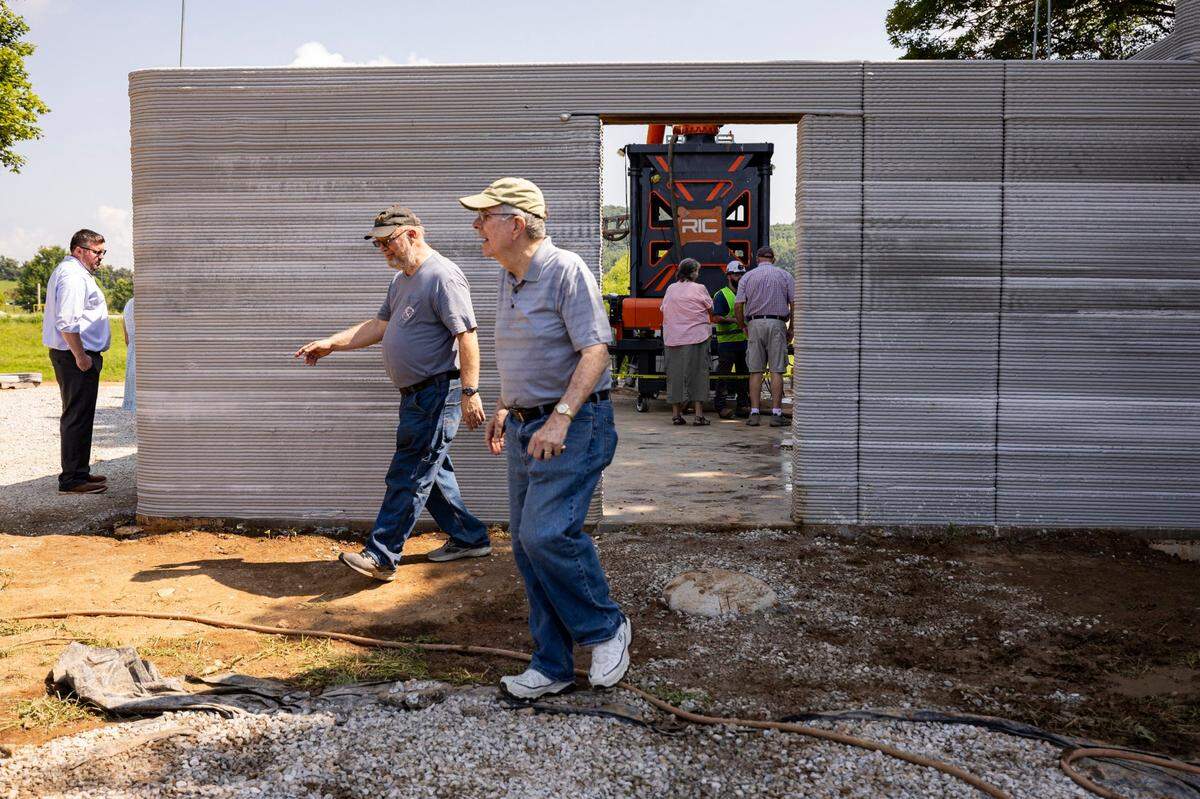
SCC hosted a live printing demonstration of Floodbuster 1, Kentucky’s first 3D-printed concrete house. The structure, which is a demo and will not be occupied, is a step forward for a technology “that is going to play a major role in how we move rural Kentucky forward,” U.S. Department of Agriculture Rural Development State Director Travis Burton said at the press conference.
“We’re looking at a new approach to housing, and a new way to utilize technology right here at home,” Burton said.
Kentucky is no stranger to the housing crisis. In 2024, the commonwealth was 206,207 housing units short of what is necessary to fill the needs of its more than 4.5 million residents, according to a 10-member Kentucky Housing Task Force.
Seifert said her hope for the future of the project is to create opportunities for those in need.
“For me, it’s about benefiting Appalachian folks, folks who struggle with addiction, youth who age out of foster care, trafficking survivors, veterans,” Seifert said. “We need to create opportunities for these folks that are good... not ones that result in incarceration.”
Ryan Cox, director of Skyland 3D and RIC Technology, a partner on the project, said traditional American homes are built at $180-225 per square foot. With 3D-printed housing, Cox said the price plummets to $60-80 a square foot.
Cox said a main factor in the cost decrease is a change in “where the workforce is applied.” He said the process isn’t taking away jobs, but rather training the same workers to do something different.
A drop in work time also plays a role. Cox said a house can be printed in just 40 hours.
“That robot doesn’t take overtime. It doesn’t need payroll deductions. It doesn’t need a 401K plan,” Cox said. “It doesn’t need all those added benefits... so those costs are going to continue to plummet.”
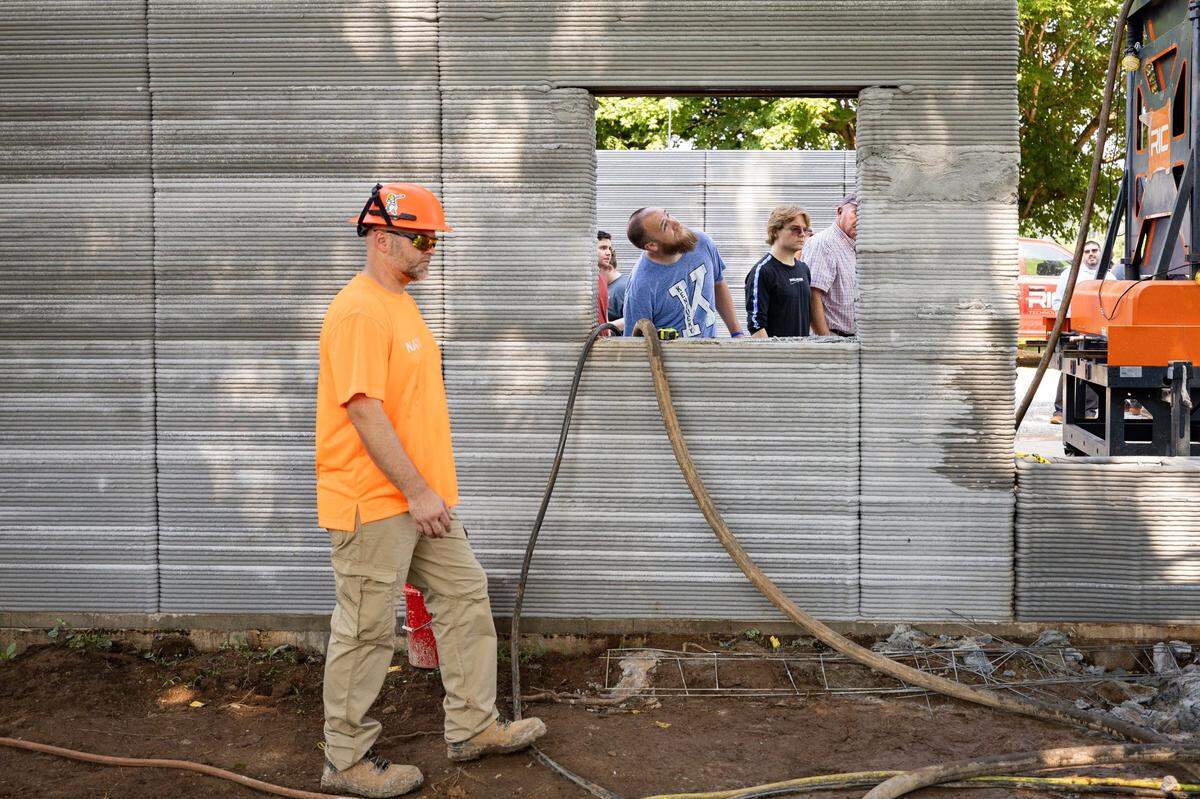
The SCC project also aims to tackle another problem that has devastated Kentucky communities recently. Floodbuster 1 is designed to withstand natural disasters like wind and flooding.
Cox told the Herald-Leader each corner of the structure has a series of “webbed fingers” that extend across each wall. These fingers provide a “rigid, robust framework within the wall system.”
“Each corner on this house is structurally reinforced for the ability to take and withstand impact from a wave or high stress on winds,” Cox said.
Floodbuster 1 can withstand winds up to 200 miles an hour, officials said. In May, an EF-3 tornado, which is capable of reaching wind speeds up to 165 miles per hour, according to the National Weather Service, killed 20 in Kentucky.
How does 3D printing a house work?
3D house printing is carried out by a robotic arm that positions wet concrete into the shape of a structure, so it can form. Cox said the robot is “drawing a map” of the structure before raising itself up and placing the concrete.
The concrete is mixed by two workers before being fed through a hose into the printing machine to be placed.
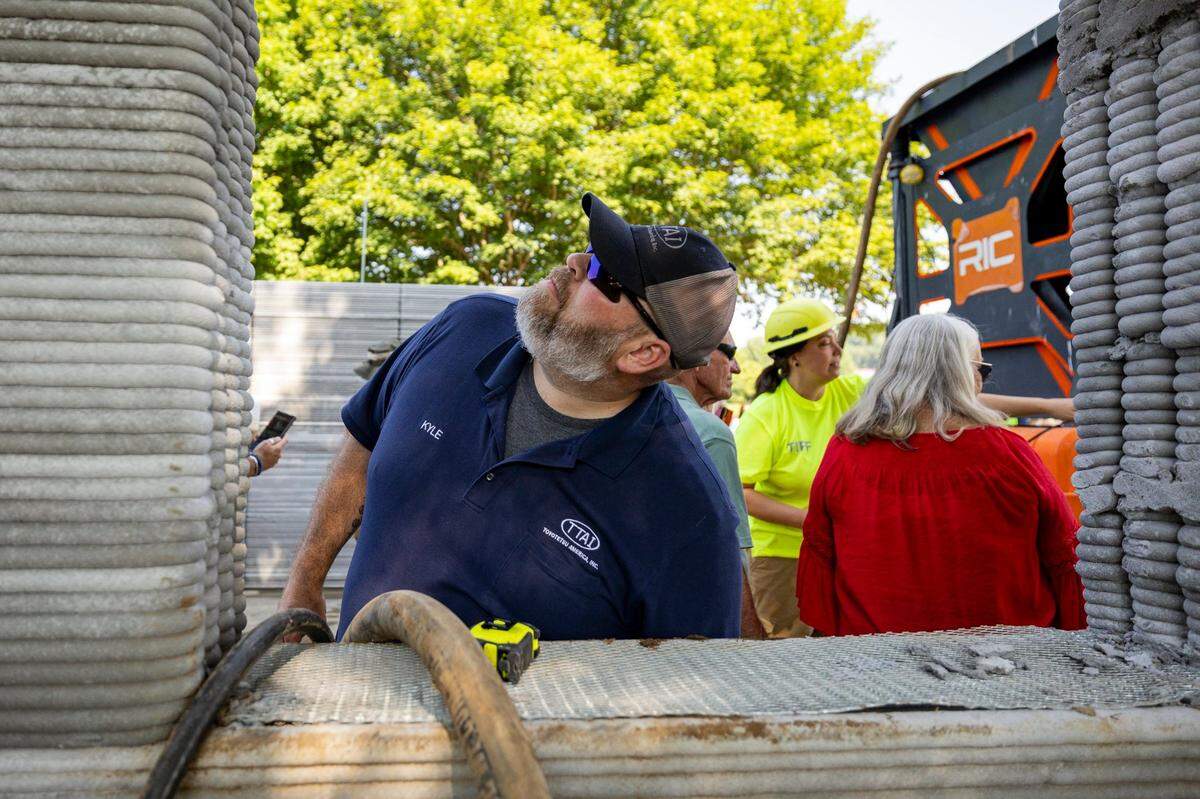
Project manager Andrew Clapper said the robot doesn’t matter as much as the design does. This design took two months: one month to create the floor plan and another month to finalize.
He said there were 12-13 workers on the Floodbuster 1 job site, but said “realistically” the job could get done with just four, two mixing the concrete and two working the machine.
Cox said all the wall, window and door systems are 3D printed. The house will remain as a demo. According to the project’s website, the initiative was supported by a grant from the USDA and the Appalachian Regional Commission.
What’s next?
The second Floodbuster is already in the works, and will be an office at Bluegrass Veterans Ranch, a tiny home initiative in Somerset, Seifert announced at the press conference.
“The next phase of this is going to be benefiting veterans that struggle with homelessness,” Seifert said.
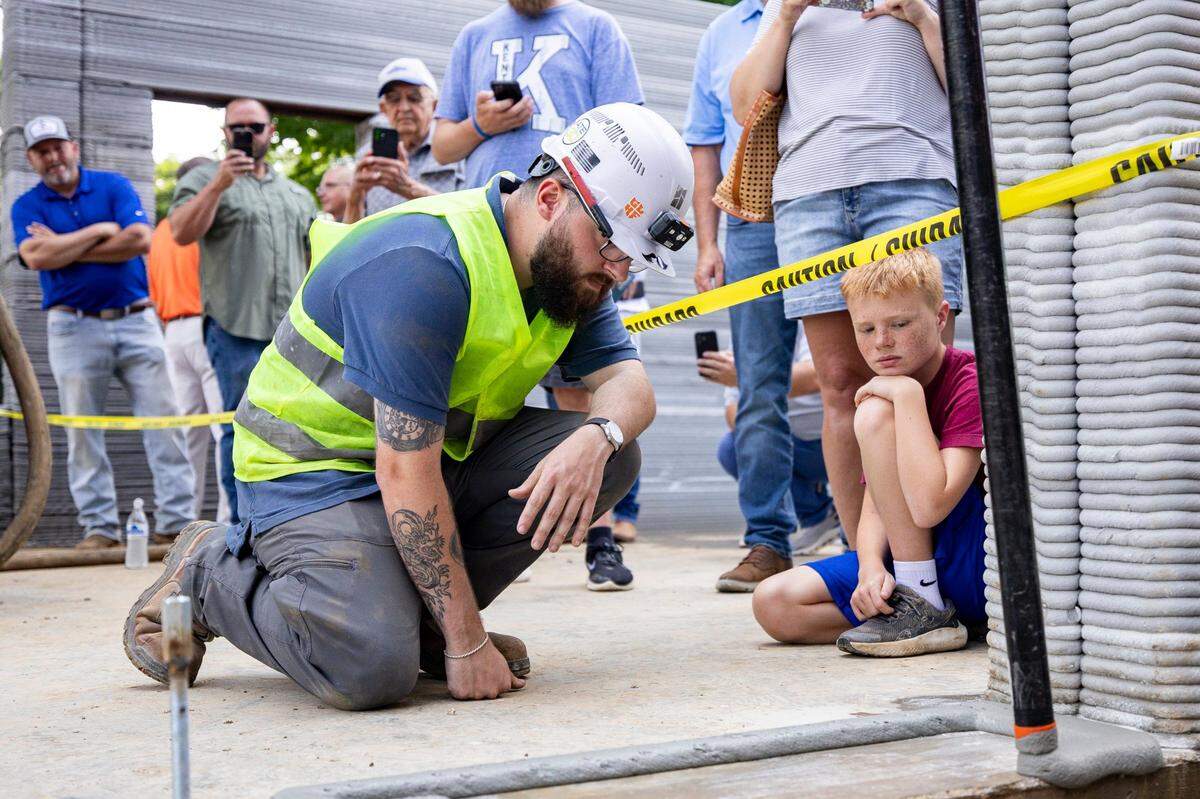
SCC Professor and Director of the Kentucky Community and Technical College System Additive Manufacturing Center, Eric Woolridge, said at the press conference that his dream for the project isn’t “just the houses.”
“The dream is very big” he said. “It’s all of the small businesses that can start up around this technology right now and start making new things.”
Seifert said figuring out scale is the challenge when discussing a timeline for this process to expand.
She said the timeline depends on how quickly the project can get funded “to replicate what these folks are doing here.”
This story was originally published June 30, 2025 at 5:00 AM.