‘It’s a disgrace.’ KY unions push back against Trump effort to oust unions
AI-generated summary reviewed by our newsroom.
- Federal unions protested Trump-era policies reducing collective bargaining rights.
- VA, TSA, and HUD employees cited layoffs, red tape, and morale declines since 2023.
- Union leaders urged Congress to pass HR 2550 to restore federal labor protections.
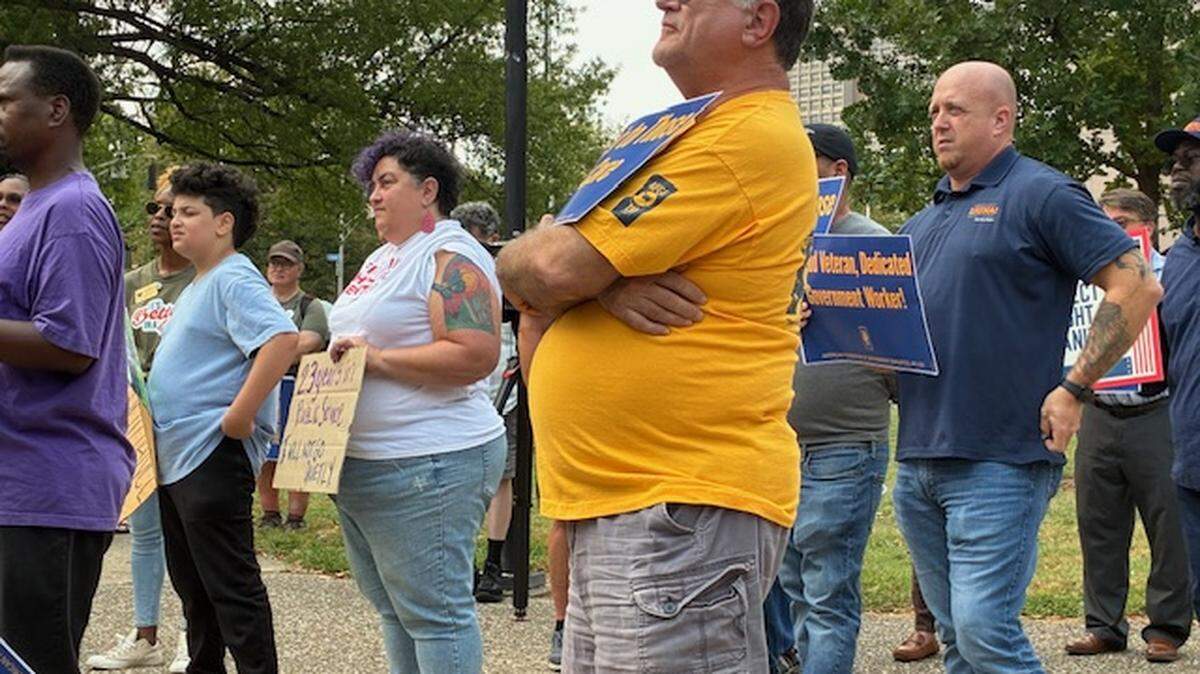
Federal union officials and supporters gathered Friday outside one of Kentucky’s largest federal buildings to protest and push back against the efforts of President Donald Trump’s administration to slash the federal workforce and stifle federal employee unions.
Shannon McCallister was on her way to work March 7 when she hit an 8-point deer.
The executive vice president of the American Federation of Government Employees TSA Council 100 for Kentucky called her boss to let her know. The union represents Transportation Security Administration or TSA employees at Kentucky airports.
Her boss had bad news. Not only had thousands of government employees been notified of termination or offered buyouts, but President Donald Trump’s administration had also canceled AFGE TSA’s collective bargaining agreement.
Thanks to a lot of hard work, that collective bargaining agreement was eventually reinstated, McCallister told a group of federal government union officials and protesters who gathered outside the Romano Mazzoli Federal Building in downtown Louisville Friday evening.
But that doesn’t mean threats to TSA employees are over.
“We know that a possible government shutdown is looming,” McCallister said. TSA employees will be required to show up to work despite no guarantee the government will pay them.
She asked: How will they afford to go to work without being paid?
McCallister urged the crowd to contact members of Congress to let them know government workers aren’t political pawns. They are workers with kids and jobs just like everyone else.
“We cannot continue this barrage against American workers,” she said.
Up to 450,000 federal employees have lost union protections
Various federal employees told their stories and urged those who attended Friday’s protest to call members of Congress and urge them to pass House Resolution 2550, which would restore collective bargaining rights that were largely stripped from federal employees by Trump’s executive order in March.
More recently, the administration has gone after unions representing National Weather Service and U.S. Paton Service employees.
In August, it gave U.S. Department of Veterans Affairs unions days to exit federal buildings after announcing the administration was ending all collective bargaining agreements for VA employees.
As many as 450,000 government employees have been stripped of their union rights, according to some estimates.
AFGE Local 113 President John Hetzel is a veteran who worked for the VA in Louisville for 33 years.
Trump’s attacks on VA workers “is personal to me,” he told the crowd. The VA is largely staffed by hard-working veterans who care about the people they serve, he said.
Multiple unions have sued over Trump’s executive orders. Those lawsuits are ongoing.
“It’s illegal,” Hetzel said.
Cuts to federal staff, programs affecting morale
U.S. Rep. Morgan McGarvey, the only Democrat in Kentucky’s federal delegation, was the only Kentucky senator or congressman to speak on Friday.
“We are talking about protecting our veterans who are protecting our veterans,” McGarvey said of stripping union protections from VA employees.
Other federal employees told the crowd previous buyouts and layoffs have left many federal agencies understaffed and demoralized.
Anice Chenault has worked for 23 years at the U.S. Department of Housing and Urban Development, or HUD, in Louisville. Chenault was hired through a fellowship program designed to encourage those with advanced degrees to go into government work. The Trump administration recently eliminated that program, she said.
HUD has lost roughly 30% of its workforce, Chenault said. Her office once had 100 people. That number has shrunk to 70 people.
The agency has also made changes that make it more difficult for HUD staff to communicate and serve their clients. If Chenault wants to send a communication to more than 10 clients, she has to get six different people to sign off, creating more red tape, she said.
Federal employees are there to serve the public. But it’s getting more and more difficult to do so with fewer staff and more hoops and red tape to jump through, she said.
“It’s a job where we all go in and work our hardest on things that we really care about for people that we really care about,” Chenault said.
AFGE National Vice President Arnold Scott said the attacks on government unions and employees are deliberate and part of a larger plan by the Trump administration.
“It’s a disgrace,” Scott said. “It’s about making the government fail so people will complain and they will talk about privatization.”
Those contracts for government services will not go to working class people, Scott said. They will go to the already-wealthy. Government service is not about making a profit, he said.
AFGE started representing federal employees in 1932. The first federal collective bargaining agreement was in 1978, Scott said. Unions know how to represent people without bargaining agreements, he said.
“We aren’t going anywhere,” Scott said. “We are going to fight until we win.”