How are gas prices set in KY? From oil to the pump, here’s what to know
When gas prices went skyrocketing earlier this year, Kentucky ranked in the top five nationally for largest monthly spending increase, according to one study.
The headache of fluctuating gas prices is not contained to the pump, but instead consumers can see rising costs tied to gas spikes in many different sectors of the economy. The price you see at the gas pump reflects more than just compounding state and federal taxes — multiple factors play into the final cost at the pump.
Tension in the Middle East sent costs skyrocketing throughout the global oil supply chain recently. In the South, rising costs averaged to about an additional $39.42 in monthly expenses on gas, according to data from the Institute on Taxation and Economic Policy.
We followed the gas pipeline from start to finish and spoke with an expert to understand how prices are determined.
Ana María Herrera, associate department chair of economics at UK’s Gatton College of Business and Economics, specializes in energy economics and has studied the factors that influence the prices consumers pay at the pump.
“The biggest misconception is to think that oil companies or the president is going to set the gasoline prices; nobody’s going to do that,” Dr. Herrera said. “It is the market that is going to determine that.”
Here’s how crude oil becomes gasoline and how this process sets the prices at the pump.
Crude Oil
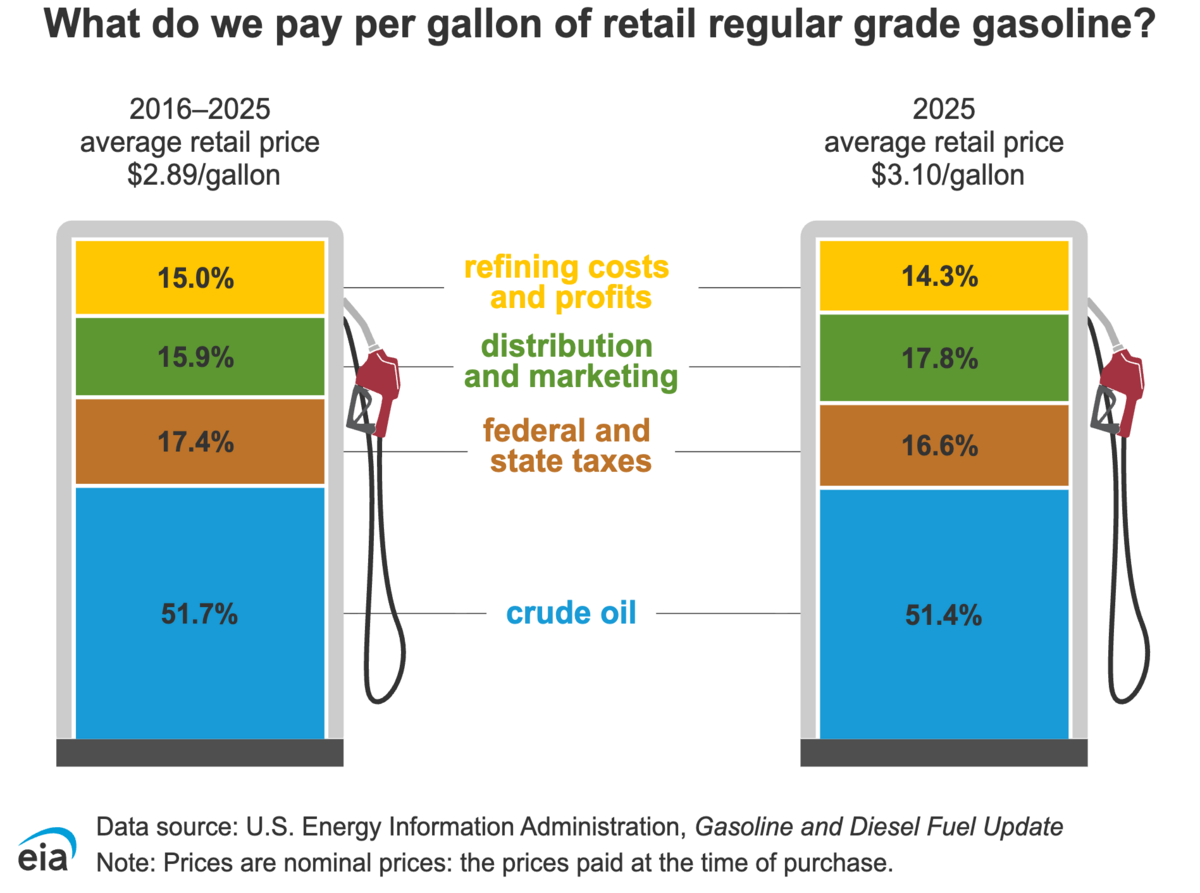
While exact data points differ, the cost of crude oil is the biggest influence on the price of gasoline.
Oil prices determine at least half of the retail price of gasoline, around 50-55%, according to Herrera.
The price of oil is driven by various interconnected factors globally, but the main factor is that oil is a continuously traded product, driven by global supply and demand. Changes in demand are important, but natural gas is the main source of power globally, so prices reflect changes in supply or scarcity.
Supply expectations are crucial to setting prices. Political conflicts or economic slowdowns that involve oil-dominant nations, like OPEC, can destabilize oil production and impact the entire market’s supply.
“The crude oil market is a global market, so whatever happens outside of the US is going to affect our gasoline prices,” Herrera said. “Conflicts that disrupt the supply in some region that produces a main portion of the oil supply mean it's going to contract at some point.”
While there are regulations and outcome expectations for the oil industry, no single government or company controls prices. Governments can take steps to offset rising costs, such as a gas tax holiday, but this could do little to counteract climbing production costs, said Herrera.
When the price of a barrel surged to $113, this translated to gas being almost $5 a gallon in some parts of Kentucky, according to data from the New York Mercantile Exchange and AAA. There are 42 gallons in a single barrel of crude oil, meaning an increase of one dollar per barrel of crude oil generally translates to an increase of about 2.4 cents per gallon at the pump.
That might not seem like too big a deal, but with a decrease in supply and rising cost per barrel, those few cents add up quickly.
Refining
After crude oil is extracted, it is refined into products like gasoline, diesel and jet fuel.
As the oil is refined, or “cracked,” the most important financial factor is the difference between the cost of the barrel and the finished product. Between these two prices is where refiners find their profit, referred to as the refining margin or the “crack spread,” for traders.
Keeping the spread wide is key for refiners, as this is where they can capture more profit.
The U.S. is the leading refiner of oil, responsible for over 900 million metric tons of refined oil each year, according to Statista. Disruptions to refineries reduce the amount of product available, if a key refinery goes offline the supply contracts and prices spike.
With a majority of American refineries located in the Gulf Coast, hurricane season can be particularly harrowing for gas prices.
“Best examples are like the 2005 hurricane season. If you look at (Hurricanes) Katrina and Rita, you see the disruption on the Gulf Coast refineries was huge,” Herrera said. “Prices ended up going 30 to 40% higher per gallon in those days because of the disruption to refining capacity.”
Seasonal differences in formula needed and consumption expectations also affect the refining process. Summer blends for gasoline are more expensive, and certain areas have stricter emissions regulations that alter the refining process or limit the number of refiners that can supply to that area.
Distribution and Marketing
Once gasoline is produced, it must be transported. The cost can include pipeline, marine, truck and rail costs associated with moving the gasoline to tankers to be picked up by trucks.
A longer pipeline and larger transportation costs can bring about differences in costs, Herrara said.
“That’s going to increase the price, and if you think about all these forces together, you can see about a 50 to 60 cents difference in retail prices across regions,” she said.
Also, local supply conditions play a part in prices.
For example, consumers can see a convenience cost at retail locations in high-demand areas like right off of major roadways, Herrera said. Comparatively, if a retailer has no competition, they can set their prices however they want and not worry about competitive pricing to attract consumers.
When a station carries a particular fuel brand, it can change the price, but it does not mean that it is owned by a major oil company. Of the roughly 152,000 retail fuel stations in the U.S., about 55% are owned by individual operators or families who operate a single store, according to the National Association of Convenience Stores.
In addition to these factors, retail stations have to address cost of maintaining a business (labor, real estate, electricity, equipment costs). Protecting profit margins at each level in the supply chain contributes to the asymmetrical relationship or “rise like a rocket, fall like a feather” phenomenon in oil-to-gas prices.
Prices at the pump adjust upwards quickly, offsetting oil prices that increase down costs of the supply chain. There is not the same incentive to respond quickly as costs fall.
Taxes
Taxes are relatively stable, but they all differ from region to region and are a part of the price.
“So taxes are a big difference,” Herrera said. “State and local gasoline taxes vary a lot across regions. They can go from 30 cents per gallon to 70 cents per gallon in other parts, like in California.”
Federally, the gas tax is 18.4 cents per gallon. Kentucky state wide taxes 26.4 cents per gallon. Certain local communities can have additional tax rates as well, though Lexington does not.
The control of the government over gas pries is really limited to tax policy, said Herrera. When trying to find the culprit for rising prices, there is one question consumers should answer first.
“What’s happened to the price of oil?” Herrera said. “That’s the biggest influence of the gasoline price.”
This story was originally published July 7, 2026 at 9:57 AM.