
Supporters work toward museum featuring a century of railroad history in Corbin
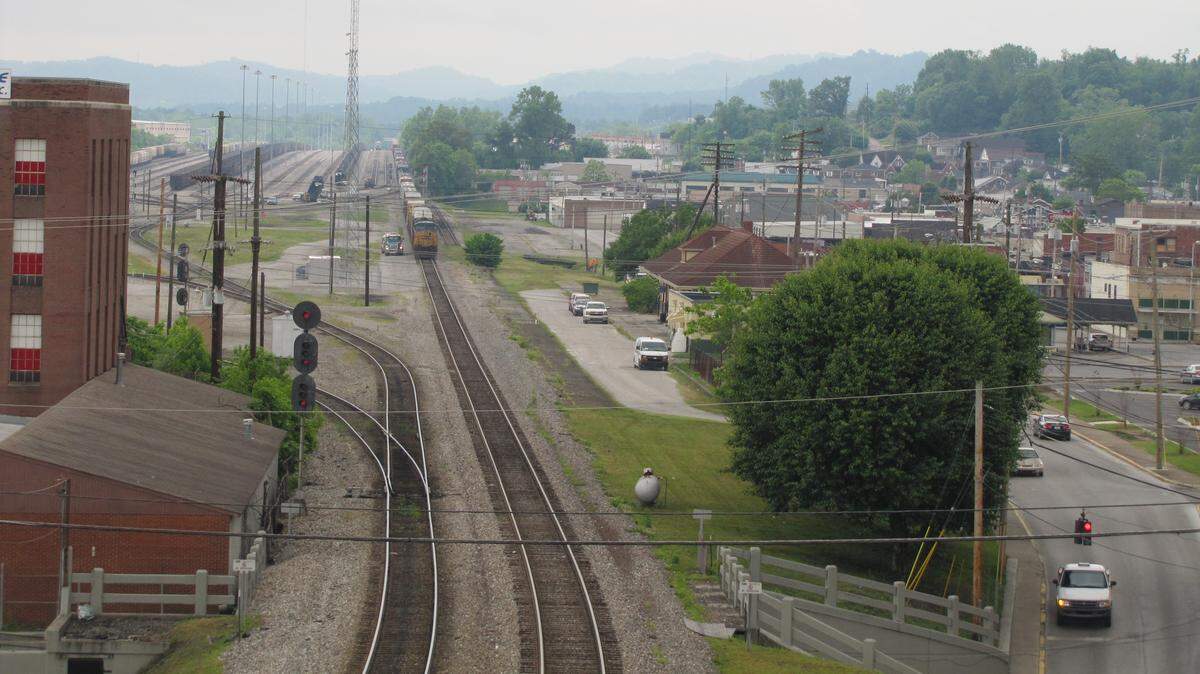
CORBIN — The effort to create a museum showcasing Corbin's century-plus history as a railroad town is gathering steam.
People have donated a variety of artifacts, including photos, tools, switchyard lamps, a caboose bell, a metal conductor's box, china used on dining cars, a $10,000 reward poster aimed at catching people who blew up train tracks in Harlan County, and log books documenting decades of passenger and freight service in the coalfields of southeastern Kentucky.
One of the jewels of the museum will be Engine 2132, an early-1920s steam locomotive that was used to switch train cars at the Louisville & Nashville Railroad yard at Corbin. The engine is the last remaining steam unit built at the long-gone L&N shops in south Louisville, said Maggy Kriebel, head of the Corbin Tourism and Convention Commission.
"It's integral to Corbin," Kriebel said of the historic engine. "She's majestic."
The museum will be in the old L&N Depot in downtown Corbin.
The place that ultimately became Corbin was home to just a scattering of small farms before the L&N extended its main line to the area in the early 1880s, opening access to the region's rich coal deposits, according to the Kentucky Encyclopedia.
The railroad ultimately extended lines through Bell County and into Harlan County — where U.S. Steel had built the largest coal tipple in the world at Lynch — and the L&N yard at Corbin grew into a major freight and passenger terminal.
Corbin grew with it as hundreds of people came for jobs as engineers, machinists, boilermakers, carpenters and track workers, and at all the places to serve them.
The population grew from a few hundred in 1890 to 8,000 by 1920, according to a history Kriebel provided from H.E. Everman, a former professor at Eastern Kentucky University.
There was a time when nearly every family in town had a tie to the L&N, said Bob Terrell, 82, who grew up in Corbin and was once the economic development director.
"I don't think that this area would have been anything compared to what it is now if the railroad had not come," said Terrell, whose grandfather worked for the L&N.
The L&N merged in the early 1980s into what is now CSX Transportation, which still has a major rail yard at Corbin.
There had been interest locally for some time in creating a full-scale museum, but a couple of efforts had fallen through, Kriebel said.
About 18 months ago, the city tourism board decided to bring renewed focus to the job with additional resources. Additionally, the tourism commission got a $10,000 grant from EKU's Center for Appalachian Regional Engagement and Stewardship, which paid for student intern Jeffrey Cawood to help with research and other needs.
Kriebel said CSX, the L&N Historical Society and the University of Kentucky also have helped.
Local officials hope the museum boosts tourism, but the museum also is a heritage-preservation project, Kriebel said.
Carl Gambrell said he's glad Corbin is getting a museum based on that heritage.
"I always was amazed that the city of Corbin didn't have something like that because it was such a great railroad town," said Gambrell, 77.
Gambrell, who retired in Jacksonville, Fla., has more than a century of association with the L&N and subsequent companies. His father worked 47 years for the L&N; Gambrell worked more than 42 years; and his oldest son, Charles, a machinist at the CSX yard in Corbin, has been with the company 36 years, Gambrell said.
Several other relatives also worked for the railroad. Gambrell donated a locomotive bell, a lantern and other items to the Corbin museum in honor of that association.
In addition to historic pieces, the museum will include interactive displays and oral histories.
Even though the museum already has numerous artifacts, Kriebel is still soliciting items.
Among other things, she would like to have old railroad uniforms and more pieces related to the steam era of railroading. "We desire to have a really amazing final product," Kriebel said.
The goal was to have the museum open by now, but it has taken longer than expected to work out some details, including a lease with CSX for space to display historic train cars and how to get them to Corbin.
The city owns the restored L&N Depot, but not the surrounding property. CSX recently agreed to lease some adjoining land for the museum, and also agreed to deliver an 85-foot-long Pullman passenger car that was used in the area, Kriebel said.
The car is in Cincinnati. It could be in Corbin within weeks, Kriebel said.
However, getting Engine 2132 home remains a key challenge. For one thing, it weighs nearly 120 tons, said Ron Flanary, who is active with the L&N Historical Society.
Flanary said L&N workers built 400 steam locomotives at the sprawling Louisville shops between 1905 and the 1920s, but only Engine 2132 survives.
The railroad sold the engine to a power company in Florida in the early 1950s, which used it for a while and then parked it.
Ultimately, the mayor of Bainbridge, Ga., asked for it, and that's where the engine ended up on display in a city park, Flanary said.
After a good deal of discussion, Bainbridge officials agreed to let Corbin take the old engine.
The plan is to restore the engine to its original appearance, which is possible because of historic photos.
"We know exactly what it's supposed to look like, and that's what we're gonna do," said Flanary.
He said he has donated a brass steam bell and lamps for the restoration, while a friend has given a whistle.
Kriebel said she is working to get the engine home. She hopes to do that by fall, then work on the museum this winter and open next spring.
Flanary said he thinks the engine will be a big draw for the museum. It has a coal tender and wooden caboose, which also was built in Louisville.
"This engine has a deep Kentucky history," he said. "I think railroad enthusiasts will probably beat a path there to see this thing."
This story was originally published July 3, 2015 at 5:12 PM with the headline "Supporters work toward museum featuring a century of railroad history in Corbin."