
Kentuckians who fly Confederate flags have no plans to take them down
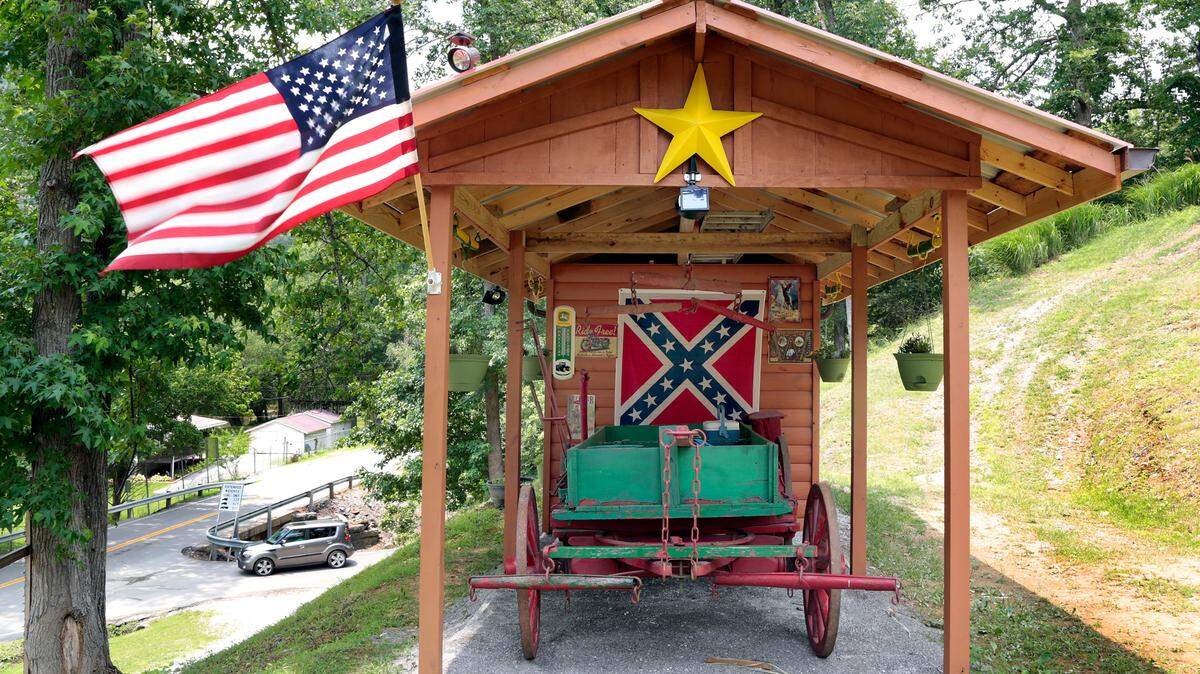
On a small shed at the side of a winding Eastern Kentucky road, Veronica Collins proudly has tacked up the Confederate battle flag. For her, she says, the flag has nothing to do with skin color and everything to do with heritage.
Collins and her husband, Jerry, bought the flag in October at the nearby Civil War re-enactment of the Battle of Leatherwood. Now it's displayed right below an American flag and above an old-fashioned wagon at their home in Letcher County. Collins gets questions about why she displays the flag, but she said she doesn't get any complaints about it.
Across the United States, many people are calling for the removal of Confederate symbols after nine people were shot and killed June 17 during a Bible study at Emanuel African Methodist Episcopal Church in Charleston, S.C. The alleged shooter, Dylann Roof, had several pictures of himself with Confederate flags.
In Eastern Kentucky, Collins and other residents who fly the Confederate flag say they see the flags as part of their heritage. They have no plans to take them down.
In a small Letcher County cemetery just off Ky. 7 in Jeremiah, a Confederate flag flies high above the tombstones. Many of the markers stand in memory of Kentucky Confederate soldiers, including Pvt. David Back, who died in the Civil War and is buried in Camp Douglas, Ill.
To Homer Smith, who maintains the cemetery, the Confederate soldiers are veterans, too, and the flag honors them.
"As far as I'm concerned, I don't see it hurting anybody," Smith said.
Taking down the Confederate flag isn't going to change what is in people's hearts, said Phillip Newsome of Perry County.
"Our nation needs to grow up a little. We need to quit worrying about the past and focus on the future," New some said. "We need to start accepting people for who they are."
Newsome doesn't fly a Confederate flag, but he views it as a part of history. There is discrimination in America, but the Confederate flag is not part of it, he said.
After the Civil War, the Confederate flag symbolized a "lost cause" for many Kentuckians, said James Klotter, a state historian who teaches at Georgetown College. "It was kind of romantic," he said. "A vision of the South."
History is never a static thing, though, and the flag is beginning to symbolize something else, Klotter said.
In the 1950s and '60s, the meaning of the Confederate flag started to change from its more historical "Southern" context to become a symbol of the resistance to civil rights, Klotter said.
This issue had been building for a while, but it has burst into the public's eye pretty suddenly, Klotter said.
Jerry Collins said he does not mean to hurt anyone's feelings by displaying the flag. He said he hates what happened in South Carolina, but "that flag didn't kill no people."
He also noted the ongoing debate in Kentucky about whether a statue of Jefferson Davis should be removed from the Capitol Rotunda.
"What's going to be next after Confederate flags, and they move Davis?" he said.
Collins asked: George Washington owned slaves; is he going to get carved off Mount Rushmore?
"I like history, and I don't think they should do away with it," Collins said.
Jack Gibson of Letcher County has flown his Confederate flag for more than 25 years. When asked to summarize in one word what the Confederate flag meant, Gibson said "history."
"When you were 17 or 18, you felt like you were a rebel"; that was the principle idea of flying the flag, Gibson said.
People tend to use the Confederate flag when they want to invoke a sense of rebelliousness, said Anne Marshall, author of Creating a Confederate Kentucky.
The flag was never officially a representation of Kentucky. While at first Kentucky was neutral, the state began favoring the Union pretty early into the war, Marshall said. There was a Confederate breakaway in Kentucky, and a star was added to the Confederate flag for Kentucky. However, the government was unorganized, and there never really was a functioning Confederate Kentucky, Marshall said. Nevertheless, the Confederate flag was pretty easy to find after the Civil War, Marshall said.
Last week, a CNN poll showed similar sentiments nationally as those expressed by Eastern Kentuckians who fly the flag — 57 percent of Americans see the Confederate flag as more of a "Southern pride" symbol than as a racist one, the poll found.
Yet, for others, the flag is a reminder of slavery and discrimination. In the CNN poll, 72 percent of blacks saw the flag as racist.
"People try to argue it doesn't have anything to do with race," Marshall said. "Most historians will tell you that's not true."
Jarvis Williams, a Knott County native who is black, said he didn't immediately think of the heritage aspect of the Confederate flag when he was growing up. Rather, he thought of the flag as a symbol of black suppression.
"I saw the Confederate flag, and my initial reaction was one of trepidation," said Williams, who is now a professor at Southern Baptist Theological Seminary in Louisville.
"While we should not try to erase our history," Williams said, "this particular flag represents a movement to stamp out blackness." It should not be celebrated as if it is any other American symbol, he said.
Both sides of the flag debate have arguments that should be heard, but people interpret the world through a particular ethnic lens, Williams said. For many blacks, the Confederate flag invokes fear.
Pulling down the Confederate flag doesn't end racial bias, Williams said. "But it sends a message that this is a country that celebrates freedom and liberty for all races."
This story was originally published July 5, 2015 at 5:08 PM with the headline "Kentuckians who fly Confederate flags have no plans to take them down."