
How did masks morph from personal protection into divisive political symbols?
On a Saturday afternoon a few decades ago, my family was sitting in a packed cinema in the sub-basement of a Tokyo skyscraper. The movie was about an American family, sick of urban stress, moving to a wilderness cabin deep in the forest. The movie father warned his children to be careful, “Our nearest neighbor is 25 miles away.”
The Japanese subtitle unrolled down the screen, noting the nearest neighbor was 40 kilometers away. The audience reaction was immediate: uproarious laughter.
Japan is an island nation roughly the size of Montana but with 126 times as many people packed in. Maybe 40 centimeters apart, but 40 kilometers between houses is simply beyond belief. Crowded conditions foment such reactions and behaviors, like wearing surgical masks at the slightest sniffle or cough. It’s no big deal and has never been a subject of debate, just a longtime common courtesy to minimize the spread of infections and show consideration for others.
You may have noticed that’s not the case in America these days. Instead of being simple sanitary devices that help minimize the spread of COVID-19, ordinary cloth masks or the absence of such facial coverings have become divisive political symbols and statements of obedience to or defiance of official recommendations in a hyper-partisan election environment.
How in the world did such silliness happen?
In one sense, it’s historically understandable that a nation forged in a bloody rebellion against a distant king and a brutal civil war 80 years later maintains strong suspicions of authority, especially one emanating from Washington’s insulated imperial bureaucracy. Those suspicions reside deep in the hearts and minds of President Donald Trump’s political base, which — no surprise — resides deep in the president’s mind when he opts against a mask nearly all of the time.
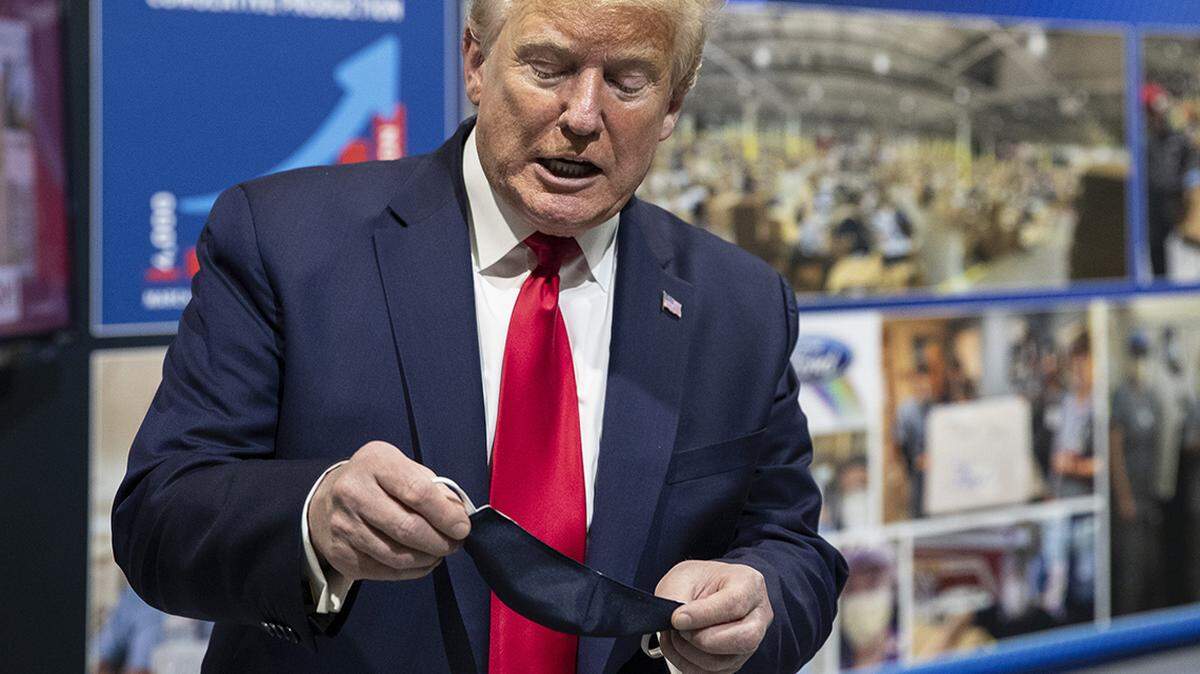
To be fair, the president recently said. “I’m all for masks. … I would wear (one) if I was in a group of people, and I was close.” Which, in fact, he did during part of an automotive plant tour. But all of the president’s other public outings have been bare-faced.
Joe Biden, the presumptive Democratic nominee, wears a mask during infrequent forays up from his Delaware basement, often pulling it down on his chin like a drool towel. Biden declared as president he would mandate everyone wear a mask. Who exactly would enforce such silliness — defunded police departments? And what would not be enforced while armed officers busied themselves citing the lack of facial coverings?
Gallup found more Americans claiming they routinely wear a mask. But during Trump’s recent Tulsa rally, superior Biden supporters had a grand time on Facebook and Twitter scouring crowd photos for the few in masks and wishing the others ill health for their stupidity. And now we’re back to that infamously condescending “basket of deplorables.” How’d that work out for Hillary Clinton?
In March, at the pandemic’s serious start, masks weren’t a great concern since in theory most of us non-essentials were cloistered at home. But as the virus scourge wore on and everyone didn’t die, the urgent warnings of Washington officials began to sound hollow and overblown. Especially since you weren’t sick and probably knew no one who was.
Additionally, some governors and mayors, mostly Democrats, got rather high-handed about their orders. New York City’s Mayor Bill DeBlasio took special umbrage at Orthodox Jews holding funerals and study groups and had police cite them. Americans in recent years have been attending religious services less frequently. But being told officially that was now prohibited incited growing fears and complaints about free speech and religion.
Then came a Black man’s death at the hands of Minneapolis police. The ensuing widespread riots and lootings featured large crowds wearing masks, not against the virus, but against tear gas and identification. Social distancing was nonexistent.
Also nonexistent in most places were firm responses to the violence from municipal officials, mostly Democrats. The hypocrisy was blatant and overwhelming. So, crowds rioting or marching were OK health-wise, but worshipping in churches wasn’t?
As with many rules written by governments, inconsistencies are consistent. For instance, one recent day Virginia had 29 COVID-19 deaths, 28 of them in nursing homes. But under his latest strictures, Gov. Ralph Northam forbids sitting at bars but permits 100% restaurant capacity. Beaches are open, but no Frisbee-throwing. Churches may hold services, but only families can sit close. Water parks also are open, but not waterslides.
As eagerness to reopen the economy grew among idled workers and governors, mostly Republican, rules were relaxed. Mask enforcement was lax. Virus cases surged, though not deaths. So, some lockdowns were reimposed.
All these varying state conditions — new problems here but not over there — produced a myriad of mixed messages infecting national media, not really known for nuanced coverage of anything local, especially if Trump might be tagged with some responsibility. Flattening the curve was no longer the goal. Now, preventing deaths was, which doesn’t happen in other flu seasons.
And as Americans seem to do these days with political temperatures rising, Trump opponents saw his orange hands everywhere — and why doesn’t he wear a mask? Likewise, many Trump supporters grew cynical about the disappearing doomsday and followed suit, relishing the chance to troll the mask faithful by going maskless.
Of course, both sides are juvenile. And it’s all combined to make common courtesy in this country now rather uncommon.
This story was originally published July 7, 2020 at 6:00 AM with the headline "How did masks morph from personal protection into divisive political symbols?."