
Trump allies dehumanize enemies with religious rhetoric. That inspires violence | Opinion
The public is increasingly concerned about political violence in the United States. Questions have been raised about the impact of dehumanizing rhetoric used by some politicians and their supporters.
There is a relationship between dehumanizing others and the greater likelihood of violence against them. Research on war propaganda, or the strategic use of language to legitimize violence against the “enemy,” involves a repetition of interrelated themes that:
- Dehumanize/demonize/animalize the “enemy,” while characterizing one’s own group as representing “good” and “truth.”
- Presume that “enemies” are evil beyond redemption.
- Assert that “good” people have an obligation to stop them or the world as we know it will be destroyed.
War propaganda is dangerous and has no place in the politics of a democratic republic. Such dehumanizing rhetoric is distinct from expressing opposing views, criticism or even anger toward opponents.
The use of politicized war rhetoric has been increasing in the U.S., and this tendency is not occurring on “both sides” of the political spectrum. Aside from Donald Trump’s recent use of the word “vermin” to dehumanize opponents, of equal importance is the proliferation of harshly degrading rhetoric coming from religious leaders targeting anyone who opposes Trump. This tendency results from the intermeshing over the last four decades of the Republican Party with fundamentalist Christian churches — many of which view the world through a lens of good or evil, and claim that their interpretation of the Bible is the absolute truth. This fusion emerged from political mobilization through churches to support Ronald Reagan in the 1980s, and has grown since then.
Fundamentalists within many religions believe their interpretations are the absolute truth, and that those who oppose their claims to speak for God are characterized as evil and must be converted or destroyed. Such religious beliefs are used to maintain authoritarian political control today in theocracies such as Iran and Afghanistan, and supported the legitimacy of past monarchies in France and Great Britain through the “divine right of kings” — which is one reason America’s Founding Fathers were adamant about the separation of church and state.
‘Spiritual weapons’ at Missouri tour stop
The religious characterization of opponents as “demonic” and “satanic” is not new — but the degree to which this rhetoric is currently used to characterize political opponents is.
Consider the Rev. Joel Tenney, who opened for Trump at a December rally in Iowa by claiming that those who oppose the ex-president are involved with “demonic forces” and more. Or Trump adviser Michael Flynn, now conducting a Reawaken America Tour with Roger Stone and Donald Trump Jr. to mobilize churches to “join the army of God,” which promotes “political war” through characterizing opponents as evil, and whose goal is to put fundamentalist evangelical doctrine “at the center of American life and institutions.”
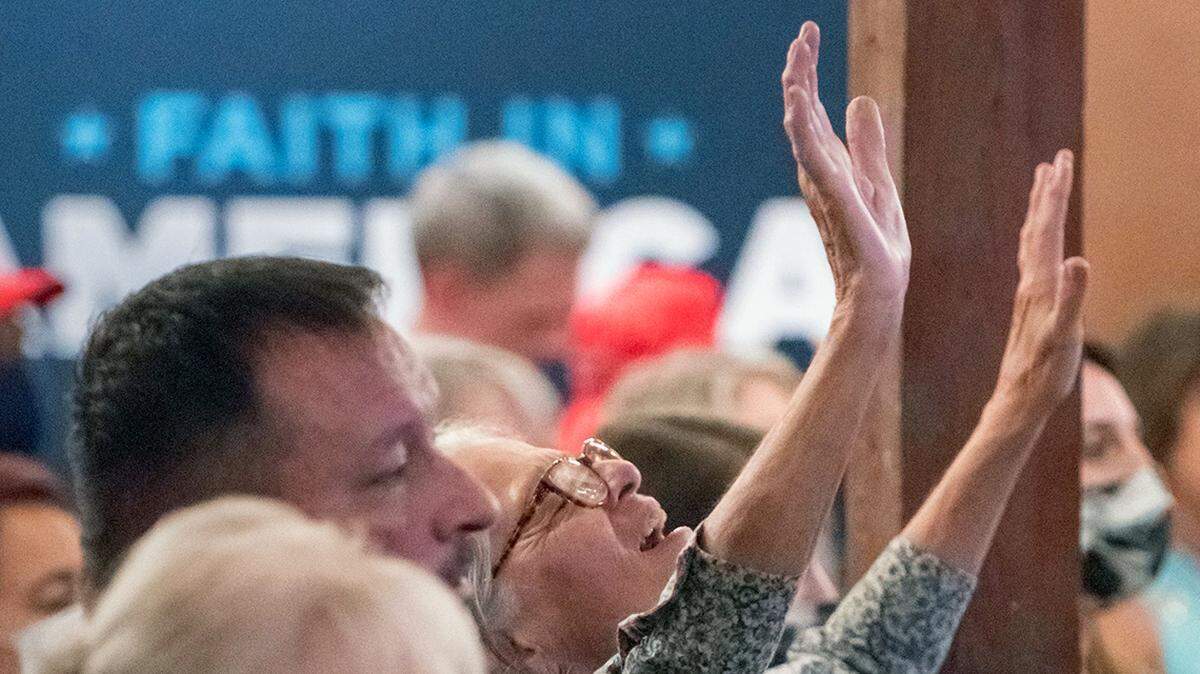
The Reawaken America Tour brought its message to Branson, Missouri, where flag-waving fundamentalists characterized support for Trump as a war between good and evil. Tour co-organizer Clay Clark stated, “We are ready to go to war with the enemy, to bring this country back,” as he called for the blowing of a shofar — “horns seen as spiritual weapons that herald the unleashing of God’s power,” in the words of The Guardian newspaper.
It is true that morality informs political beliefs, but sectarian religious dogma must never be used in place of reason, evidence and debate — or a democratic republic no longer exists.
Most Americans are understandably cautious about criticizing religious beliefs. However, respecting one another’s religion does not mean allowing politicized religious leaders and candidates to engage in dehumanizing war rhetoric toward opponents, which increases the likelihood of violence towards them.
It is within American traditions and obligations to hold those exploiting religion for political gain accountable. Thomas Jefferson argued that God gave mankind reason “as the umpire of truth,” and expected citizens to evaluate religious leaders to identify those who were credible from charlatans or those who were simply mad.
Thomas Paine wrote in “The Age of Reason” that “All national institutions of churches … appear to me no other than human inventions, set up to terrify and enslave mankind, and monopolize power and profit.”
It is the obligation of those who believe in our democratic republic to call out those seeking to gain political power through using dehumanizing rhetoric, whether they call themselves religious or not.
This story was originally published January 14, 2024 at 7:35 AM with the headline "Trump allies dehumanize enemies with religious rhetoric. That inspires violence | Opinion."