
Letters: Capilouto column omits archaeology. Check facts on climate. Slide rules and coal?
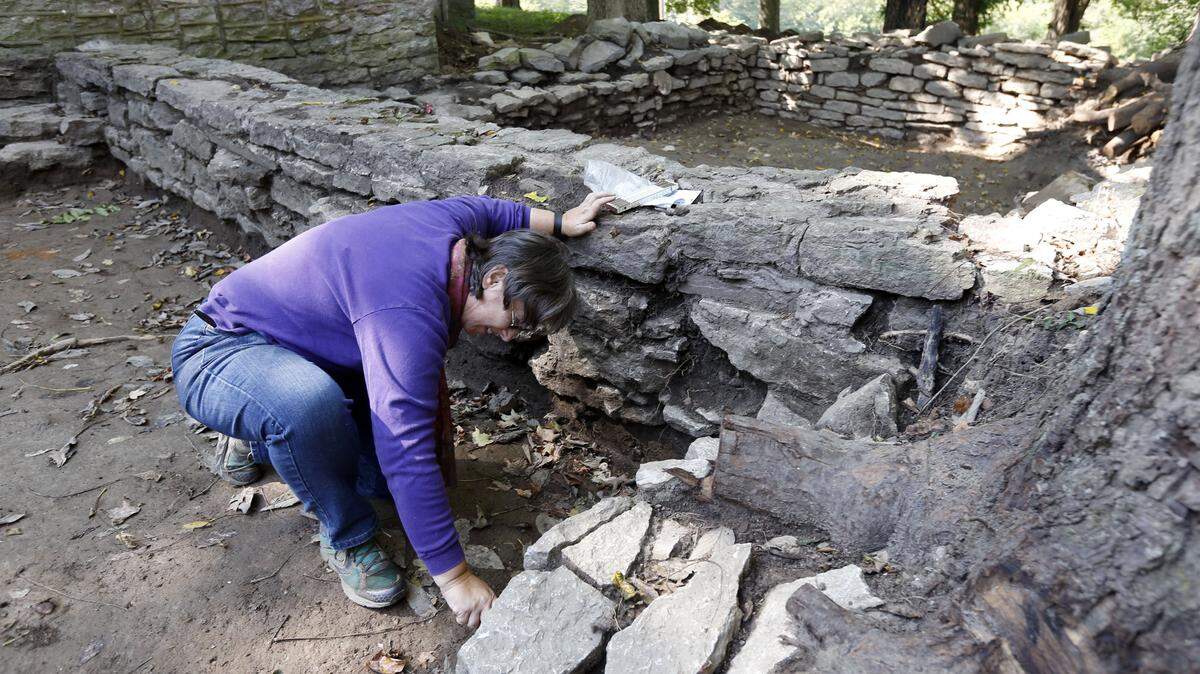
Closed ‘doors to discovery’
“(O)pening doors to discovery” read the headline of University of Kentucky President Eli Capilouto’s recent column.
He poses two questions: What can we learn? How can we use this knowledge to better society?
Not included in his discussion is the work of UK’s Kentucky Archaeological Survey, and understandably so. Of what possible use could be the history of Lexington neighborhood Davis Bottom? Who cares what life was like for the newly emancipated of the 1860s or recent migrants from Appalachia or Europe? Likewise, who cares about a bunch of rich people from Ashland, the Henry Clay house? And certainly not their servants, both the ones who were enslaved and their successors. What does any of this have to do with the present or the future?
These are just a few examples of the contents of the dustbin of Kentucky history documented by KAS that wisely will no longer be included in Capilouto’s “doors to discovery”. The Kentucky Archaeological Survey and the Program for Archaeological Research are being eliminated.
I hope this move is not an April Fools’ joke. There’s no fool like an April fool and this history and archaeology is pure foolishness. Don’t you agree?
Erin O’Donnell, Lexington
Check the facts
In a March 31 letter, the writer copied a 1922 Washington Post story about Arctic climate warming. Realclimate.org , a website written by climate scientists in response to the anti-science activities of deniers, has a copy of the original article.
The quote, “Within a few years it is predicted that due to the ice melt the sea will rise and make most coastal cities uninhabitable” is found nowhere in the 1922 article. Someone has added this fake quote to ridicule climate science findings. I suspect the letter writer did not look at the 1922 article, but cut and pasted an email or article that he agreed with without research.
The full article refers to a single warm season in Spitsbergen. Short periods, of warm or cold weather, do not refute the claim that world temperatures are increasing rapidly. Arctic sea ice coverage both in thickness and extent has dramatically reduced since records were first made in the 19th century. In spite of the 1922 warm spell, sea ice was much more extensive then. According to sea ice maps for 1922, circumnavigation of Spitsbergen would have been treacherous. The summer temperatures in the region today allow for regular circumnavigation by tourists.
Daniel Phelps, Lexington
Climate letter incomplete
A recent letter writer cites a U.S. Commerce Department report of dramatic warming of the Arctic Ocean with reductions in ice, glaciers and marine life. The report predicts that “within a few years…the sea will rise and make most coastal cities uninhabitable.” The writer closes with “I am sorry; I failed to mention this report was from November 1922, as reported in the Washington Post....Perhaps all this was caused by Model-T Ford emissions.”
Perhaps the writer should also have apologized for not telling the whole story. Research indicates the conditions reported in 1922 were due to local weather conditions around Spitsbergen in the eastern Arctic, and weren’t representative of the Arctic as a whole. People who deny climate change frequently cite aberrant data from one time or place to suggest today’s climate changes are part of normal fluctuations.
The vast majority of scientific climate data show clear evidence of an overall warming pattern. We are beginning to experience the impact of this warming in multiple ways, including massive storms, floods and accelerated extinction of species critical to our ecosystems. We can argue about other issues that divide us, but if we don’t come together to save our planet, nothing else will really matter.
Bev Salehi, Lexington
Climate-change letter inaccurate
A recent letter writer was only partly accurate in quoting old news about a 1922 Washington Post article on “Arctic Ocean getting Warm”, and misappropriately implied it was about climate change. If the writer had dug deeper, he would have found the 1922 article was a condensed Associated Press article about an Oct 22, 1922 American consul’s report on weather conditions found by a Norwegian expedition sent to Norway’s Spitsbergen Island and the eastern Arctic. So, the report was about weather affecting a specific area of the world, not the entire world; and definitely not about long-term climate.
David Mikkelson’s review in Snopes.com, published July 1, 2013, said it best:
“As interesting as this nearly century-old article might be from a modern perspective, however, it isn’t substantive evidence either for or against the concept of anthropogenic global warming. As documented elsewhere, the warming phenomena observed in 1922 proved to be indicative only of a local event in Spitsbergen, not a trend applicable to the Arctic as a whole.”
Realclimate.org review of the same story said, “The open-water easily extends to past 84ºN – many hundreds of kilometers further north than the ‘unprecedented’ situation in 1922.” That strongly suggests climate warming.
Joe Crouch, Lexington
Apples to oranges
The comparison that Roger Guffey attempts to make in his recent op-ed is grossly flawed. He attempts to compare the demise of articles (slide rules, typewriters, et al.) with the coal industry. The articles or inventions he cites were supplanted as a result of improved inventions -- calculators supplanting slide rules, word processors/printers replacing typewriters, etc. In each case the new device competed against the old in a true competitive market.
Today, the solar and wind generating machines are heavily subsidized by our governmental entities to the extent that $0.20 per kilowatt-hour costs gets subsidized to under $0.10 per kilowatt-hour. In a few cases the electric distribution companies are being offered mid-day prices of zero. How can anything compete with that? It has been reported by the Wall Street Journal (June 18, 2018) that the industry gets $4.8 billion in tax credits that it sells, allowing them to force the electricity costs below any reasonable number.
How can our true low-cost fuels, coal and nuclear, compete? When the coal and nuclear plants go away, along with the solar and wind subsidies/tax credits, the true cost will become apparent and our electric bills will double or triple.
Don Dziubakowski, Georgetown
Slide-rule and Studebakers?
Roger Guffey went on another rant in his recent op-ed, comparing coal to slide rules, Studebakers and logarithms. He even belittles horses! Yes, horses. Gasp!
First, Guffey chides the Kentucky coal miner for “slavishly” voting for Rep. Andy Barr and Sen. Mitch McConnell. Perhaps he is right and those miners should abandon those who are at least trying to do something to help them and throw in with those who are sworn to wiping out their way of life. That would be smart.
Continuing, he allows that “the people who put the men on the moon did so using slide rules to calculate predictive scientific data.” While I wasn’t part of the moon landing, I was a student at the University of Kentucky at the time and used first an IBM 7040 computer and later an IBM 360 computer. I suspect the folks at NASA had a good bit more than a slide rule.
You seldom see a Studebaker on the road or an IBM Selective typewriter these days, but a majority of Kentucky’s electricity is, today, generated using coal. I’ll wager Guffey had a Pickett slide rule attached to his belt during college. Real scholars used a Post Versalog.
Dave Rosenbaum, Lexington