
Anderson County should honor its Union heroes instead of arguing over Confederate past
Recently, a petition has been circulating around Lawrenceburg calling for the relocation of a Confederate statue sitting on the Anderson courthouse lawn. This petition was created after a BLM march coincided with armed men and women in camouflage surrounding the statue. Since that time, the statue has been a symbol of racial division in the small town.
To understand the basis of the racial tension surrounding the topic of the Civil War, we can first look at the famous Cornerstone Speech presented by the Confederate Vice President, Alexander H. Stephen on March 21, 1861, prior to the start of the war. Stephen was clear that the secession was a direct result of disagreements regarding the enslavement of African Americans. He announced that science proved that not all men were created equal, and that whites were the supreme race. He also said that enslavement was justified by the Bible.
Fortuitously, Kentucky fought for the Union. The Kentucky state government did not sanction the actions of those who sided with the South. Kentucky’s contribution of manpower to the Civil War was overwhelmingly Union. The Commonwealth provided 90,000 Union troops to the union, as opposed to the 30-35,000 who fought for the Confederacy, a ratio of nearly 3 to 1.
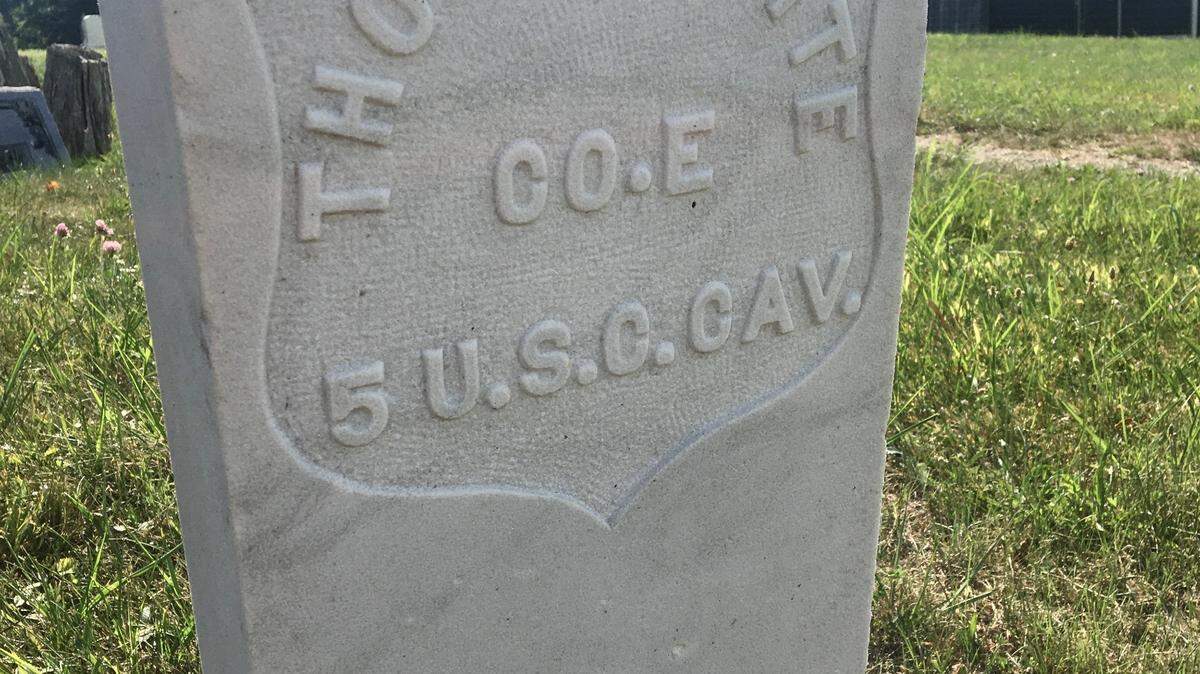
We don’t hear about our Union soldiers. A listing of those brave men doesn’t exist. While trying to rectify that, I located biographies of 34 black members of the 5th United States Colored Calvary who were from Anderson County. President Lincoln’s Emancipation Proclamation only freed slaves in states that were openly hostile toward the Union. Since Kentucky refrained from secession, the slaves within Kentucky remained slaves. Late in the war, the federal government called for enlistment of colored regiments and granted release to those who agreed to serve the Union. In great numbers, Black men enlisted to fight for their freedom. As a result, many former slaves from Anderson County joined the Union.
Two such men were George and Thomas White. Following the Simpsonville Massacre, George was listed as missing in action and presumed to be buried in a mass grave trench. He was finally honored with a headstone in 2009. George’s brother, Thomas, also served the Union. He survived the war and returned to Anderson County. He is buried at Woodlawn Hills Cemetery.
These soldiers had to fight for their individual freedom by fighting for the freedom of all slaves. They deserve a monument in Lawrenceburg above anyone who fought for the Confederacy.
So why do we have a Confederate monument when, clearly, our history is rich with heroic stories of Union soldiers who fought against slavery? Let me be clear: our heritage is not Confederate, and to understand we have to look more deeply at the history of the monument itself.
One thing we do know is that The United Daughters of the Confederacy erected the statue.
The United Daughters of the Confederacy, also referred to as UDC, is best known for promoting the “Lost Cause” by building monuments glorifying the Confederacy and gaining control of public school curricula. The Daughters spread a false history of the South; a society built on white supremacy and slavery. They were remarkably successful in their goals.
Example after example is available of how UDC unabashedly promoted White Supremacy, but let’s focus on some of the words of Mildred Lewis Rutherford. She was the historian general for the National United Daughters of the Confederacy, and her views are considered UDC gospel.
She described African Americans as “savage to the last degree, climbing coconut trees to get food, without thought of clothes to cover their bodies, sometimes cannibals, and all bowing down to fetishes – sticks and stones – as acts of worship.” She claimed that slavery elevated [the slave] above his nature and his race. In 1914, she said “I rejoice that my father was a slaveholder, and my grandfathers and great-grandfathers were slaveholders, and had a part in the greatest missionary and educational endeavors this world has ever known.” This was said 20 years after the statue was erected on this lawn, 51 years after the Emancipation Proclamation (1863), and 49 years after the end of the Civil War (1865).
Also speaking to the United Daughters of the Confederacy’s true intent was their relationship with the Ku Klux Klan. UDC dealt in and preserved Klan artifacts and symbolism. They commissioned a portrait of Randolph Shotwell , a self-confessed leader of the Ku Klux Klan which was dedicated by Capt. Walter Taylor, a Ku Klux Klan leader who took the convention podium fully robed and hooded in formal Klan regalia. UDC endorsed a book titled “The Ku Klux Klan or Invisible Empire”, which promoted the KKK and White Supremacy. In 1926, the UDC erected a monument to the KKK in Concord, North Carolina.
This is the same United Daughters of the Confederacy UDC that erected the statue sitting at the Anderson County courthouse.
Through their own words, actions, and affiliations, it’s clear that the United Daughters of the Confederacy intended to promote the Southern ideology of racism.
Former Mayor of New Orleans Mitch Landrieu said it well: “These statues are not just stone and metal. They are not just innocent remembrances of a benign history. These monuments purposefully celebrate a fictional, sanitized Confederacy, ignoring the death, ignoring the enslavement and the terror that it actually stood for.”
Removing Confederate statues will not solve racism, but it’s an indication that we are ready to deal with the truth. I encourage Anderson County Fiscal Court to relocate the statue to a more appropriate location, surrounded by a full, accurate history of the Civil War. It’s time to lead; silence isn’t acceptable.
Holly Harrison-Hawkins lives in Lawrenceburg with her husband and two children.