
Don’t be too hasty on moving monuments. Their history may be more complicated.
As controversies initiated by the police killing of George Floyd sweep through the nation, public outcry for an end to American racism and its disproportionate effects on the African-American community has also resurfaced the call for removal of Civil War monuments from the American landscape.
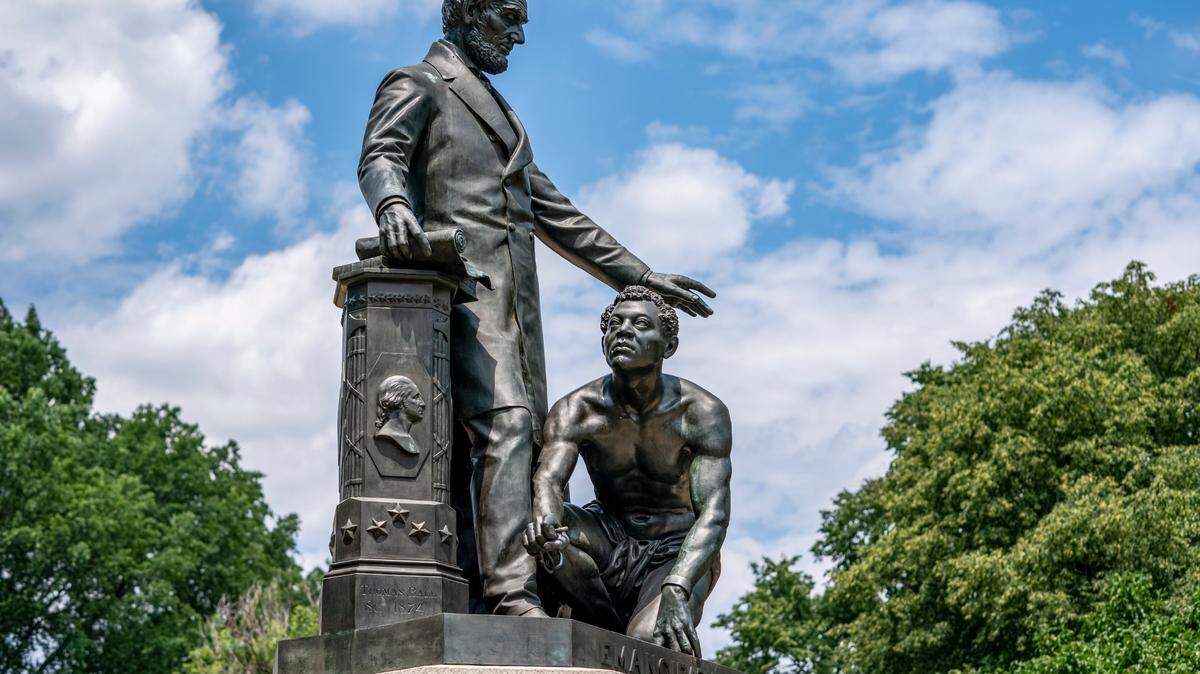
One monument political leaders and community advocates have targeted for removal is Washington, DC’s “Freedom’s Memorial.” While installation of “Freedom’s Memorial” on Capitol Hill in Lincoln Park was controversial from its beginning, today’s reasons calling for its removal have changed. Strangely enough, the crusade to remove “Freedom’s Memorial” from Lincoln Park is led primarily by African Americans and Senate Republicans, the very people and political party responsible for its installation.
Erected in Lincoln Park on April 14, 1876, in a ceremony presided over by the first Dean of Howard University Law School, John Mercer Langston, with Frederick Douglass delivering the keynote address, President Grant, cabinet members, and supreme court justices in attendance, the memorial depicts Kentucky-born President Abraham Lincoln, holding his hand above the body of a kneeling black man. The kneeling black man, willingly portrayed by escaped Kentucky slave Alexander Archer, is meant to represent the last man captured under the Fugitive Slave Law. The man has snapped the chains of slavery as Lincoln offers him the benefits of the Emancipation Proclamation. Public criticism offered through a twenty-first century lens as reason for removal of the monument center primarily upon the image of the kneeling black man, who many see as assuming a subservient position to Lincoln’s proffered, paternalistic hand. Critics argue the monument does not accurately portray the active role African Americans played in obtaining their own freedom throughout their period of American enslavement.
Okay. I get it. You don’t like the image of a black man on his knees under the hands of a white man. However, I think as African Americans, we are asking a great deal from one monument. As a historian, I must say I prefer the image of an unchained black man rising to a standing position. Even more, I am proud of the fact that less than ten years following the end of the Civil War, formerly enslaved African Americans led by the call of a black woman, escaped slave Charlotte Scott, raised all the funds necessary (a total of $16,242) to commission the work of crafting this monument. I am proud of the effort it took for newly freed, nineteenth-century African Americans to politically lobby and successfully win the right to install this monument in the highest, most visible park in the land - Capitol Hill. It took over 100 years to gain federal approval and support to establish and open the National Museum of African American History and Culture in the nation’s capitol as a worthy addition to the Smithsonian Library system.
I am proud of the fact that members of the 6th United States Colored Troops Heavy Artillery unit not killed April 12, 1862 in the Fort Pillow Massacre by Ku Klux Klan founder and Confederate General Nathan Bedford Forest, contributed the most to ensure this monument’s completion and installation in recognition of their 300 fallen comrades.
At the time of its installation, as today, this monument represented the first and only national monument to Lincoln totally paid for by African Americans. African Americans who had lived the enslaved American experience, chose this monument and this location to commemorate their sacrifices. To demonstrate their desire and knowledge of their history, African Americans chose to erect “Freedom’s Memorial” on the site of the former Lincoln Hospital, where United States Colored Troops lucky enough to receive any form of medical treatment at all, had lain injured, bleeding, and dying for the cause of black freedom. The treatment of wounded black men, cared for in this location and on many other American battlefields was rendered primarily by black women, dedicated to the care of their families and their community.
Yes, legally, physically, emotionally, we had been on our knees, praying for Emancipation, praying for an opportunity to fight, praying for an opportunity to win. Then as today, we were asking, I would dare say even praying, that the United States government recognize our humanity. Rather than joining forces dedicated to erasing our history, I think we would do better to know, celebrate and protect our history! Don’t eradicate! Educate!
Alicestyne Turley , Ph.D. is the coordinator of the International Storytelling Center in Jonesborough, TN, a Kentucky Humanities Council Scholar, a commissioner of the Kentucky African American Heritage Commission and a board member of the Kentucky African American Heritage Center.