
You think this is a contentious election? You should have been in Kentucky in 1900.
During this election, we’ve heard charges and countercharges about vote fraud, voter intimidation and suppression, and even threats of post-election violence.
In other words, the U.S. is living through an experience Kentucky had 121 years ago with a contentious gubernatorial campaign.
That 1899 race didn’t end until months after election day, and only after a large group of armed citizens camped out around the State Capitol in Frankfort, the razor thin election margin was overturned by the General Assembly, and Gov. William Goebel died from an assassin’s bullet.
The hotly contested election was between Goebel, who was Democratic leader of the State Senate, and Republican Attorney General William Taylor.
Goebel had enemies in both political parties. He was a tough, reform-minded politician from northern Kentucky – and a hard-charging adversary of the Louisville and Nashville (L&N) Railroad, one of the nation’s most powerful corporations.
Goebel’s support for corporate regulation, public education, and expanded rights for Blacks, women, and workers put him at odds with conservative, pro-Confederacy Democrats who dominated Kentucky politics from the end of the Civil War until the 1895 election of Republican Gov. William O. Bradley
In the days before the November 1899 vote, Kentuckians expected election day to bring widespread violence and fraud.
Louisville’s Democratic Mayor deployed 500 police officers around the city, ostensibly to keep the peace, while Gov. Bradley mobilized the state militia. Both sides accused the other of intimidating opposition voters by “force of arms”.
On election night, Goebel had a small lead, while votes from Republican mountain counties were slow to come in.
Days later, the final count showed Taylor edging Goebel by about 2,000 votes out of almost 400,000 cast.
As the apparent winner, Taylor was inaugurated on December 12. However, Goebel filed an election contest when the 1900 General Assembly (controlled by Democrats) convened three weeks later.
A committee of legislators was appointed to investigate Goebel’s allegations, including vote fraud in eastern Kentucky and illegal election activities by the L&N, which later acknowledged spending the equivalent of $16 million in today’s dollars to defeat Goebel.
As the contest proceedings began, almost 3,000 armed Republican “witnesses” arrived in Frankfort from eastern Kentucky.
Historian Thomas Clark later wrote “These wild drunken mountaineers were carried (by the L&N Railroad) to the Capitol . . . for the purpose of intimidating a recalcitrant General Assembly in its recount of the votes of the November election.”
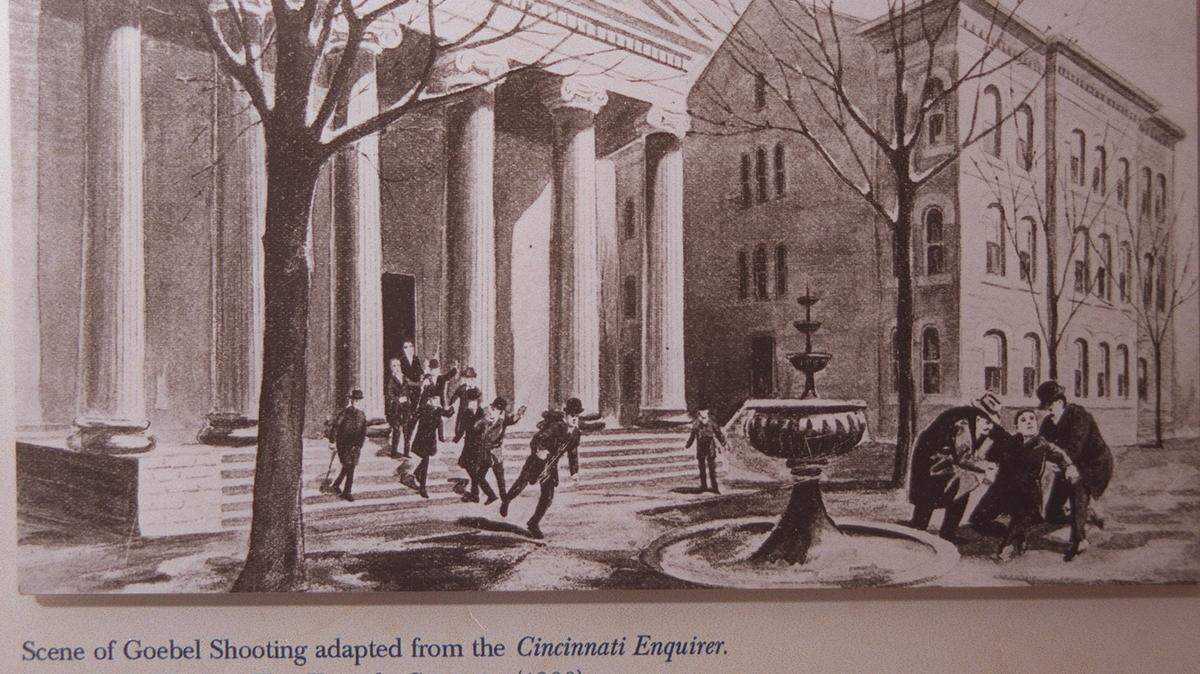
On Jan. 30, as the election contest was wrapping up, Goebel was walking to the Capitol to attend the Senate.
As he passed the fountain out front, a shot was fired from a nearby building. Goebel fell to his knees, and a colleague exclaimed “My God! Goebel, they have killed you!”
“I guess they have,” Goebel said.
However, Goebel survived for several days. Gov. Taylor declared a “state of insurrection” and attempted to adjourn the Legislature immediately.
Ignoring Taylor’s declaration, legislative Democrats tried to meet in several Frankfort locations, but were blocked by the state militia.
Finally, they secretly assembled at the Capitol Hotel, where Goebel lay mortally wounded in a room upstairs. With a quorum present, the General Assembly declared Goebel and his running mate J.C.W. Beckham the winners of the election.
When Goebel died a few days later, Beckham became Governor. However, Taylor went to court, claiming he was the duly elected Governor.
Kentucky’s highest court found that Goebel and Beckham were legally elected, and when the U.S. Supreme Court agreed, some order was restored to Kentucky’s chaotic political landscape.
Whatever happens in this year’s election, let’s hope it unfolds more peacefully than it did in Kentucky in 1900.
John Schaaf (John.Schaaf1975@gmail.com) and co-author Robert Schrage wrote Hidden History of Kentucky Political Scandals, which includes a chapter on the political rise and assassination of Gov. Goebel.