
On the 100th anniversary of the 19th amendment, honor Kentucky’s suffragists by voting
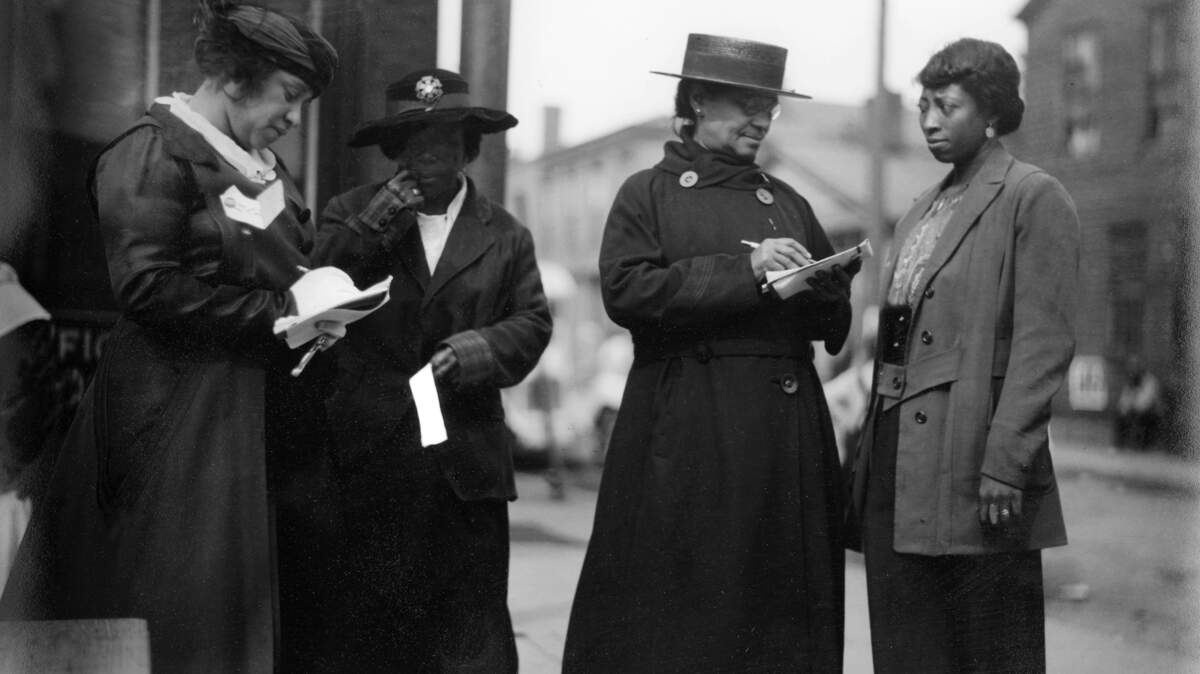
One hundred years ago, American women prepared to vote in their first presidential election with a mixture of enthusiasm and apprehension. For suffragists relishing the sweet taste of victory, Nov. 2 marked the culmination of decades of struggle. Many women had been ambivalent or even opposed to “Votes for Women,” but they too recognized the responsibility they now shouldered. When Kentucky ratified the 19th Amendment in January 1920, lawmakers went a step further, ensuring that women could vote that November, regardless of whether the Amendment was finalized. Kentucky women had nearly ten months to prepare for this moment, and they had not wasted a minute.
The Kentucky Equal Rights Association, now renamed the Kentucky League of Women Voters, led efforts to equip women. The KLWV organized door-to-door registration drives and helped plan “Citizenship Schools” across the state. In Owensboro, for example, women completed a fifteen-week curriculum that required them to read and digest the Constitution, debate current issues, and review the basics of American government and history.
Practical steps had to be taken to accommodate the new voters. Precinct boundaries were redrawn, and communities appointed female election officials.
Observers speculated as to what the November election would bring. Many skeptics argued that women would stay home, or, if they did show up, they would vote like their husbands did, adding votes to the tally but leaving the outcome unchanged. Others predicted that voting women, with their natural concern for the poor and the weak, would band together to demand comprehensive reform.
Male politicians were particularly uneasy now that the rules of the political game had changed. Both parties hoped to secure the allegiance of women voters, who numbered some fourteen million nationally and more than half a million in Kentucky.
More than anything, many Kentuckians feared that voting women would disturb the racial order. Kentucky was a two-party state, unlike the Deep South, which lined up solidly behind the Democratic Party. In Kentucky, Black women could make a real difference. Democrats scurried to register every possible white female voter to offset Black women’s votes, which were sure to go to Republicans. Democrats warned in stark terms what was at stake. One Democratic congressional candidate urged white women to vote for ”national prosperity, for peace on earth and good will to men, and FOR WHITE SUPREMACY.”
Despite efforts to intimidate and embarrass them, Black women made their intentions clear, registering in numbers approaching 100 percent in some communities, The Lexington Herald reported.
On election day 1920, Kentucky women—black and white—turned out to make history. According to the Owensboro Messenger, many women followed the advice of party workers and voted before they even washed the breakfast dishes. “Aunt Judy” Perkins, a Black woman almost ninety years old, lined up at dawn and thus had the honor of casting the first vote in McCracken County. Suffrage leader Madeline McDowell Breckinridge proudly marked her ballot for Democrats Cox and Roosevelt, not knowing that it would be both her first and her last time to vote in a presidential contest. Breckinridge suffered a stroke two weeks later and died at the age of forty-eight.
Using sophisticated statistical methods, political scientists Corder and Wolbrecht estimate that 57 percent of the Kentucky women voted in 1920. While that number was substantially lower than male turnout (an impressive 85 percent), Kentucky had one of the highest participation rates in the nation, far surpassing states like Virginia, where an estimated 6 percent of women voted.
Kentucky has a proud voting heritage, though recent elections when fewer than one in three eligible Kentucky voters cast a ballot, might suggest otherwise. We must do better. We owe it to suffragists who fought so hard to gain voting rights for women, and we owe it to Black Kentuckians who stood up to intimidation and violence. New voters carefully prepared to do their duty in 1920. Let’s follow their example and fulfill our responsibilities as citizens, this year and every year.
Melanie Beals Goan teaches history at the University of Kentucky. The University Press of Kentucky recently published her new book, “A Simple Justice: Kentucky Women Fight for the Vote.”