
In 1954, Fayette County students helped create the polio vaccine that saved millions
The last several weeks have witnessed many milestones in Mr. Covid’s Pandemic. On the dark side—over half a million deaths in the United States alone. On the hopeful side—the exemplary leadership by our governor and by our local officials from the outset of the crisis, three vaccines in record time, and efficient vaccine deployment passing 100,000 vaccinations in Lexington in only three months. Some have looked to the Spanish flu pandemic of 1918-19 for historical comparisons and guidance. Since vaccines were not developed to halt the Spanish flu, this does not give us a full appreciation of the current scientific achievements or more importantly of the community partnerships needed for vaccine testing.
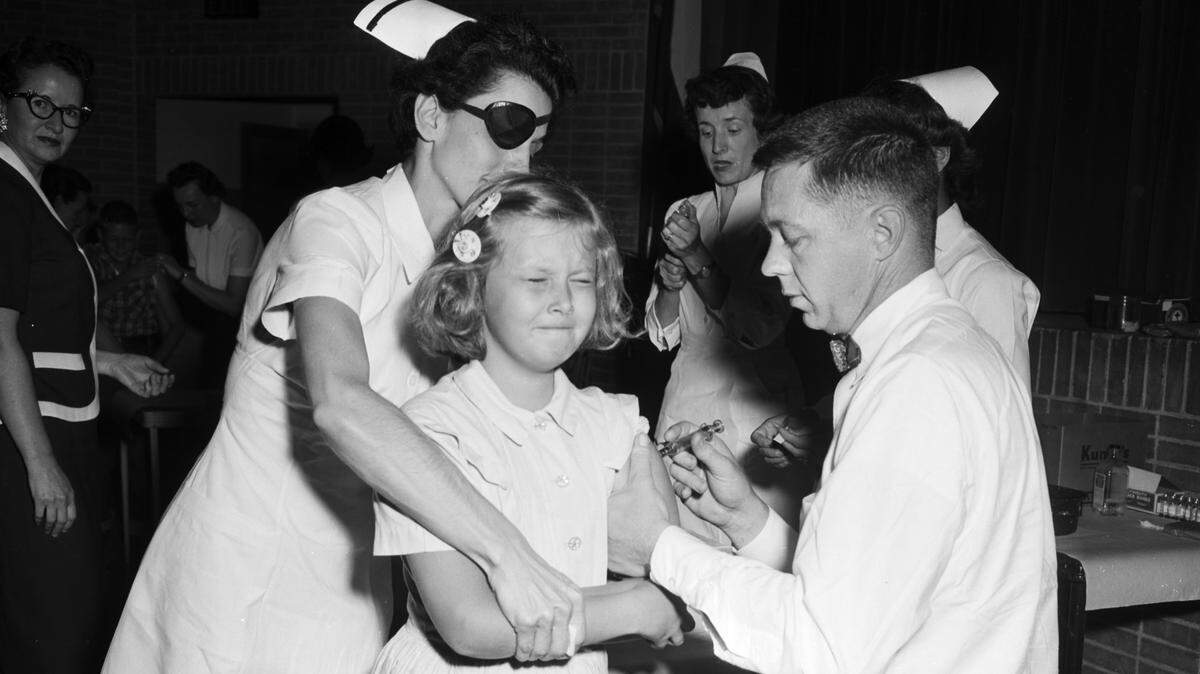
While preparing a lecture on polio for our residence physicians in neurology, I discovered that the first, second, and third grade students of Fayette County were actually research participants in the largest vaccine trial of the Salk polio vaccine in 1954. Each child got a little card proclaiming them “Polio Pioneers” and in truth, each of them helped conquer this dread disease.
I was an elementary grade student living in Chicago in 1954. According to the CDC, there were approximately 120,000 cases of paralytic polio between 1950 and 1953 in the United States. Polio came during the summer season and so came the parental restrictions on us little kids. Parents were terrified that their own child might end up with a permanently paralyzed leg or an arm. Worse yet, their child might end up in an iron lung, the equivalent of being on the ventilator permanently. I recall that we were not allowed to eat ice cream or swim. I’m sure that each family had their own version of these neighborhood safeguards.
Recall that President Roosevelt had been in a wheelchair because of polio. He helped found the March of Dimes to raise money to support the National Foundation for Infantile Paralysis. Their mission was to fund the development of a vaccine to prevent polio. Vaccine development was not under the government purview at this time. The culmination of this effort was a formalin inactivated vaccine developed by Dr. Jonas Salk at the University of Pittsburgh which was advanced to formal clinical trial with the same extreme urgency felt today during the COVID-19 pandemic. The circumstances were very different, however, and that is how our Fayette County Schools fit in.
Although the vaccine was developed by Dr. Salk, testing the vaccine was conceived and directed by Dr. Thomas Francis Jr. an epidemiologist at the School of Public Health at University of Michigan. This much was known. Polio was very infectious, spread by the fecal/oral route, and most definitively counted by the paralysis it caused during the summer peaks from June to September. Also in 1954, medical science could not check for the polio virus or for immunity to the virus with a simple and quick laboratory test like we can today for Covid.
So it was easy to outline what needed to be done: Vaccinate a bunch of kids before the anticipated 1954 summer polio peak and then count how many children got paralyzed by the polio virus afterward. But how to do this quickly before summer? And how many children? Much has been written in absolute awe of Dr. Francis’ leadership and organization of this national effort. Consider that on April 26, 1954 the vaccinations started, with eventually 441,058 children receiving their first vaccine injections and 209,806 receiving placebo injections. These same children were then injected again one week and five weeks later for a total of three injections. Amazing! And these were only first, second and third grade students in their elementary schools. More than a million other children were observed but not vaccinated to get baseline rates of polio in other communities. This massive effort required hundreds of thousands of teachers, doctors, nurses, and volunteers.
But what of Lexington? According to Dr. Francis’ report, Fayette County had 5,785 eligible students of whom 3,574 participated. Elementary schools at the time were: Arlington, Ashland, Carver, Cassidy, Constitution, Jefferson Davis, Douglas, Harrison, Johnson, Kenwick, Abraham Lincoln, Maxwell Street, Picadome, Russell, Booker T. Washington, and Yates (list courtesy of Lexington Public Library). Dr. S. B. Marks was the local health official involved and Mrs. Irene Coons and Mrs. Irene Schaper were the physical therapists who participated in the outcome assessment of cases in Kentucky (Jefferson County was also a field trial site). To appreciate the enormity of this effort, watch the historic video announcing the results of the polio field trial (https://www.youtube.com/watch?v=nkr269ube9k). This was not a one-minute quick news bite but a thorough scientific review by the Surgeon General of the United States.
Our local Lexington Polio Pioneers helped get us to where we are today whenever we take our own children to the pediatrician’s office for their vaccinations. We should remember them and thank them, especially in this time of Covid. Polio and Covid are vastly different viruses but some things about pandemics and vaccine development remain the same—truth, rigorous science, and community engagement to move us safely forward.
Edward Kasarskis is a professor of neurology at UK who specializes in ALS (Amyotrophic Lateral Sclerosis).