
‘Terrible hurt in so many families.’ Alzheimer’s eludes the search for a cure.
This summer, my mother, Sue Neikirk, attended my daughter Allison’s wedding to Taylor Taluskie. At the start of the day, awaking in a hotel rather than at home, she asked my sister, Marsha Seamans, “Where am I and why?” Marsha, with the comfort and patience her voice always carries, explained they were there for the wedding.
“Who is getting married?” my mother asked.
“You are,” my sister teased.
“Who am I going to marry?”
“Joe Schmo.”
“No I’m not,” my mother answered, emphatic and smiling.
That evening, she was resplendent in a blue, sequined jacket. She was witty, warm and very much in the moment. Because she tired easily, she needed to sit, not mingle. No matter, people stopped by say hello and hug. She recognized some people, asked us about others, “Who was that?”
The next day, she remembered none of this.
My mother has Alzheimer’s disease. It is not getting better. It is not going to get better. There is no cure, and what treatments exist seem like science trying but accomplishing little. With rhythmic regularity, headlines announce this or that breakthrough, fueling hope. The latest is Aduhelm, which may clear some of the cobwebs off the brain. It’s progress but incremental.
Ours is one of 6 million American families and 75,000 Kentucky families with a loved one in some stage of Alzheimer’s. None of us like talking about it, much less telling our story publicly, as I am doing now. But the not telling hides the terrible hurt in so many families. If you don’t know this story, you need to know it. The more you know it, the more likely you are to become an advocate for research to find treatments and cures. Our loved ones with Alzheimer’s need an army of advocates.
I have been impressed by the development of vaccines against COVID-19. I am dismayed that people are resisting getting their dose and dismayed, too, that the whole thing has been politicized. I had COVID, as did other members of my family. An uncle died from it, a dear friend nearly did. The idea that we have a way to stop it and won’t avail ourselves of it baffles me. I wish the Constitutional summons to “promote the general Welfare” was where the politics of this started and stopped. I also wish that the moonshot that gave us the Pfizer, Johnson and Moderna vaccines would also give us something for Alzheimer’s.
In our family, as perhaps in yours, we know a thing or two about medical breakthroughs and their power to change a fateful course. Just before her 70th birthday, my mother was diagnosed with multiple myeloma, a cancer that in 2006 was a death sentence. We took Mom to special clinic where the medical team coupled twin stem cell transplants with high dose chemo. It was risky. Experimental. But it was a chance to live. And it worked.
A few years later, when she had a recurrence, multiple myeloma treatments had advanced because researchers, able to map the human genome, had discovered new ways to target the cancer cells while damaging fewer healthy ones. Mom stayed in Lexington and took pills. No IV port. No long hours in a hospital chair hooked to a chemo drip. No devastating weakness. No weeks away from home.
Her treatments worked in the way that cancer treatments works, which is to say the best treatments knock on the cancer but damage healthy cells, too. A patient is never quite the same. I have no idea whether my mother’s Alzheimer’s has anything to do with her cancer or the treatment. She would, after treatment, forget something now and then and laugh it off, “Chemo brain.” Those small lapses became more frequent, and the information lost greater.
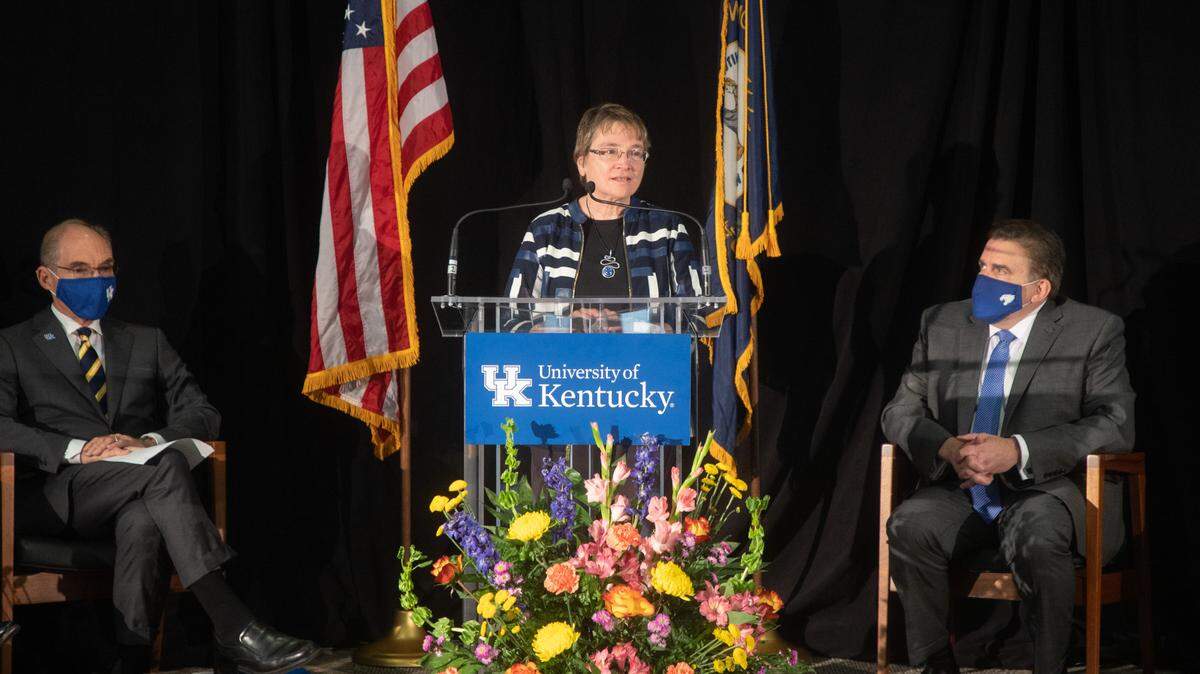
No one can tell you cause and effect with many major diseases. Many if not most cancers fall into that category as does Alzheimer’s. Researchers are looking but answers are elusive. In our state, the Alzheimer’s Disease Research Center at the University of Kentucky College of Medicine is contributing to the inquiry. This past week, the center received $14.5 million in renewed funding from the National Institute on Aging.
UK President Eli Capilouto, in announcing the grant, said this, poignantly and correctly: “I can think of few words more frightening or haunting than, ‘You have Alzheimer’s.’ Three words. A prognosis that changes life and many, many families.” He pledged that UK would make the utmost efforts to contribute to solving what he called “one of society’s greatest medical mysteries and challenges.”
COVID-19 researchers worked eight days a week to find a vaccine. The federal government, first guided by a Republican administration and then by Democratic one, supported that work. In the end, their collaboration of science and private enterprise produced effective vaccines. Would that such a collaboration might produce an Alzheimer’s treatment with such speed and effectiveness.
Such a breakthrough would be greatly appreciated in our family and, no doubt, by millions of other families, who quietly, in their homes and in their prayers, are struggling to make each moment another moment of joy for someone they love, even if each of those moments are as fleeting as a second hand’s position on the clock a second ago.
Mark Neikirk, a resident of Crescent Springs, is the executive director of the Scripps Howard Center of Civic Engagement at Northern Kentucky University.