
Fast cars and angry drivers: Let’s slow down and try to remember a more civil era.
As if we needed another measure of the anger in our culture, there is the morning commute. Or any time spent behind the wheel of our cars.
The National Highway Traffic Safety Administration released a paper last summer concluding that drivers were taking more risks during COVID-19’s first wave. With the roads less crowded, people drove faster, were less likely to wear their seatbelts, and more likely to be on drugs or drunk.
Now that the roads are filling up again, we haven’t slowed down and welcomed one another back to America’s most communal activity. Instead, we seem extra mad that all these other people are on the road, too. With nerves already frayed over mask and vaccination debates, we are ready to ram. Though official numbers lag the pandemic, an internet search suggests I’m not alone in this concern. Stories from around the country quote police suggesting a spike in aggressive driving.
In recent months I have avoided any number of collisions with someone in a damn-the-torpedoes hurry. A car nearly backed into me in the market parking lot. In defense of the driver, she was parked next to an SUV the size of the Space Shuttle and could not see around it. Still, she backed out faster rather than with greater caution. I was able to stop in time and honk. She braked, looked at me guiltlessly, pointed at the SUV and lip-synched, “Not my fault. I couldn’t see.” There might have been an expletive in there, too.
Then, at a three-way stop, I was last among the nearly simultaneous arrivals, so two cars went before me. Out of turn, a third pulled forward and shot across the intersection, turning left. Impatience was a virtue in his book of road etiquette,
On the interstates, drivers now treat passing as if it were the last laps of the NASCAR Cup Championship Series. They weave right and left, trying to edge their way forward as if they can see the finish line and hear the cheering fans. They don’t just get close enough to read your bumper sticker. They get close enough to read your VIN number.
Maybe this is a last gasp of freedom as drivers recognize the age of Autonomous Vehicles is rapidly approaching. We who grew up fancying the Corvette or Carrera rue the day when we push a button and let Siri take it from there.
More probably, our bad manners on the road are just a reflection of the current tone of public discourse in general. We have taken to screaming at one another. Social media amplifies our rage. So, apparently, does the act of driving.
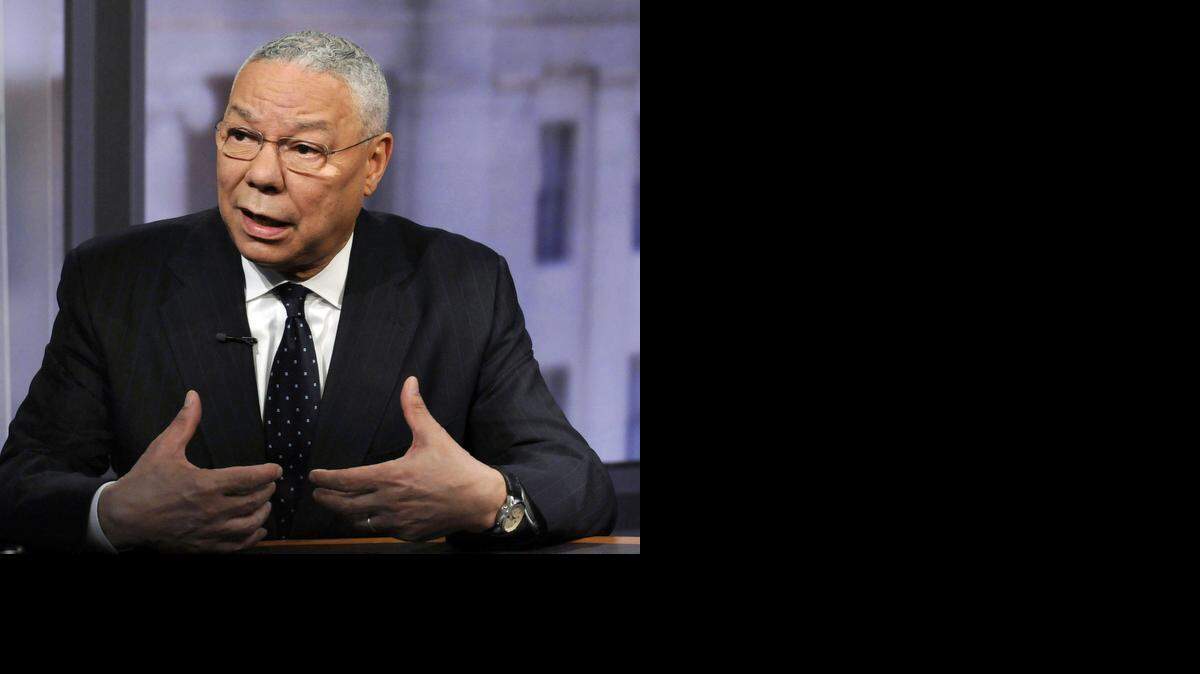
But there came a story late last month reminding us another way to behave, whether as drivers or as human beings. It came from a man whose name is synonymous with civility, Colin Powell. Shortly after his death from COVID complications, an old Facebook post of his began recirculating.
He tells of being in a hurry on the DC beltway when he had a flat. The general, a self-described “car guy,” felt plenty competent to change his own tire, but it was cold and the lug nuts were not cooperating. A younger man pulled over and offered to help. He wore a prosthetic leg to replace the one he’d lost in Afghanistan. The two men changed the tire. Here are General Powell’s words, first posted on Jan. 24, 2019:
“Then we both hurriedly headed off to appointments at Walter Reed. I hadn’t gotten his name or address but he did ask for a selfie. And then he sent me the message below last night.”
‘Gen. Powell, I hope I never forget today because I’ll never forget reading your books. You were always an inspiration, a leader and statesman. After 33 years in the military, you were the giant whose shoulders we stood upon to carry the torch to light the way and now it is tomorrow’s generation that must do the same. Anthony Maggert’
“Thanks, Anthony. You touched my soul and reminded me about what this country is all about and why it is so great. Let’s stop screaming at each other. Let’s just take care of each other. You made my day.”
Our nation’s current lack of civility, whether on high-speed vehicular highways or high-speed information highways, is a well-documented concern. Trying to change the course of things, the Public Relations Society of America built a webinar series with attention to the topic and published white paper sounding the alarm: “Civil discourse is in a state of crisis. Public dialogues today are celebrated not for what they accomplish but for whom they divide…. In short, we are living in an age of rage.”
I’ve been reading Yale constitutional scholar Akhil Reed’s new book, “The Words That Made Us: America’s Constitutional Conversation, 1760–1840.” As he ably tells it, the nation was born in outrage, but it was a righteous outrage over a genuine affront by the King and Parliament. Some 250 or so later, we have every reason to calm down. Unemployment is under 5 percent. The Dow Jones Industrial just broke 36,000. Vaccination rates are above 70 percent in some states, albeit lower in Kentucky. And our leaders are, after decades of knowing they should, on the cusp of approving universal preschool. We are not at war and we have Netflix.
So maybe General Powell’s words bear repeating: “Let’s stop screaming at each other. Let’s just take care of each other.” Meanwhile, slow down and use your turn signal. Please.
Mark Neikirk is the executive director of the Scripps Howard Center for Civic Engagement at Northern Kentucky University.
This story was originally published November 5, 2021 at 8:27 AM.