
Ky students need to understand their history. Legislators shouldn’t try to stop them.
I don’t remember the white student’s name, just what he said to me after my Kentucky history class one day: “My parents or grandparents never told me about any of this. We needed to know the truth. Thank you.”
I had lectured on the Jim Crow era in Kentucky and cited Mayfield, the Graves County seat and my hometown, as an example of communities in the South and in border states like Kentucky where racial discrimination was the law and the social order.
Conservative white Republican state representatives have introduced legislation in the General Assembly to limit the freedom of public school teachers to teach about systemic racism, of which there’s no better example than the Jim Crow era, when African Americans were kept separate and unequal from whites.
HB 14 and 18 would prohibit the teaching of anything that causes a student to “feel discomfort, guilt, anguish, or any other form of psychological distress on account of his or her race or sex.” HB 18 covers public colleges and universities, like West Kentucky Community and Technical College, where I taught for two dozen years. SB 138 would similarly curb classroom discussion of systemic racism.
In HB 14, read “white” for “race.” In other words, teachers mustn’t make white students feel bad by exposing them to unpleasant truths like slavery and Jim Crow segregation, lynch mobs, and denying people the vote based on their skin color.
Anyway, House Speaker Tip O’Neill famously observed that “all politics is local.” So is history, which is why I tried to localize it if possible.
I’m 72. I grew up in the waning years of the Jim Crow Era. My description of Mayfield in the 1950s and early 1960s seemed as foreign to my students as the Peloponnesian Wars of ancient Greece. (I also taught European and American history.) Nearly all of them were born long after Brown v. Board, the 1964 Civil Rights Act and the Voting Rights Act of 1965, all of which doomed de jure discrimination.
In my childhood, white store owners wouldn’t hire Blacks except as janitors or to run errands or deliver goods. Some business owners wouldn’t hire Blacks, period.
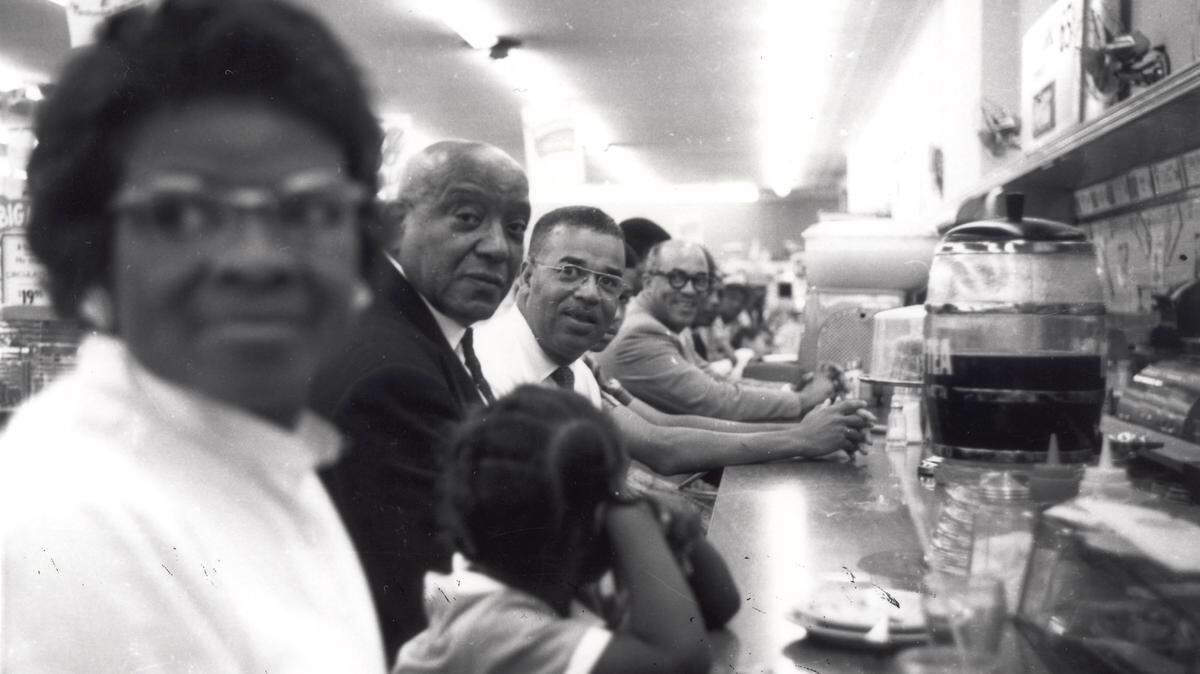
Dining areas in white-owned eateries were off-limits to African Americans. So were the soda fountain at the drugstore and the dime-store lunch counter. (African Americans could eat in restaurant kitchens, where cooks were often Black, or order take-out food.
They couldn’t stay at the town hotel or local motels. Schools, neighborhoods and cemeteries were segregated. White-only Maplewood Cemetery — with its Confederate memorial gates— symbolized who was on top in town. It was on a hill; Peaceful Valley, the Black cemetery, was down below.
“It is appalling that the most segregated hour of Christian America is 11 o’clock on Sunday morning,” Martin Luther King Jr. said in 1963, my freshman year at Mayfield High School.
Historically Black churches never turned away whites. But the only Blacks in white churches were janitors and nursery child-minders. White churches prominently displayed copies of Warner E. Sallman’s “Head of Christ” painting, which showed Jesus with blue eyes and dark blonde hair.
“Sign, sign, everywhere a sign,” crooned the Canadian Five Man Electric Band in a song that came out in 1971, the year I graduated from Murray State University. The song wasn’t about segregation, but to me it seemed appropriate for Jim Crow laws because when I was in grade school, “white” and “colored” signs were everywhere.
Blacks couldn’t use “white” toilets or drink from “white” water fountains. Courthouse toilets were segregated. Blacks couldn’t use toilets in white establishments. At the local Greyhound bus station there were “white” and “colored” fountains.
At the Princess, one of our two movie houses, Blacks had to sit in the balcony. The Legion Theater, the other one, barred Blacks. There were Black veterans in town, but the local Legion post was white-only.
Hospitals were segregated. Like Maplewood Cemetery, Mayfield Hospital symbolized the local hierarchy. The “Colored Ward” was in the basement.
This might sound strange coming from a history teacher, but I took some comfort in my students’ lack of awareness of the Jim Crow era. (Almost all of them were white.) Their incredulity and disgust at institutionalized racism at least suggested how far we have advanced from the “separate and unequal” society of my childhood.
Yet the rise of Trumpism — largely rooted in racism, with a hefty helping of sexism, misogyny, nativism, xenophobia, homophobia, and religious bigotry to boot — is proof that we have far to go. Bills like HB 14 and 18, minority voter suppression laws and right-wing book banning are more evidence that W.E.B. Du Bois’s 1903 observation that “the problem of the Twentieth Century is the problem of the color-line” applies to the 21st century as well.
Anyway, trying to hide historical truth from students can boomerang on conservatives. “They’ll want to know why people are trying to limit their understanding of the past,” said Murray State University historian Brian Clardy. They’ll get mad or get curious and find out for themselves.”
Berry Craig is a professor emeritus of history at West Kentucky Community College in Paducah and an author of seven books and co-author of two more, all on Kentucky history.