
Wendell Berry: UK’s plans for Memorial Hall dishonor art, artists, history and ‘honest thought.’
I have been slow to respond to Eli Capilouto’s release of his latest plan for the fresco by Ann O’Hanlon in Memorial Hall. It gave me a lot to think about, and I have thought with care.
To start with, I was obliged to consider that I agree with President Capilouto’s motive for removing the fresco: his wish that the university might be a place of “diversity, equity and inclusion.” My support of racial equality has long been a matter of public record. To the president’s three principles I would, as I assume he would, add freedom — freedom of course from all varieties of slavery and oppression, but specifically, as necessary to grownup education, the freedoms of speech, thought, writing and reading, teaching and learning.
Given our agreement on those great principles, our only difference appears to be that, whereas the president would serve them by willingness to destroy or endanger things of cultural and historical value, Tanya Berry and I propose to serve them by preserving everything of value.
And so we remain entirely at odds over the O’Hanlon fresco. Our difference is in no way addressed by the president’s announcement of Nov. 24. He and his people appear to have forgotten that Tanya and I filed our suit only to protect the fresco as a public work of art. Our suit was filed in response to President Capilouto’s earlier announcement that he was going to “take it down.” But this press release, along with other documentary evidence, suggests that the university will ask us to withdraw our suit, not in return for any credible assurance that the fresco will be preserved and kept available, but instead in exchange for a “plan,” both large and vague, to “remove” and “relocate” the fresco which in fact would subject it to a significant possibility, even a likelihood, that it will be destroyed.
The new plan rests upon the university’s case against the fresco, which remains a flimsy rationalization, in several ways open to question. It ignores the fresco’s considerable value and significance as a work of art, which has been attested by qualified critics, some of whom have been employed as such by the university. It has therefore the standing of an artwork of established worth. Insofar as the university has already publicized its disapproval of the fresco and concealed it from public view, and insofar as President Capilouto has expressed publicly his willingness to destroy it, and insofar as he and the university now assume willingly the risk of its destruction, the university is implicated in acts and threats of censorship. This appears to be a precedent that can be expanded without limit. If President Capilouto, largely on his own initiative, can define or sequester or endanger or destroy this fresco, what then can prevent him from forbidding an invited speaker to speak, or from forbidding any book to be assigned by a professor, or from removing a disfavored writer’s books from the university library?
The university’s allegation against the fresco is that “it depicts in distorted fashion the way enslaved people and other marginalized peoples were treated in Kentucky.” If this statement were to be made in a freshman theme, or in a court of law, it would need to be supported by some sort of authority. Surely in this case we need the testimony of historians who know the history of central Kentucky. If any members of the university’s history department are familiar with the history in question, their silence about it is an embarrassment to them and to the university.
In its official disesteem for her work, the university has offered not even a polite regard to Ann O’Hanlon, who was still in her twenties when she painted the fresco, already a remarkably gifted and accomplished young artist. She was also a graduate of the University of Kentucky, which has paid little attention to her and her work until now, when it has allowed to fall upon her, with no effort to limit its damage, the implication that she was a racist. So much for the university’s interest in justice to women.
Tanya and I know very well that Ann O’Hanlon was not a racist, as we think is shown by the character of her attention to black people in her fresco. If only to validate their intelligence, President Capilouto and his supporters ought to ask themselves a question that to us is obvious: What would they think of the fresco if there were no black people in it?
If only to vindicate their reputation as critics and patrons of the arts, the president and his supporters need to remember that they paid the artist Karyn Olivier to make a second prominent work of art in Memorial Hall that would respond to the O’Hanlon fresco from the point of view of a black person. But now they appear to have abandoned any interest in her or her work, as well as her appeal to keep the fresco in place.
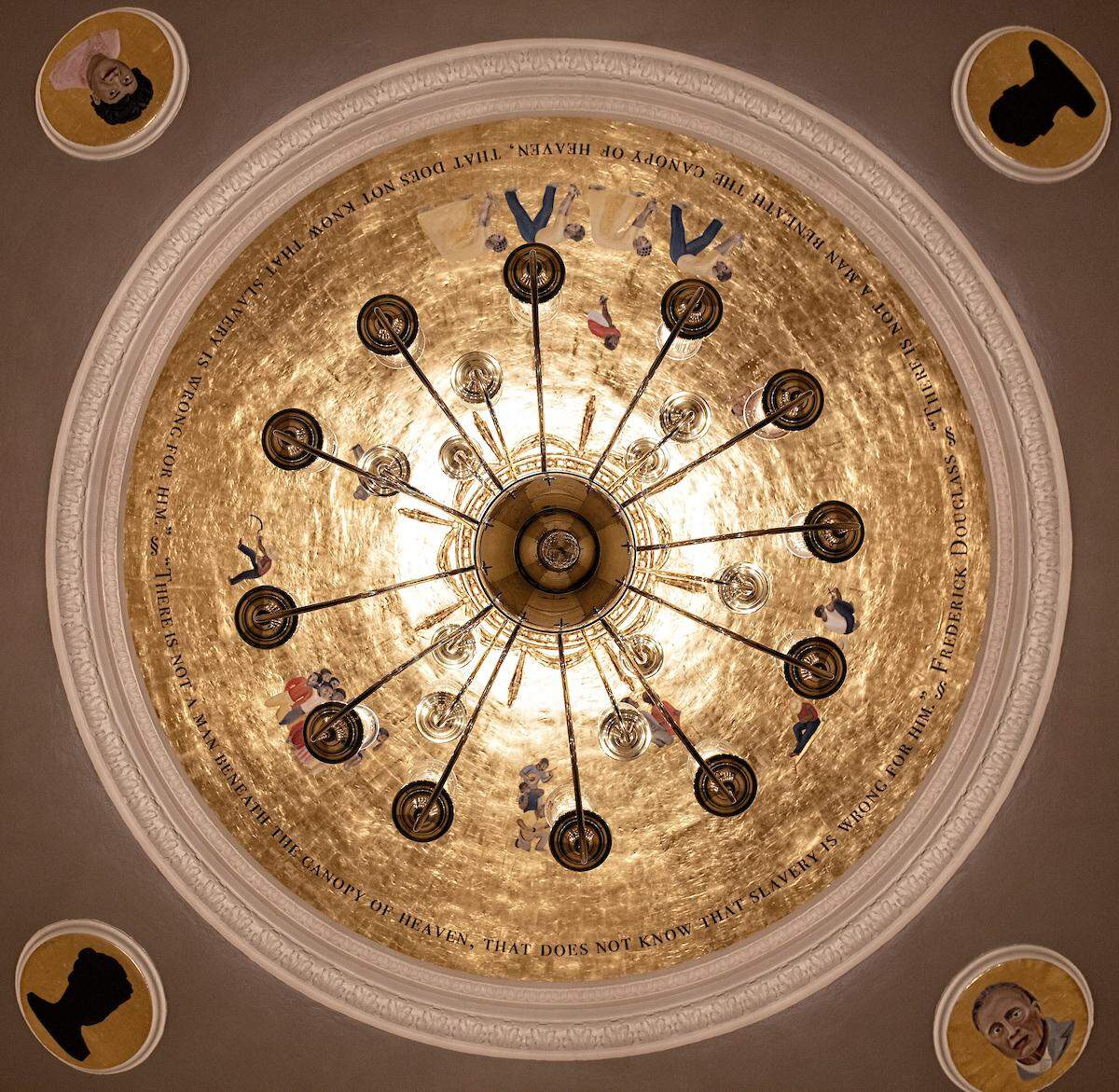
Before the announcement of Nov. 24, our case against the university involved only the O’Hanlon fresco. Now the president’s plan has attached the future of that single work of art inextricably to the future of Memorial Hall itself – and this necessarily enlarges the scope of our case. Now we have got to remind all of our fellow Kentuckians that Memorial Hall was built and dedicated to honor the university’s own students and graduates who were killed in World War I. Now, according to President Capilouto, the building “will be transformed as a space…to celebrate diversity and inclusion…” This also should be a matter at least of historical interest. Is there somewhere a statute, or has there been a referendum, permitting the university to withdraw and replace its tribute to its once-honored dead – and to do so apparently as an expedient to get rid of the fresco or to win a case in court? What our legal contention now amounts to is a morally reckless, fantastically complicated plan, requiring a luxurious expenditure of the tax money of a poor state, versus our request, simply, that the university should assume its proper responsibility to preserve and display the fresco – just as it did for 80 years at no cost.
We grant the likelihood that the university may now have to expend some money, as well as some thought, to keep the fresco from being defaced or destroyed by disaffected students — a possibility that can only have been increased by the university’s disreputable efforts to associate the fresco with racial slurs on the campus and with racial violence elsewhere. We must ask also how the security and happiness of minority students might be increased by the dedication of just one building to “diversity, equity, and inclusion.” We think it might help if every building were to be so dedicated, as it should be – just as both the student body and the fresco would be more secure if the university taught and exemplified in all its buildings the rudiments of honest thought.
Wendell Berry is an essayist, poet, novelist and farmer in Henry County.
This story was originally published December 22, 2022 at 9:32 AM.