
Lexington should move urban rail lines to avoid a disaster like East Palestine | Opinion
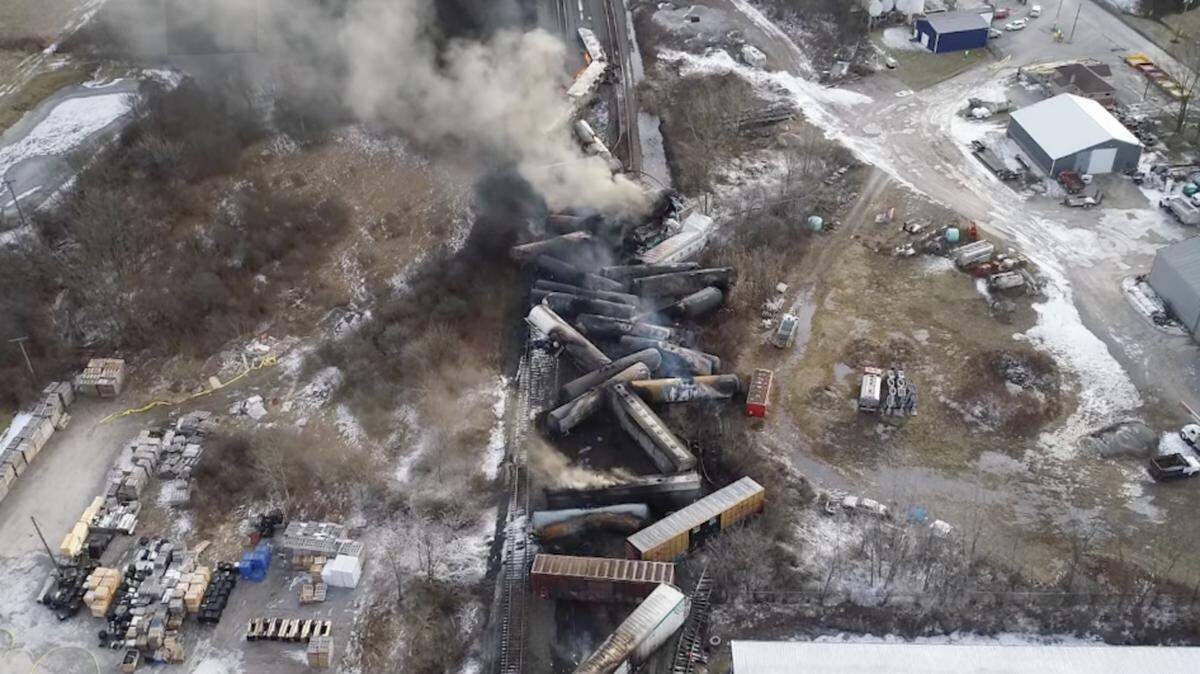
The city with the most to lose from an urban train disaster is Lexington, Kentucky.
Most cities have already relocated freight tracks out of their densely populated areas to rural routes, where derailments like East Palestine, Ohio, are less deadly.
Freight trains carry massive quantities of toxic material too dangerous to be on our city streets, but the freight route in South Lexington is much worse, it goes right through the densely populated heart of our city.
Derailments of hazardous materials require evacuation of a one-to-two-mile radius for good reasons: the toxic chemicals and gases can be deadly.
When two Norfolk Southern trains collided in Graniteville, S.C., one massive tank car released chlorine gas, nine people died and hundreds were injured as the fog of deadly gas covered their small town. In Waverly, Tenn., a derailed propane gas tank car exploded and set the whole town ablaze killing 16 people.
The Norfolk Southern freight lines run parallel to Nicholasville Road and for about four miles from Fayette Mall to the Broadway underpass they are endangering more than 100,000 people and some of our most valuable assets, our hospitals.
Concentrated within a one-mile radius of the Waller Avenue train crossing are the University of Kentucky Hospital, Shriners Hospital, Baptist Lexington Hospital, Saint Joseph’s Hospital, the entire University of Kentucky campus and thousands and thousands of homes.
Our hospitals serve the whole state, not just Lexington, so every state and federal representative should help us eliminate this danger. It’s a ticking time bomb.
Just imagine the exact train derailment they had in East Palestine with 38 massive, burning rail cars exploding toxic materials and gases in South Lexington.
There is no warning with derailments, so the first hours would be chaos as the homes close to the derailment are destroyed and incinerated. Firefighters would be in serious jeopardy from exploding tank cars with no knowledge of what hazardous materials are in them. Our emergency departments would be trying to assess how to evacuate thousands of patients, doctors, nurses and staff from all the hospitals, while the air becomes toxic, and the roads are blocked by thousands of fleeing citizens. Total chaos. No city is prepared for an urban rail disaster.
Misti Allison, an East Palestine, Ohio resident, testified during the U.S. Senate hearing on the Norfolk Southern railway disaster in her town. “My seven-year-old has asked me if he is going to die from living in our own home,” Allison said. “What do I tell him?”
Only one thing can destroy the heart of our city, a freight train disaster. Can we eliminate this danger? Yes, 100%. Relocating the freight route means the danger is gone forever, just like in other cities.
We cannot force the railroad out of South Lexington, but we can offer something much better: we can build them a brand new freight route through farmland west of the city that will be faster and safer, saving the railroad time and money. It’s a win/win for the city and the railroad. Horse farms and railroads have coexisted for centuries, including top farms here in the Bluegrass.
Mayor Gorton and the councilmembers whose districts are near the freight route need to start hearings on the HAZMAT danger of a derailment exactly like the one in East Palestine, then expand it to include deadly chlorine and propane gases being released. The hearings will be chilling, but necessary.
It is not too soon to engage the railroad, like former Mayor Fred Fugazi did in the 1960’s, in order to successfully remove the train tracks from downtown.
The speed of relocating the freight route will be driven by our citizens, doctors, students and staff at UK, and homeowners who want to be certain a horrible train disaster like the one in East Palestine never breaks the heart of Lexington.
.jpg "Fred Pope (1).jpg")
Fred A. Pope is a retired advertising executive in Lexington.
This story was originally published April 7, 2023 at 11:01 AM.