
The debate around affirmative action is missing some crucial components about education | Opinion
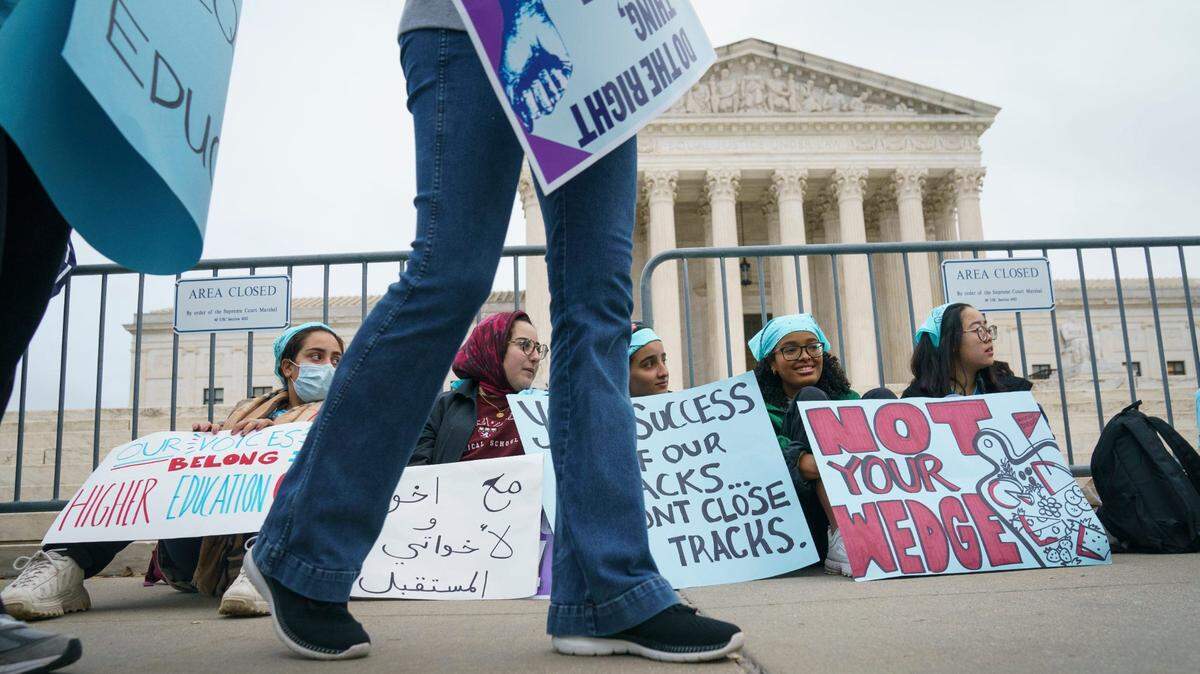
It’s been two weeks since the Supreme Court’s ruled on affirmative action, and while I personally disagree with the decision itself, I’m even more discouraged by the conversation surrounding it. To the right, I see white conservatives celebrating the end of another initiative promoting diversity and equity in our society, to which they’ve historically viewed themselves as the victims in favor of undeserving minorities. On the left, liberals have seen this as a step backwards in their efforts to right the wrongs of America’s past, another instance of racial discrimination by America’s white majority. And caught in the middle is the Asian community that now finds itself as a pawn in this front of America’s growing culture war.
As an Asian-American myself, my own views on the issue are mixed. On one hand, I’m troubled by Harvard’s systemic reduction of Asian applicants’ “personal” score,” seemingly to suppress their academic merits. On the other hand, I do believe that a diverse campus community is critical to a well-rounded education, and I recognize the role that race-conscious admissions policies play in promoting diversity and racial equity in education.
But let’s take a step back. What does racial equity in education actually look like? I’d argue, and I believe that most would agree, that racial equity is achieved when the average black student is equally as qualified as the average white student, the average Asian student, the average Hispanic student, and so forth. When this happens, I’m confident that diversity everywhere, from college campuses to corporate boardrooms, will naturally follow.
With this objective in mind, it becomes clear that affirmative action only moves us towards this vision of racial equity in a round-about way — the idea being that granting a minority student admission to a better university can elevate the student’s life trajectory, and by extension the potential of success for their children. While this can help uplift minority communities, it takes generations before an impact can be felt.
Thus, racial equity in education cannot be achieved in a meaningful way with just college admissions policies. Instead, there needs to be a focus on why the average black and Hispanic student underperforms the average white and Asian student, and how our local school systems and communities can help these students overcome that.
Even so, colleges and universities can – and should – still play an active role in this; the University of Kentucky, for example, is the largest university in the state and thus has a share of the responsibility for educating and building our collective future. Its mission statement reads, “As Kentucky’s flagship institution, the university plays a critical leadership role by promoting diversity, inclusion, economic development, and human well-being.” To me, this includes both current UK students as well as the next generations to step foot on its campus.
So, I strongly believe that universities should be more involved in the local communities they serve. Countless studies have shown the impacts that educational enrichment, even at the Pre-K level, can have on long-term educational and career outcomes. UK should work with Fayette County Public Schools and organizations like their Family Resource / Youth Services Centers to establish Pre-K and daycare programs, after school enrichment, summer camps, etc. tailored to low-income and minority students and families. Furthermore, the university could sponsor student organizations to donate books, school supplies, and other educational materials to the schools that need them most.
This is what the conversation around affirmative action is missing. Amid the ugly discourse, the actual vision of racial equity in education has been forgotten. While I do find it unfortunate that those students currently experiencing inequitable obstacles will no longer be able to benefit from affirmative action, this decision is more a call to action to reevaluate our entire schooling system – so that one day, the quality of an applicant, and the outcomes of their education, are no longer correlated with race.
Kevin Jing is a Lexington native who attended Dunbar High School and recently graduated from the University of Southern California.
This story was originally published July 21, 2023 at 8:26 AM.