
Who’s afraid of the Comer Hook? Here’s what’s really at stake in Ky redistricting case. | Opinion
I’ve managed to teach political science in Kentucky for a quarter century without working on behalf of a political party. That nonpartisan stance matters to me because my students come from across the political spectrum. I want everyone to feel welcome in my classroom.
When Kentucky faced a lawsuit against its new district maps for electing legislators, however, I agreed to serve as expert witness on behalf of the state. It’s virtually impossible to get involved in redistricting litigation without “taking sides,” because one party draws a map and the other seeks to toss it out. In Kentucky, Democrats wanted to ditch two Republican-drawn maps, so my role temporarily aligned me with the GOP.
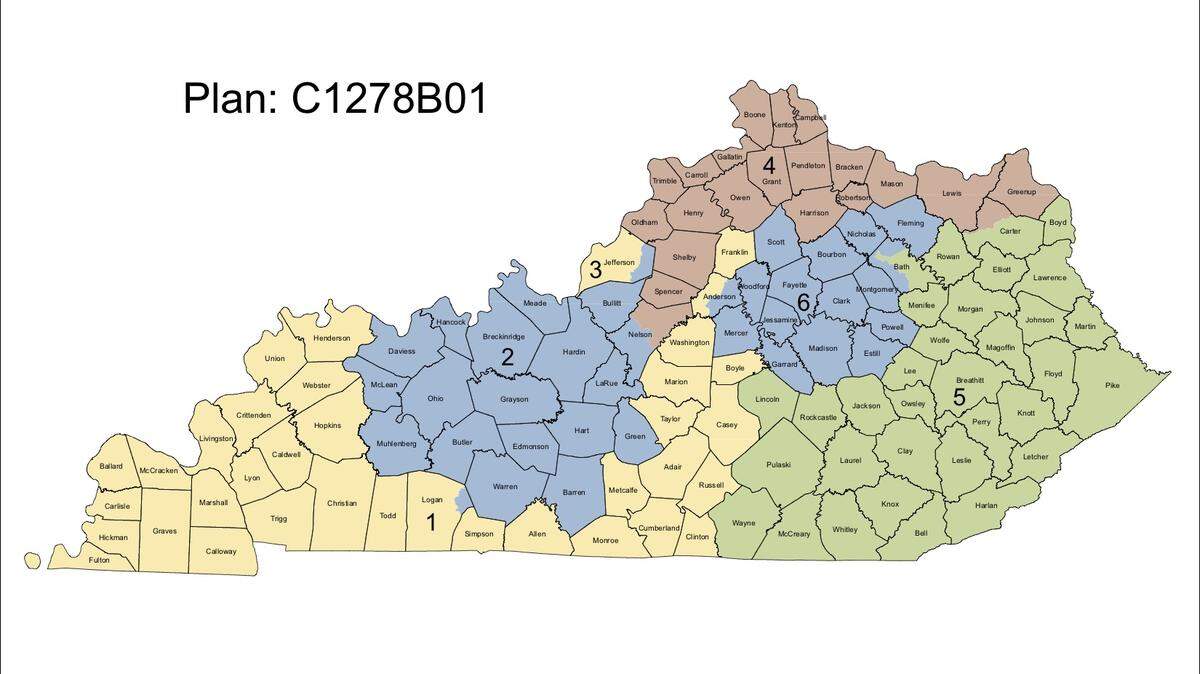
Kentucky’s redistricting battle might seem an unlikely time for an independent to climb off the fence. Republicans already dominated the General Assembly going into 2022. Letting them draw a more-favorable map threatened to make the House more lopsided. The state’s new congressional map, meanwhile, included an oddly shaped West Kentucky district that’s been widely condemned. Why would anyone, other than a devoted Republican, help protect that handiwork?
I’ll explain why and, in doing so, try to clarify what is at stake in the oral arguments now taking place before the state Supreme Court.
When courts settle a controversy, they do more than pick a winner. They explain their ruling and, if they rule against state law, they decide on a remedy. The winner often matters less than how judges justify themselves, because that doctrine will translate into rules guiding future policy.
Kentucky’s redistricting case will be no exception. A Democratic victory could change little.
The oddly shaped 1st Congressional District might have made U.S. Rep. James Comer happy, because it hooked up to his Frankfort home, but it did little to help the GOP. The Court could toss out that map without having any effect on Kentucky’s congressional delegation. Republicans hold five seats now and, under any reasonable replacement map, they’d hold five afterward.
Similarly, Democrats argue that the current state House map splits up certain counties more than permitted by Section 33 of our Constitution. But even if the Court agrees, so what? Not even political scientists hired by the Democrats argued that better districts would significantly increase their party’s influence. The GOP holds a supermajority now and, even if a new map lets Democrats claw back a handful of districts, Republicans would retain a supermajority afterward.
Indeed, the likely consequences of a Democratic victory are so minimal that you might wonder why they would take on the expense of litigation. The answer is that the state Supreme Court’s opinion could have serious downstream effects on representation in Kentucky, and perhaps nationwide. Kentucky is a minor battlefield in a bigger war, one moving from state to state as attorneys try to build momentum for a sweeping change in election rules.
The goal of reformers is to have the long-standing practice of “partisan gerrymandering” — drawing legislative maps to favor the party in power — declared unconstitutional. That’s where the real risk comes in.
If judges want to shift authority over redistricting away from the legislative branch, they would need to define a partisan gerrymander, thereby imposing new rules to shape future mapmaking. Inevitably, they’d be picking and choosing among complex quantitative methods, which courts have a poor track record of doing. Moving the process to some kind of nonpartisan redistricting commission would not remove the dilemma; it would simply push the task of sifting statistical choices onto others who might or might not be better prepared for the job.
The evidence presented in Kentucky’s litigation, offered by a pair of political scientists shipped in from Boston, illustrates the risks. The Harvard professor attacked Kentucky’s districts by comparing them to computer-simulated maps he’d constructed based on no knowledge of Kentucky’s political landscape and zero regard for most considerations that should shape legislative representation. (The one exception: His simulations honored Kentucky’s redistricting rules as he understood them.) So the expert was comparing a real-life map to lab-grown alternatives that not even he could endorse as viable. It was an unfair standard.
The other Democratic expert relied on a statistic for judging Kentucky’s districts that did not actually measure whether Republicans had “gerrymandered” the borders. Instead, his analysis depended on residential patterns that mapmakers cannot influence. When I used his method to analyze a state House map proposed by Democrats, the analysis implicitly accused them of having drawn a map unfairly biased toward Republicans, which is just silly. To make matters worse, oddly shaped districts – the usual sign of gerrymandering – could improve the results if they helped Democrats. It was a senseless statistic.
That’s why, as an elections scholar, I thought I should help the state. Not because I care if Republicans win, but because if they lose, I hope they’ll lose in a way that does no lasting harm to how we link voters to representatives. The current maps may be imperfect, but if state courts insist on legislative districts that will satisfy outside analysts, the replacements could be far worse.
Stephen Voss is a political scientist specializing in elections and voting behavior at the University of Kentucky.
This story was originally published September 20, 2023 at 10:09 AM.