
No matter how offensive the protests, we must support free speech on UK’s campus | Opinion
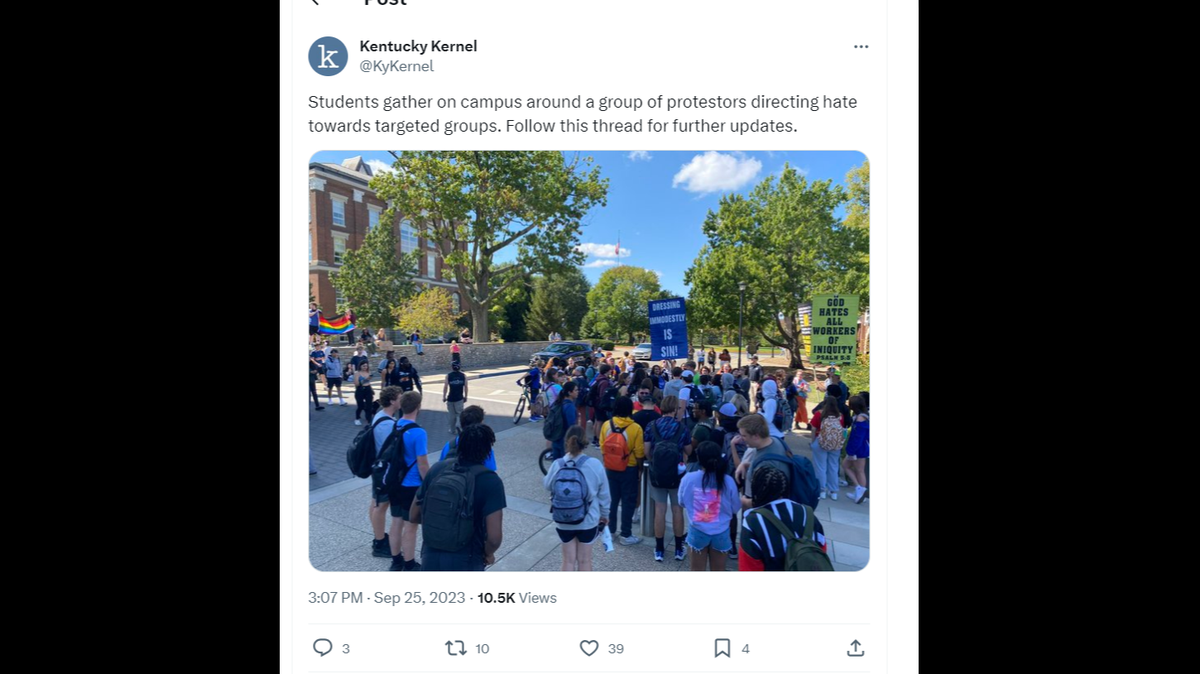
On Monday morning, Sept. 25, students at the University of Kentucky were met with protesters from a Christian organization in front of their main class building. These individuals were displaying, and vocalizing, messages that any passerby would have deemed offensive and startling. Some of these messages consisted of comparing women to property, and even comments that some women were dressing in a way that was warranting of sexual assault.
This is no doubt a troubling scene to be presented with on your college campus, and even in the case of some students, your home. The two speakers caused students to begin to crowd around them in an attempt to shout down their viewpoints. However, this was not the end. As in many cases involving “unwanted” speech on college campuses, this even turned violent, with the speaker and a student engaged in a physical altercation that had to be stopped by campus police.
This garners the question, is this allowed on campus?
Under the First Amendment of the United States Constitution, these speakers, and all provocative and “unwanted” speakers that attend campus fall into the category of protected free speech. The University of Kentucky is a public university that must adhere to state and federal law when it comes to this issue. The speakers being a member of the public rather than students does not interfere with this protection. Students, in turn may counter-protest them by gathering to offer different views that diametrically oppose those of the offensive speakers. The important part to note is that speech that makes one uncomfortable, and even blatant hate speech, is protected under the First Amendment. For this reason, the groups that have been deemed hate groups by students, are not breaking any laws by bringing their views to campus.
Following the incident, as well as the incidents that proceeded it in my time at the university, students began to question why this was allowed. Not only this, but they began to question why more is not done to stop these individuals from coming on campus in the first place. Some even go as far as pointing out that the hateful rhetoric brought to campus by these groups can be traumatizing and overtly offensive to some in our campus community. This is an opinion that I also share. I do not think you could observe these groups, or the abortion groups, or the “God Hates Gays” groups and not be upset in some way due to their aggressive language.
However, there is a reason why I do not support the banning of these groups from campus.
One need only take a brief look around the country to see a possible end to the banning of groups we find “offensive” from our campuses. We are living in an age of book bans, drag bans, legislation that bans the teaching and showing of sexuality in schools across the nation. These are also all issues that, per the Constitution, many would deem protected under the First Amendment. It was not so long ago that the nation decried “offensive,” and “vulgar” to basic LGBTQ+ rights, women’s sexual liberation, and even interracial marriage. We in some groups view these issues as core building blocks to progressive, equal rights in our country. However, if we move to ban rhetoric and speakers we find offensive as progressives, what is to stop others from using our same thoughts against us and ban our speech for the same?
All in all, the best way to secure the promise of the First Amendment is consistency, from campus hate preachers, LGBTQ+ groups on campus, to BLM protests. It is vital that the amendments promised to some of us, are enshrined for all of us. We cannot have healthy debate, transfer of ideas, and growth, without being able to voice our opinions without fear of censorship from those that disagree with us. The Founders knew this, and we must uphold it.
Gavin Cooper is a junior at the University of Kentucky studying community development and political science.
This story was originally published September 28, 2023 at 2:23 PM.