
Sixty years after MLK’s March on Frankfort, are we moving forward or being pushed back? | Opinion
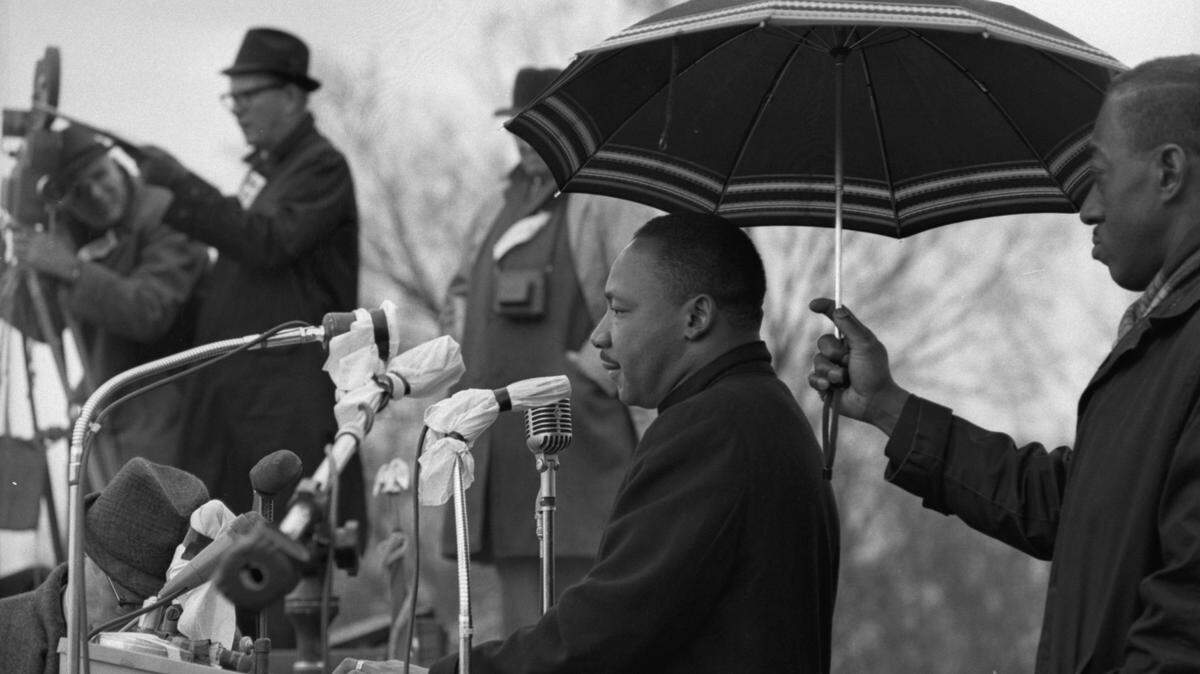
“It may be true that the law cannot make a man love me, but it can stop them from lynching me.”
Dr. Martin Luther King’s powerful words pierced the souls of the 10,000 peaceful protesters who marched to the steps of the Kentucky State Capitol 60 years ago.
On March 5, 1964, my uncle, Eugene Johnson; my aunt, Sarah Johnson; my cousin, Rosairne Black; and other Midway residents — Roland Anthony, Gracie Caldwell, Drucilla Darneal, Sandra Darneal, Marilyn Hamilton, Anna Johnson, Helen Roach Rentch, and Ruth Roach — stood in awe of a man they had only seen on television and read about in magazines. For the young high school and college students, it was life-changing, and the beginning of their involvement in politics.
Eugene, a 19-year-old Kentucky State College Student, had encountered racism which caused him to march. He recalled the first incident: “I remember when I was young, we went to Lookout Mountain in Tennessee. They had a white-only fountain. I drank out of it. I just had to. I hadn’t really seen it firsthand, it smacked me in the face. It was a wake-up call for me and that’s why I was really interested in attending the march.”
He recalled another incident while attempting to eat at the Brown Hotel during a Beta Club Conference. He remembered, “I was with the other Beta Club members, and they didn’t want to serve me, so the group got up and left. Those two things made me want to do something or made me want to be part of change.”
He was part of Dr. King’s vision, participating with him on the front lines of the Civil Rights Movement. He explained, “It was a spiritual event, and I could connect. You felt like you were about to be part of something so important. It was a beautiful and wonderful day.” He remembered the march as fun, enjoyable, and very peaceful and said, “It seemed all that were in attendance were in the spirit of the day.”
Reflecting 60 years later, he said, “His speech about equality and what we were fighting for… it stands out as one of the things we still have not attained the totality of what it was all about even today. He was a motivator and encourager.”
The march left a lasting indelible imprint on his sense of social justice. The impact still stands with him today.
“I still have the fire to continue to try to help achieve those goals of what the march was about,” he said.
In conversations with my uncle, we acknowledged we have come a long way. Evaluating where we are today it seems we have stopped marching and are being dragged back to a time when we had no rights. Today our rights are being stripped away. Our history or our place in it is being whitewashed. Attempts are being made to systematically erase our existence right before our eyes. Books are being removed from our schools out of fear of upsetting a certain section of society – said society wasn’t upset inflicting pain when it benefited them.
We must acknowledge the pain, suffering, and hurt of our past, for our country to heal. We must accept truth as truth for current and future generations to hope to live in peace and harmony as good neighbors.
The fact that our history in this country makes some folks uncomfortable doesn’t give them the right to say it didn’t happen or to hide the truth. How can a country built on “liberty and justice for all,” “the pursuit of happiness” and “in God We Trust” want to reject and bury it? We’re created equal but are we treated equally?
Our ancestors are no longer getting lynched with rope or beaten with whips and chains. Instead, our people are being gunned down in the streets, and our history of struggles is being erased from the classrooms.
Eugenia Johnson-Smith is a member of the board of the Midway Museum, a columnist for the Lextropolis, and a motivational speaker.
Frankfort will hold a commemorative march for the anniversary, next Tuesday, March 5 at 10:45 a.m., starting at the Capital City Museum and moving to the Capitol grounds.