
School choice opponents are either confused or trying to confuse voters | Opinion
As the political season heats up, it’s worth detailing precisely how confused the opponents of school choice have become. Those opposed to giving families a broader range of learning options for their kids appear not to understand much about how school choice works.
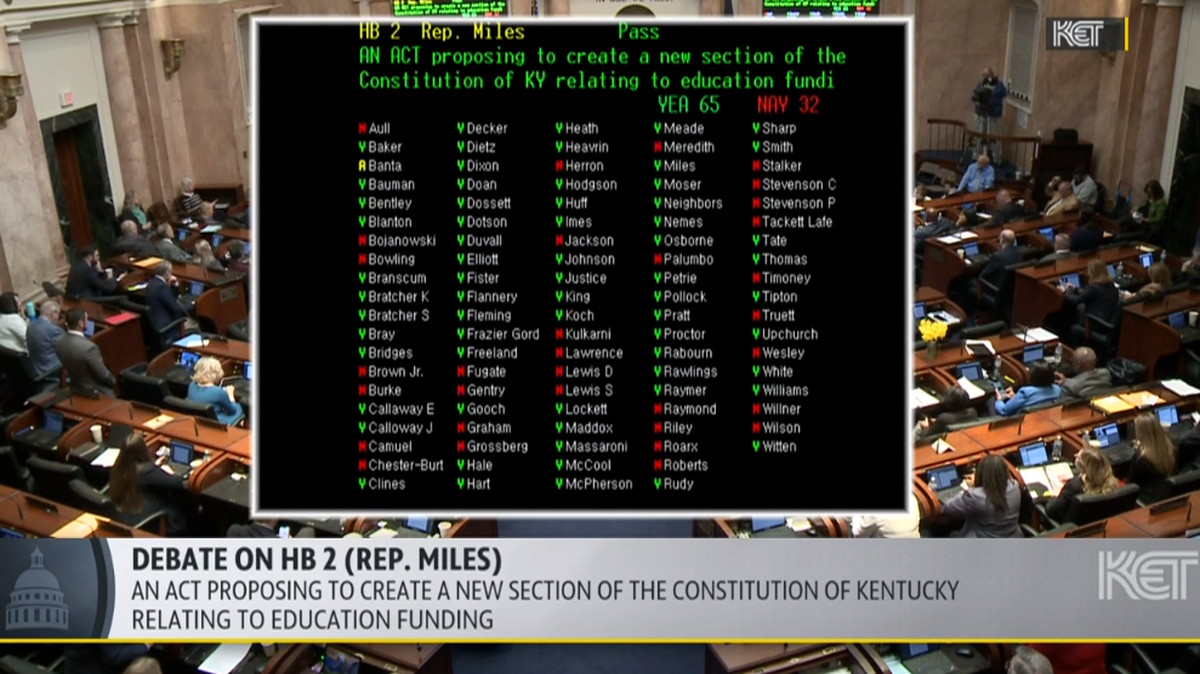
Amendment 2, appearing on the ballot this November, will empower lawmakers to expand education options for Kentucky families. The amendment does not create any choice program, but it will prevent courts from interfering in the future when the General Assembly adopts new programs to give families new learning options.
The opponents of Amendment 2 are led by members of the public education establishment who don’t want parents to have other options. Those leaders routinely refer to the amendment as a “voucher” proposal. They appear to be trying to obscure what vouchers really are, or that there are many other ways to give families more education choices.
A research report called The 1-2-3’s of School Choice, from the nonpartisan group EdChoice, documents the many ways that students benefit from school choice programs.
First, opponents appear to want voters to forget that Amendment 2 would destroy the legal hurdles that currently stand in the way of the creation of charter schools. Charter schools do not involve vouchers. Charter schools are tuition-free public schools that already exist in 45 states and are largely free of top-down regulatory burdens. That freedom allows those schools to innovate and respond to students’ needs.
Second, in 10 states homeschooling families may receive some kind of public assistance to purchase curriculum or give homeschool students a chance to access public school extra-curricular activities and sometimes even individual classes.
Third, scholarship tax credits programs exist in 20 states and encourage private donations to scholarships that help eligible students attend private schools. Tax credits are not vouchers, but they provide parents some of the most robust new learning options.
Education Savings Accounts, found in 18 states, are like vouchers but often have wider eligibility criteria and broader options for how ESA dollars can be spent.
Finally, three states give students the right to attend a public school other than the one assigned by their district if a seat is available to them. Currently this is the only form of school choice available in Kentucky, but even this form of choice has been stymied by districts that want to minimize parents’ eligibility.
Vouchers do indeed exist in 14 states and the District of Columbia. Voucher plans provide a set amount of education dollars directly to families, sometimes based on some income eligibility. Families may then use the voucher to offset education costs, including at private schools.
What all these policies have in common is the idea that every family, regardless of their income or zip code, should have the right to choose a school that is the best fit for their child, a privilege already exercised by affluent Kentucky families every day.
Education tax dollars do not exist to prop up schools or districts but are for the benefit of children whose families should have some say in where their kids learn. A huge number of states, including every state that borders Kentucky, has already recognized the need to empower parents by adopting one or more of the school choice plans described above.
But Kentucky cannot have any of these programs unless Amendment 2 is approved by a majority of voters in November. That’s why enemies of Amendment 2 don’t want you to know what school choice really is, or how it works.

Gary W. Houchens, PhD, is Professor of Education Administration in the School of Leadership and Professional Studies at Western Kentucky University. A former teacher, principal, and school district administrator, he served on the Kentucky Board of Education from 2016-2019.