
I’m a private school student. Here’s why I disagree with my school on Amendment 2. | Opinion
Every day when I drive into school, I’m greeted by yard signs blazing with the message “YES on 2!” To see these put up at Trinity, a school that generally requests little political discussion at school, was quite a shock.
I’m a “private school kid.” I went to St. Francis of Assisi for 1st through 8th grades, and I am now a senior at Trinity High School. I will always be indebted to those schools for providing me with fantastic educations and experiences in the most formative years of my life.
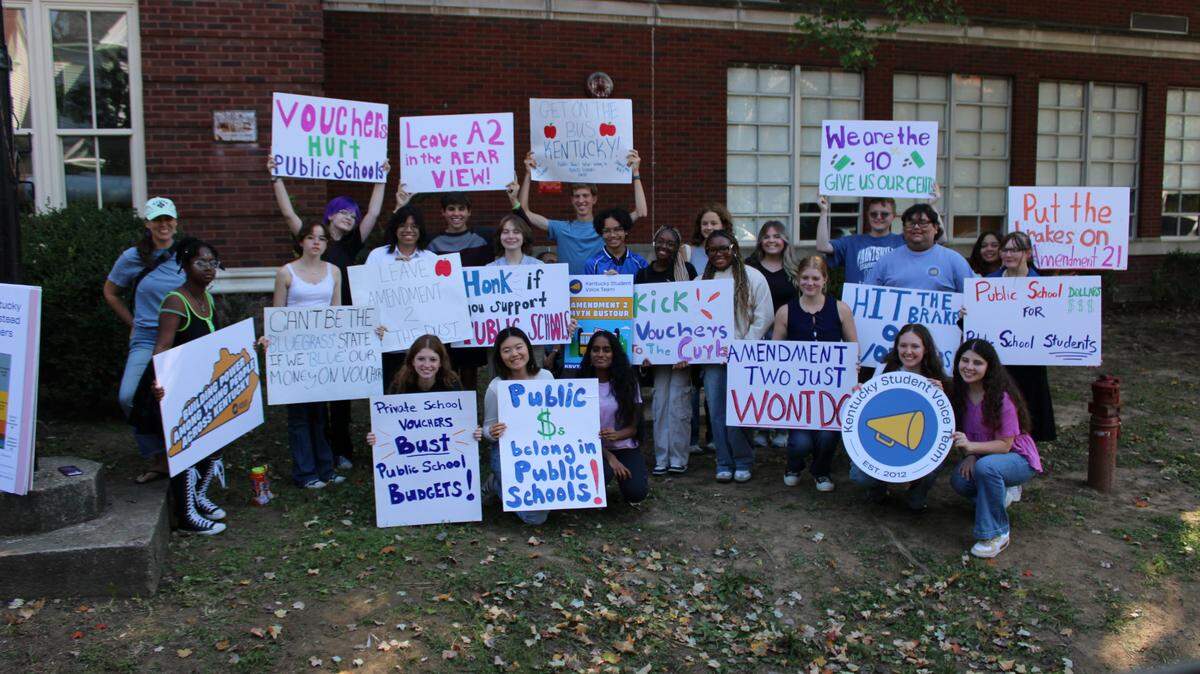
But to say I am disappointed with Trinity’s stance on Amendment 2—a Kentucky ballot measure that would allow public tax funding to be used for private schools—would be an understatement. An even bigger disappointment has been Trinity’s and the Archdiocese’s responses to criticism of their position. When both Trinity’s Student Government and Faculty Senate asked if the “YES on 2!” signs could be taken down, they were told that the archdiocese had asked us to put them up and there was absolutely no chance of them being taken down. Also, the administration doesn’t allow our school journalism program to report on any political topics and or criticisms of Trinity and its policies, so I felt that to share my views I had to look outside of the school.
In my opinion, the desire of non-public schools to support Amendment 2 is logical, but close-minded. What’s important to remember is that, in Kentucky, 65% of non-public schools are found in Louisville, Lexington, and the general Northern Kentucky area. Out of 120 counties in Kentucky, 89 of them have no access to a non-public school, and well-run, accredited non-public schools aren’t going to magically appear in those counties after the passage of Amendment 2. So, the “school choice” amendment would in fact offer students no “choice” to go to a different school.
Supporters of Amendment 2 often bring up Kentucky’s 2023 $1 billion budget surplus, claiming that that money will be used to provide funding to public schools and said schools will lose no money. However, that surplus money already has a destination. According to House Appropriations and Revenue Chair Jason Petrie, the extra money has “provided the opportunity to invest more than $2.7 billion over the next two years to improve road, rail, river, air, and water infrastructure.” Although Petrie claims they are also making “targeted investments in school facilities,” the bottom line is that significantly fewer tax dollars would go to public schools, leaving no replacement funding in their wake.
The localization of policy ideals to only focus on large population centers is a major issue, and many of my peers support the amendment out of a personal desire to pay less. Even for those who demonstrate a need for significant financial support, schools like Trinity have the money to provide it.
In the summer of 2022, a donor provided money for Trinity to install a video board in the football stadium. At a high school. And although projects like the video board improve the school experience for Trinity students, it’s selfish that we want to take public funding instead of using funds we clearly have available from alumni and tuition when schools in our own city don’t have the funding to provide busing services for students. The cost of the video board system has been estimated at $750,000, which — if donated to be used for financial aid instead of campus improvements — could have provided vouchers on scale with Florida’s voucher program to nearly two entire grades at Trinity (around 630 students). The money is there, yet the desire to improve the school in superfluous ways is stronger than the desire to have well-funded education available throughout the Commonwealth as evidenced by the school’s unwavering support of the amendment.
In the past two summers, I have seen the positive effects of public funding going to public schools firsthand through my participation in the Governor’s School for the Arts in 2023 and the Governor’s Scholars Program in 2024. In those combined eight weeks, I met students from all across the state whose public education put them in the position to attend such prestigious programs. If funding for public schools is cut, the effect that could have on a student’s access or support in applying to free opportunities like GSP and GSA could be devastating. Also, the programs themselves might lose funding and either have to reduce the number of students that are able to participate or rely even more heavily on donors. That’s one of the scariest things about Amendment 2 — it basically serves as a blank check for vouchers to non-public schools with no clear place for the funding to come from other than taking it from public schools.
As someone who is in the exact situation this Amendment is designed to benefit, I entreat you: Vote No On 2 this election day. The state of public education and the state of Kentucky will be grateful.
Liam Amick is a senior at Trinity High School. He participates in theatre and academic team, and plans on attending college to study education or political science.
This story was originally published October 30, 2024 at 12:14 PM.