
Instead of confronting underfunding and inequality, KY Legislature chose Amendment 2 | Opinion
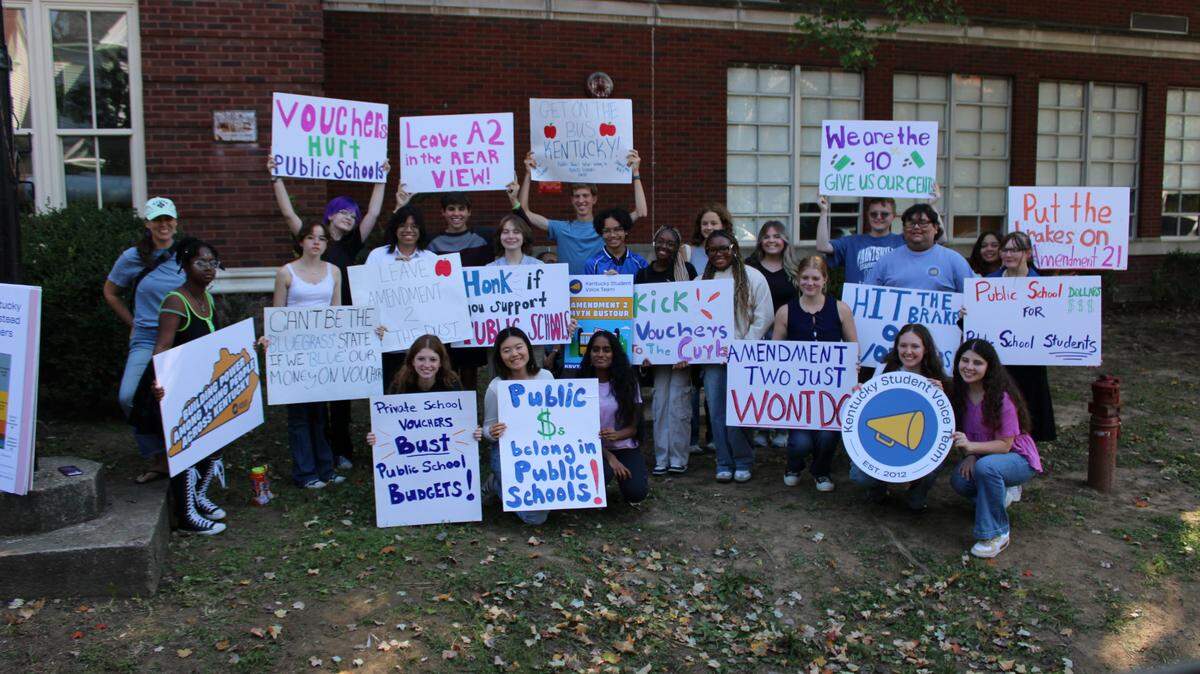
As a high school student in Kentucky, I have always viewed school as a sort of sanctuary—a safe place that encourages self-discovery and provides an immersive learning environment. Lately, however, it feels like this refuge is increasingly under threat. New laws and policies, such as Constitutional Amendment 2, have transformed my school from an environment that prompts individual growth to a battleground of sparring political ideologies.
I attend an underfunded majority-minority high school and am deeply concerned with the ramifications of Amendment 2. This proposed amendment would alter the Kentucky State Constitution, allowing legislators to divert taxpayer dollars away from public schools and into the pockets of nonpublic or religious institutions. While the Amendment’s marketed promise of educational “choice” sounds appealing, it poses a massive threat to schools like mine that already struggle to receive adequate funding and resources for our students.
Additionally, Amendment 2 risks further neglecting schools that serve and support the most vulnerable students and communities. Many of my peers and I rely on the resources that our public schools can offer, including counseling, youth service centers, and academic support. Diverting our financial support would mean even fewer resources to help us succeed.
Moreover, the amendment also comes with an issue of a lack of public oversight over nonpublic educational institutions. Private schools are not bound by or subjected to the same rules, oversight, curriculum standards, or transparency that public schools require. This means that taxpayer dollars could be allocated to places that may not prioritize the best interests of students and lack the capability to educate and prepare students for the future. These schools also have the potential to enact exclusionary practices—such as discriminating against students based on their race, religion, sexual orientation, or disabilities. This would make it even more difficult for students trying to access private education by further marginalizing those in already under-served and under-resourced environments.
The intentions behind vouchers depict an unwillingness to confront the systemic inequalities that persist within public education. Instead of developing and creating pathways to confront systemic issues of underfunding and inequality between school districts, Amendment 2 seeks to worsen the state of our public education system. It would create a classroom environment where the only students who are welcomed are those who fit a specific mold—a financial one—while others are left outside the door. Only 10% of students attend a private or religious school in Kentucky. This means that 90% of Kentucky students will be left without support as our school funding is being redirected to private schools.
This is the potential future we face if Amendment 2 passes. We should be working together to improve our public education system, not ripping its foundational support from underneath it. As Kentucky voters consider this amendment, I urge them to reconsider Kentucky’s promise that every child deserves an adequate and equitable education. We must invest in our public schools and fight for the resources we need to make our students successful—rather than creating a two-tiered system that favors only the wealthy and the privileged.
Supplying students and staff with more platforms to express their concerns and personal experiences is essential in redirecting the spotlight to the people who will be most impacted by this Amendment if it passes. Now, more than ever, it is vital for students and educators to speak out against Amendment 2. This is our time to take action by sharing our stories with our local elected representatives and joining our local school board meetings.
Carlie Hall is a Senior at Tates Creek High School and a Youth Ambassador with the Partnership for the Future of Learning. She is passionate about journalism and reporting on issues affecting today’s youth.