
Cuts to Kentucky Humanities threaten a vital program for rural areas | Opinion
In high school civics we learned that our country was founded on democratic principles growing out of the 18th-century Enlightenment, the so-called Age of Reason. Freedom of speech, equality, freedom of the press, and religious tolerance were key principles in the formation of government. Enlightenment ideals of natural rights, popular elections, and the free exchange of ideas were at the core of this novel enterprise.
Following the American Revolution, the Founding Fathers, doubtless influenced by unsung founding mothers, crafted a constitution embodying these ideas, a government ensuring a free exchange of ideas that became part of college curricula and more generally the public consciousness as part of our national identity.
Jefferson, the father of one of our great universities, recognizing that our democracy depended on an informed citizenry, saw the humanities as essential, subjects like history, literature, philosophy that too often today are overshadowed by a workday curriculum of technological training stressing the fundamentals of commerce to ensure our children with a living. What is the bread of our lives without toppings of homemade butter jelly ?
Kentucky Humanities, formerly the Kentucky Humanities Council, was created to bring ideas and knowledge to those left minimally exposed to the humanities in their upbringing or schooling, especially in underserved areas and rural communities outside our big cities. If not everyone had opportunities for higher education, Kentucky Humanities was conceived as a means of bringing the humanities to under-served communities, often through libraries, to ordinary citizens. If the people could not come to the humanities, the humanities could come to the people.
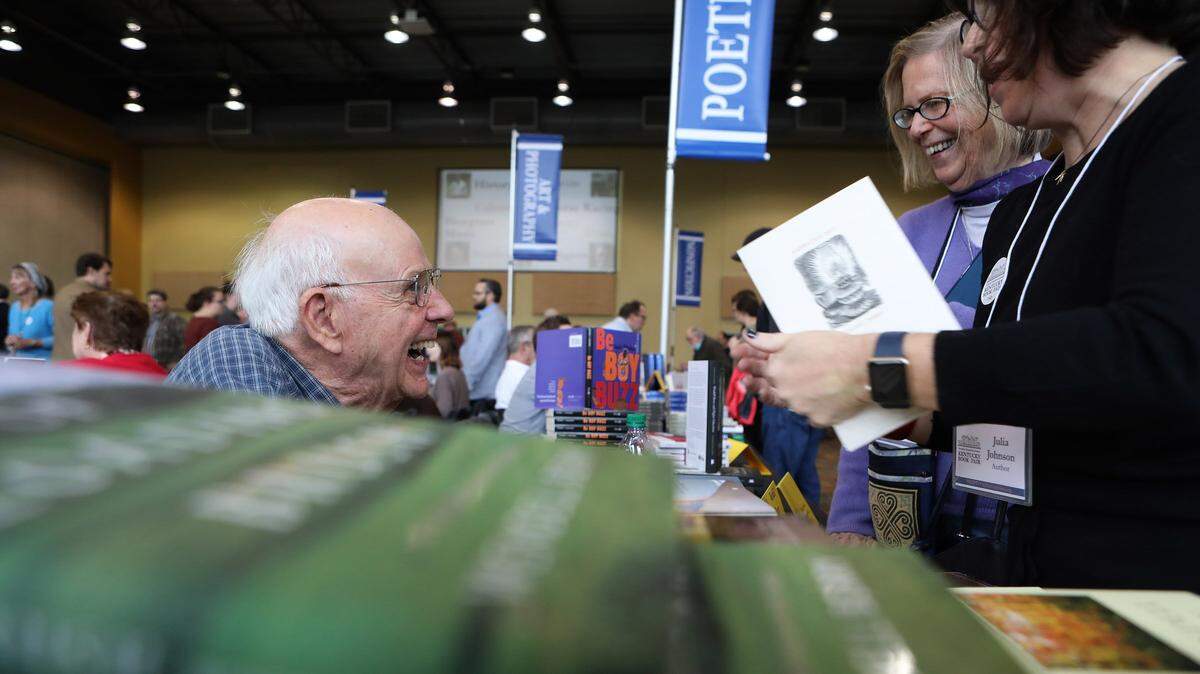
Programs such as Chautauqua, which brings fact-based bios of Kentuckians to the stage — from Henry Clay to Jean Ritchie — has been one of its most successful programs. So has sponsorship of the Kentucky Book Fair that permits readers, young and old, to interact with writers and their books. Another program that promotes outreach of the humanities is a Speakers Bureau that enables small communities and large to offer speakers on a variety of subjects relating to Kentucky’s past. Kentucky Humanities also sponsors Kentucky Reads, entailing selection of a book each year by a Kentucky writer and facilitating book discussions in libraries and churches with book discussions throughout the Commonwealth. This year’s selection is Savory Memories, published by the University Press of Kentucky and featuring Kentucky writers’ memories of the centrality of food in our culture.
When I learned that our federal government proposes to cut funding to Kentucky Humanities, which pursues the ideals at the core of who we are as a nation, I was shocked and deeply saddened. Having served on the board of the Kentucky Humanities decades ago, I knew that its programs with a small budget and hard-working staff got a maximal bang for the buck. I knew these programs were instrumental in enlightening and, yes, sometimes entertaining, all of us. Now it was to be severely impaired, and there was some question whether its programs could continue.
Over the past four years Kentucky Humanities has sponsored nearly 2,500 events reaching more than three million Kentuckians as well as awarding 1.6 million dollars in grant funds to cultural organizations across the state. Today, federal funding has been cut to zero. Added to the other assaults on the arts and humanities such as proposed cuts at the National Endowment for the Humanities and National Endowment for the Arts, Kentuckians will be deprived of much of the cultural enrichment that makes life worth living. These cuts will be less visible in our larger cities, but they will have a disproportionate impact on the smaller towns and rural communities in which these programs are too often the only game in town.
What can we do to sustain the worthwhile programs that Kentucky Humanities fosters? The most effective remedy is to contact our representatives and voice our support for Kentucky Humanities. We must not let our democracy, built on idealism and the marketplace of competing ideas of the Enlightenment, starve in an era that one cynic has described as the Endarkenment. Let’s help Kentucky Humanities keep the lights on.
Richard Taylor is Kentucky’s former Poet Laureate and the author of “Elkhorn: Evolution of a Kentucky Landscape.”