
Kentucky has too many counties. Do we have the political will to fix it? | Opinion
AI-generated summary reviewed by our newsroom.
- Kentucky ranks third in total counties despite being 25th in population size.
- Over half of Kentucky’s 120 counties have populations under 20,000 residents.
- Small counties receive equal road funds as large ones, straining state resources.
It seems as if everyone is unhappy with the government. Certainly, if you spend any time on social media that is an easy conclusion to come to. Too often policy proposals, especially at the federal level, are not meant to make meaningful positive changes. Bills to placate a particular person, constituency or business with no firm basis are too common.
Therefore, this column will be the first of a few that provide some actionable policy suggestions that make sense but will take some political backbone to make happen.
First, Kentucky has too many counties. WAY too many counties. It’s time to eliminate some or at least streamline the process by which counties could merge if they want to.
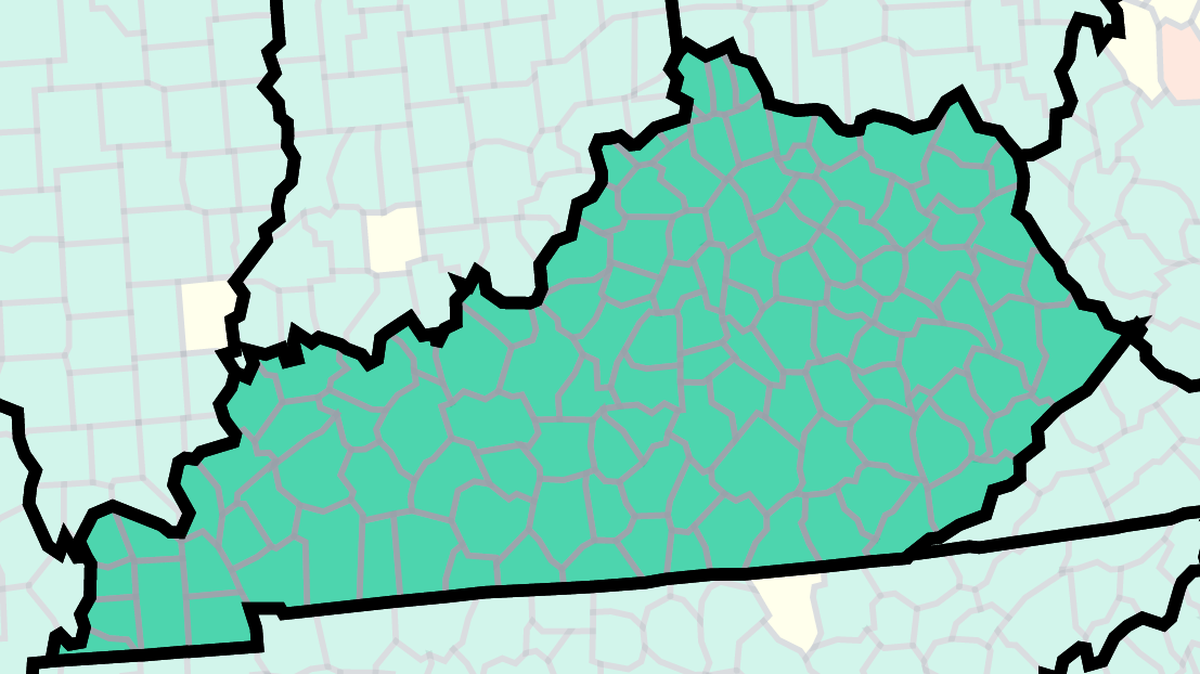
Kentucky has the third most counties in the country with 120. Yet Kentucky is 25th in population and 37th in land area among all the states. So how did we get here? Well, the Kentucky Constitution states that every person must live within a day’s travel from the county seat. Back in the 1800s, that meant a horse ride to the county seat. This required the division of many counties to fulfill that requirement. The last county to be created was McCreary County in 1912.
Today, a day’s ride would mean by vehicle. In that case, I could get from Asland to Fulton in a day. It would be a long day (6 hours according to my GPS) but fulfills the requirement. So, it’s time to get rid of all that bloat and eliminate counties, right? Because having 22 counties with less than 10,000 people in it should be easy to address. Heck, half the counties have less than 20,000 people. If we started over from scratch, there is no way we would allow this, so something is being done right?
Not so much.
Let’s take the most extreme example and look at its impact. Robertson County has the smallest area and population in Kentucky. In fact, the estimated population of Robertson County as of July 2024 is 2,382. No, that is not a typo. That is less than 6% of the population of the city of Georgetown. Yet Robertson County has an elected Judge/Executive, seven Magistrates, County Attorney, County Clerk, Circuit Court Clerk, Sheriff, Jailer, Property Valuation Administrator, Coroner, Surveyor and seven Constables. Also, they have an elected school board that services approximately 450 students. That is a whole lot of government. Remember that half the counties of Kentucky have less than 20,000 people.
So, if you live in a larger county, you might ask “why does that affect me?” There are many formulas for the distribution of funds in Frankfort that benefit small counties. The biggest example is the road funding formula, where 20% of the money distributed to counties is evenly divided among all the counties. So, for that portion, Robertson County and its 2382 residents get the same amount of money as the 329,437 residents of Fayette County.
I have many strong reservations about the actions of DOGE in D.C. But as far as the DOGE devotees in Frankfort, I provide you with this idea to implement a commonsense method to trim government that will not only save money but deliver better results. I would argue that each county should have a minimum of 20,000 people.
However, as I said at the start of this column, it will take political backbone to get it done.

Adam Koenig spent 16 years as a Republican Kentucky State Representative. He owns a consulting company, Koenig Public Policy and Political Consulting. He can be reached at adam@kpppc.us.
This story was originally published June 18, 2025 at 9:49 AM.