
Communion debate shows how church disagreements now reflect our political struggles.
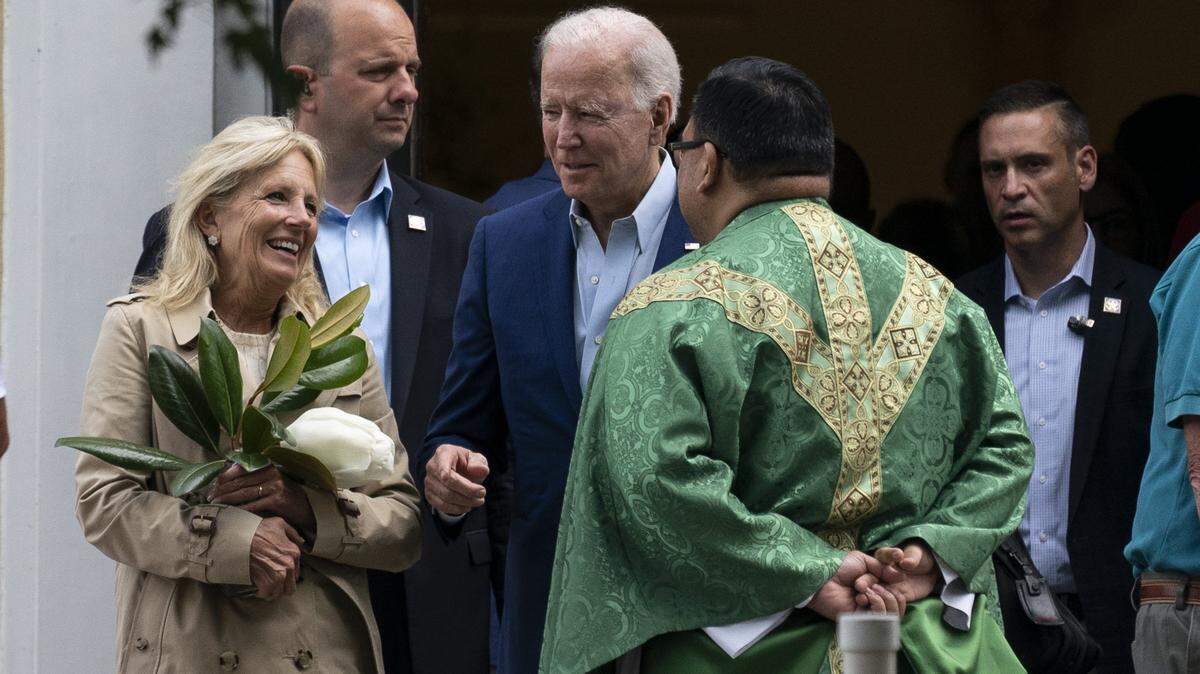
Recently, U.S. Catholic bishops voted to draft a new statement on communion which, in the words of religion writers Elizabeth Dias and Ruth Graham of the New York Times, “some hope to use as theological justification to deny communion to President Biden and other Catholic politicians who publicly advance policies that are not aligned with the church’s.”
To the extent this proposal is aimed at the president, which it is, there’s a double irony at work. Biden is just the second Roman Catholic president ever, JFK being the first. And he’s among the most dependably churchgoing Christians to reach the Oval Office in modern times.
So, on its face, his election would look like a win-win for the bishops. He’s not just a Catholic, but a serious one.
Instead, conservative bishops hope to deal him what might be the ultimate Catholic insult: Publicly denying him the eucharist (another name for communion).
It’s reminiscent of the Southern Baptist Convention, which also saw two of its members reach the White House—Harry Truman and Jimmy Carter—only to repudiate both, the former for cussing and the latter for general liberalness.
To non-Catholics, denying Biden or other Catholic politicians communion might elicit a shrug and a puzzled, “So what?”
But for many Catholics, this is a Very Big Deal. In Catholicism, the eucharist is the ultimate sacrament.
“The priest presides over the rite of the eucharist in which bread, called the host, and wine become consecrated, or holy,” Dias and Graham wrote. “Catholics then partake of the bread and wine, which they believe have been transformed into Jesus’ body and blood. Between Masses some Catholics also honor the consecrated bread, now the body of Jesus, in adoration chapels.”
Again, Catholics are taught that when they celebrate the eucharist, they’re literally eating and drinking the flesh and blood of Jesus. This transformation of the bread and wine is called transubstantiation. This idea separates Catholicism from nearly every Protestant sect.
For Protestants, communion’s bread and wine are merely symbols.
And perhaps that’s the case for a lot of Catholics, too. A 2019 poll found roughly 30 percent of U.S. Catholics actually believe the communion bread and wine become the body and blood of Christ, while about 70 percent believe, like their Protestant cousins, that the elements are only symbols.
Even so, the eucharist “is the most personal and intimate way Catholics connect with God and one another, part of the weekly or even daily routine,” Dias and Graham said. “Ultimately, the eucharist is considered the path to salvation.”
When conservative bishops seek to deny Biden communion, it’s a way declaring him unworthy of sharing Christ’s body. It implies he’s spiritually defiled. It’s an attempt to embarrass and threaten him.
In the midst of this communion commotion, journalist and historian Garry Wills—a Catholic—wrote about the evolving, sometimes contradictory history of the church’s positions on abortion.
Wills said conservative Catholics’ single-minded opposition to abortion, making it the sin worse than all others, is a modern phenomenon, as is the related insistence that human life begins at conception.
“No one told Dante that (abortion) was the worst crime, or he would have put abortionists, not Judas, in the deepest frozen depths of his Inferno,” Wills said. “But in fact he does not put abortionists anywhere in the eight fiery tiers above the deepest one of his Hell.”
Neither did the writers of the New Testament gospels choose to condemn it, he said. Nor did St. Paul, Moses or Jesus. Nor did St. Augustine. St. Thomas Aquinas said God infuses the soul into an unborn child’s body during the last stages of pregnancy.
“The Catholic Church no longer claims that opposition to abortion is scriptural,” Wills said. “It is not a religious issue. It is called a matter of natural law, which should be discernible by natural reason.”
But most experts on natural law take a pro-choice position, he said.
Decades ago in England, Wills’ pregnant wife faced a severe risk of miscarriage.
“I went to John Henry Newman’s Oratory fathers, where I had been attending Mass, and asked what I should do in that event. They looked puzzled and said the hospital should handle that.
“I found, in later questions, that the church did not prescribe or recommend baptizing a miscarriage as if it were a full human being, nor giving it last rites, nor burying it in consecrated ground. My Catholic grandmother, Rose Collins, had three or four miscarriages, but told me she did not worry about how the discharges were disposed of—she had four living children to care for.”
Only since the 1950s has what Wills called “the cult of the fetus” gradually come to dominate the church’s conversation.
Whether Wills is accurate here I’m not qualified to say, not being a Catholic or a scholar.
Yet it does seem that, if nothing else, the attempt to rebuke Biden is another among a myriad examples of how America’s church disagreements now simply reflect—indeed, are almost indistinguishable from—our secular political struggles. That’s too bad.
Paul Prather is pastor of Bethesda Church near Mount Sterling. You can email him at pratpd@yahoo.com.