
On abortion, most Americans disagree with activists on both sides, lean toward center
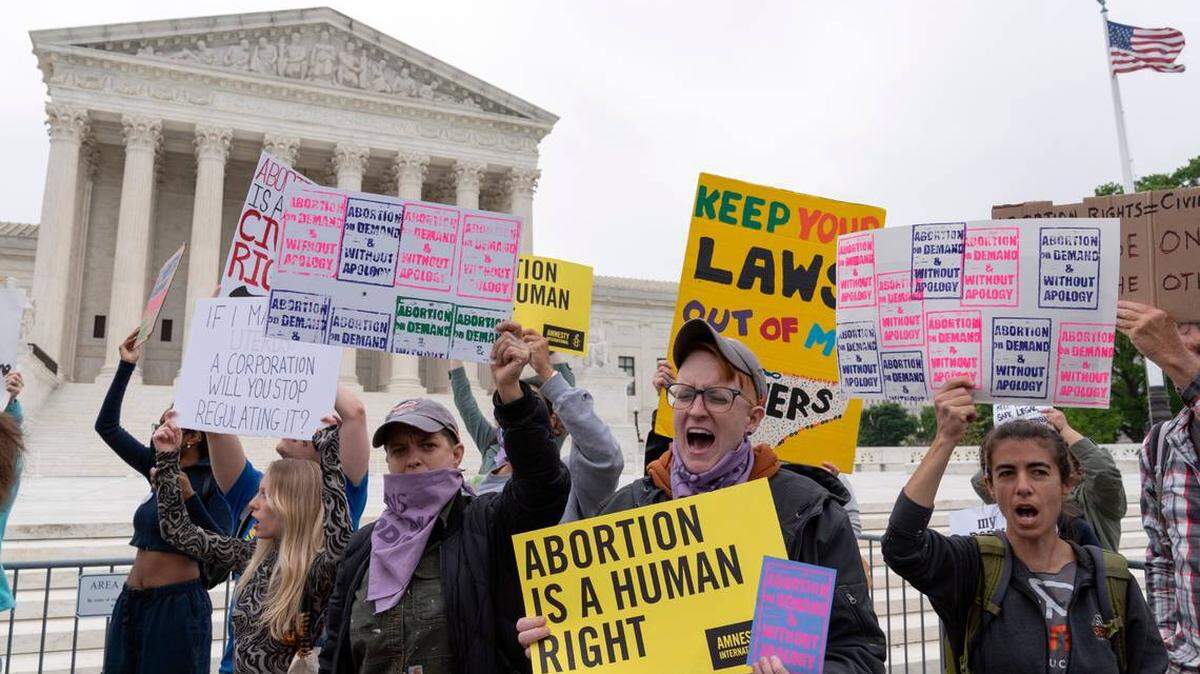
As you’ve heard, unless you’ve been vacationing off the grid in a cavern on an island in the South Pacific, recently a draft copy was leaked of a possible U.S. Supreme Court decision that would overturn Roe v. Wade.
In Kentucky, if and when that landmark 1973 case is indeed set aside, the reversal will trigger a law passed by the General Assembly that requires the state to immediately stop abortion services.
Across the nation, far and near, anti-abortion and pro-choice activists have descended into something approaching a frenzy of—depending upon their side—elation or despair. It seems a repeal of Roe would either be the greatest thing that’s happened to America in the 21st Century or the worst cataclysm to strike us since 9/11.

Both reactions are predictable. But what gets lost in our never-ending national convulsions about abortion are the views of the solid majority of Americans—Democrats and Republicans, religious and non-religious, men and women—who mainly occupy a very large middle ground.
Although both anti-abortion and pro-choice activists claim the majority sides with them, polls designed to tease out more nuanced views have repeatedly shown that most Americans are double-minded about abortion and don’t fall neatly into either camp.
“There is ample evidence that many people are ambivalent about the issue or experience significant cross-pressures in formulating an opinion,” said Scott Keeter, a senior survey advisor to the Pew Research Center, in an article on the Poynter Institute’s Politifact website.
And that’s as true of churchgoers as everybody else. While the Roman Catholic Church, for instance, is staunchly pro-life, the laity in the pews is far less so.
Most Americans want abortion to remain legal in circumstances such as rape, incest or a serious health-threat to the mother. At the same time, they want abortion restricted to circumstances such as those, or at least to the earlier months of pregnancy.
If there’s anything approaching a consensus on abortion, that’s probably the consensus. Keep abortion legal, but make it rarer and harder to get.
In a 2019 column, I cited a national NPR/PBS NewsHour/Marist poll which found that only 18 percent of respondents said abortion should be available to a woman any time she wants one during her pregnancy. Just 9 percent said abortion should never be allowed. Taken together, that’s only 27 percent, total, who held the two absolutist positions usually propounded by activists.
The majority of people were in-between. For example, 86 percent of U.S. adults—including 73 percent of self-described “pro-life” respondents—thought abortion should be legal at any stage of pregnancy if it’s needed to protect the life or health of the woman.
Still, overall, 61 percent of respondents also said abortion should be significantly restricted.
Louis Jacobson, the author of the Poynter Institute’s Politifact article, writes that during five decades of Gallup surveys on abortion:
“ ‘Legal under any circumstances’ has generally attracted between 20% to 30% support, while ‘illegal in all circumstances’ has pulled between 10% and 20% support. The top choice has always been ‘legal only under certain circumstances,’ which has generally polled between 50% and 60%. There is no discernible long-term trend in any direction.”
(We should note, too, that even minor variations in findings among these polls may be more a matter of how the survey questions were worded than shifts in actual opinions.)
So, when pro-choice activists claim that most Americans agree with them that abortion should be legal and Roe v. Wade should stand, they’re not lying. And when pro-life activists claim that most Americans agree that abortions ought to be tightly regulated, they’re not lying, either.
But neither side is telling the whole truth.
The truth is, the majority of the American public generally takes a centrist view. Most Americans aren’t absolutists about abortion. They understand both arguments. They find abortion morally troubling and yet think there are occasions when it might be the least bad option.
I suspect the same holds true with most hot-button issues of the culture wars. I doubt we’re nearly as divided in this country as we’ve been led to believe.
Our divisions get daily exaggerated and exacerbated by extremists, those who want to pit us against each other for their own ends. Too often, the media—especially cable TV and social media—feed this lie as well because the most abrasive, most divisive voices produce the highest ratings and the greatest number of clicks.
In reality, Americans tend to abide in a great commonsensical middle. Democrats or Republicans, religious or skeptics, men or women, black or white or brown, we actually have more in common than separates us. Even on abortion.
Paul Prather is pastor of Bethesda Church near Mount Sterling. You can email him at pratpd@yahoo.com.
This story was originally published May 12, 2022 at 8:48 AM.