
Crow of Eight to Ten Thousand Expected to See First Racing at New Course Near Lexington
Keeneland, a race track constructed along lines and organized along principles drafted by men and women who look upon the racing of thoroughbred horses as the king of all sports, will throw open its gates today for its inaugural meeting of nine days. - Neville Dunn, The Lexington Herald, Oct. 15, 1936
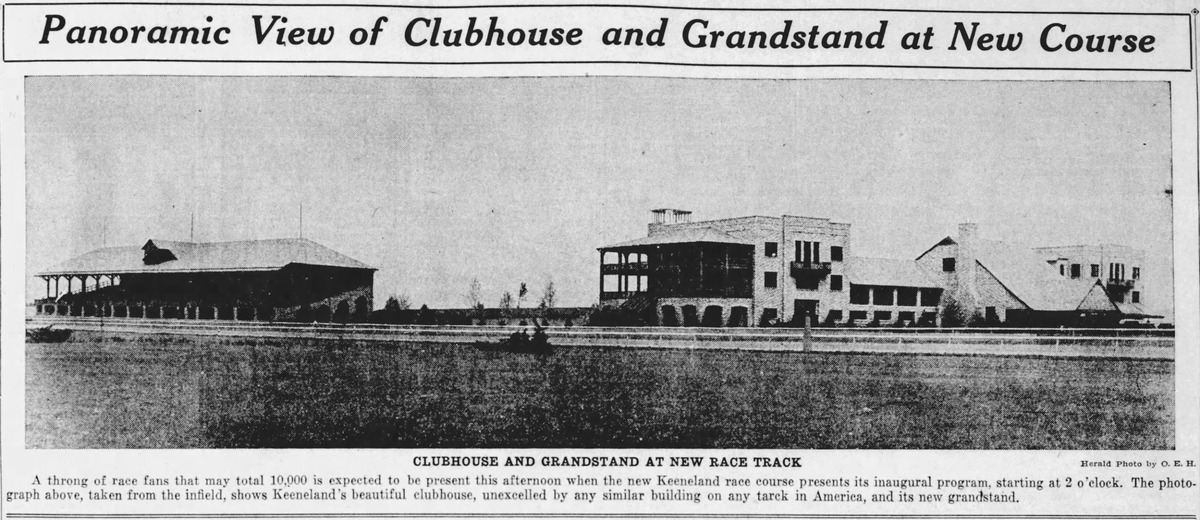
Thus proclaimed the A1 page of the Lexington Herald’s special Keeneland edition as the race track opened with a bugle (not a bang per se) on Oct. 15, 1936.
On page four of this whooping 56-page special section was a note from, what I presume, was the editorial board at the time (I say presume because it was unsigned, but it appeared directly under the masthead for the editorial board) reading as such:
Today there is added that which is truly typical of Lexington—the Lexington that was and is and is to be. Hereafter when anyone asks, “Is there a race track there?” the Lexingtonian may reply: “The most beautiful one in the world.”
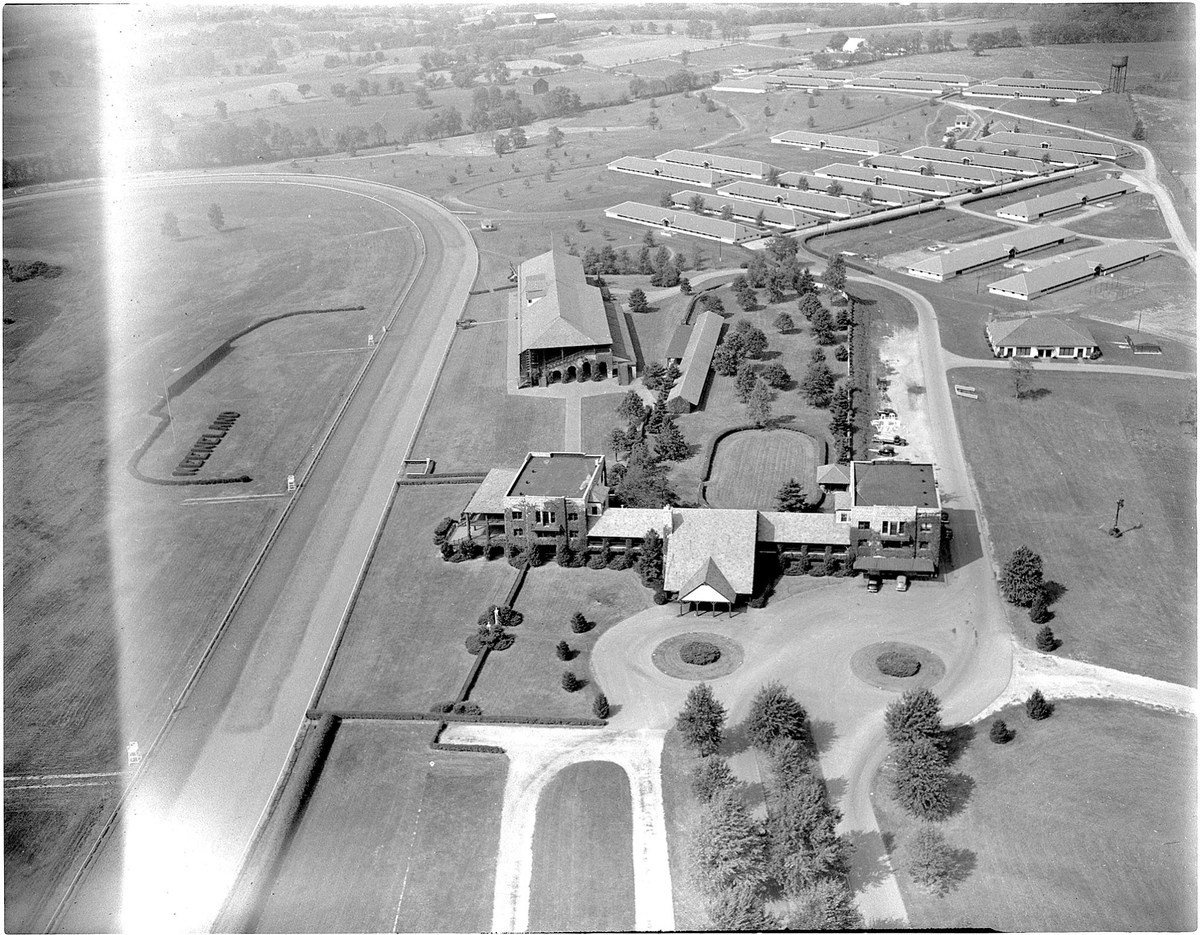
The Herald-Leader photographer snapped this aerial photograph of the Keeneland race course October 4, 1947. In the foreground is the spacious clubhouse while the grandstand is shown in the center of the picture. To the right of the grandstand may be seen Keeneland’s famous open-air paddock while some of the stables are shown at top right. The home stretch, the first turn and a portion of the Keeneland infield, where the totalisator board will be erected, are at the left. At lower left is part of the clubhouse parking lot.
For three years, from 1933 to 1936, the Horse Capital of the World was without a race course after the closure of the Kentucky Association’s race track in 1933 (more on that a bit later), which was open to 100 years of continuous racing.
Keeneland’s history dates back to 1825 when Marquis de Lafayette (the French military officer who fought on the side of America in the Revolutionary War) visited the estate of Major John Keen. John Keen and his wife, Mary, built a brick home there just after the turn of the 19th Century. As the years passed, the property eventually devolved to John Oliver “Jack” Keene, a noted Kentucky Thoroughbred breeder, trainer, and owner.
In 1935, a group of horsemen led by Hal Price Headley and Maj. Louie A. Beard purchased 147.5 acres of Jack Keene’s land and began the work transforming it into a race track.
The race track opened as a nonprofit managed by the Keeneland Association. The leadership was made up of “men who stand high in business, farming, banking and medicine as well as breeding and racing of horses.”
Perhaps the most interesting association leader, at least in my opinion, was Dr. Fred W. Rankin. Rankin, who served as second vice president of the association, served as a field surgeon during World War I; he rose to the position of brigadier general during World War II, serving as chief surgical consultant to the Surgeon General.
The Keeneland Association also had a board of directors with over 20 members. While I don’t discount the importance these men had in the creation of Keeneland, nor of their contributions to horse racing writ large, you can’t have horse racing without the jockeys.
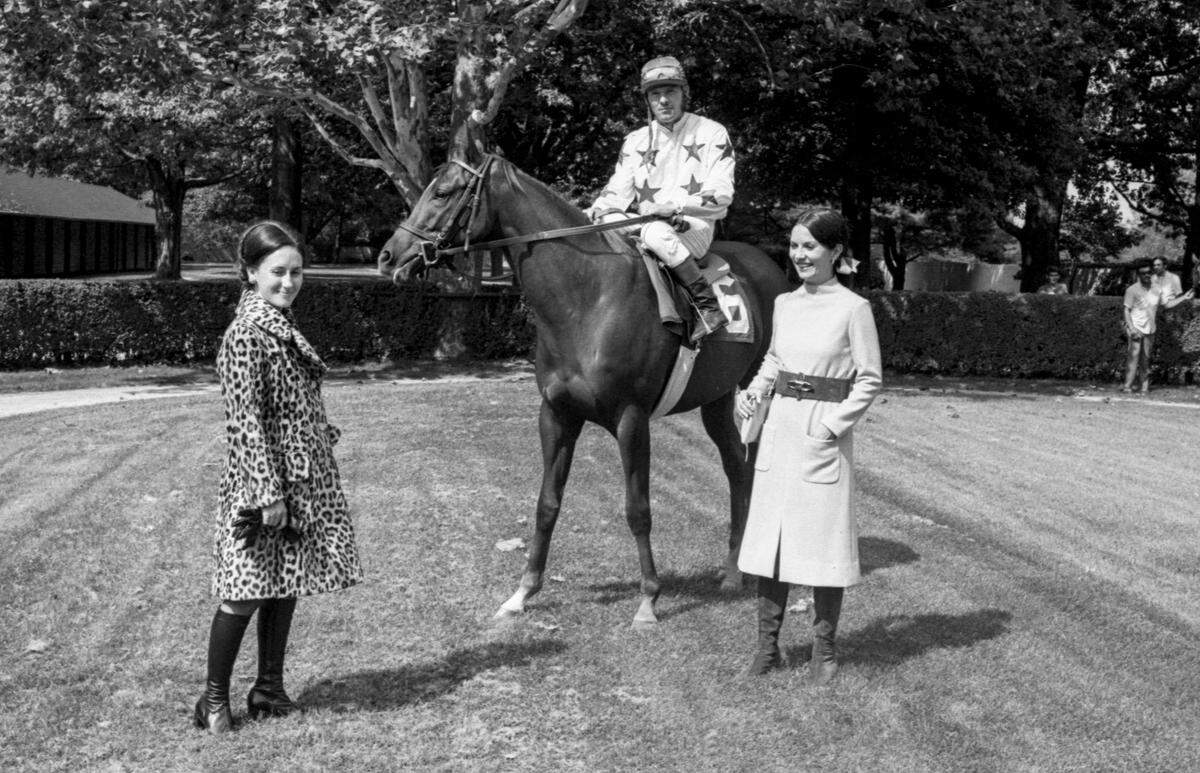
Mrs. William Lockridge, left, prepares for the cooler weather in a double-breasted slightly-fitted man-made fur coat. These fabrics are water-repellent and will not shed. Flap pockets detail this coat from Town and Country. Mrs. Hampton Adams Jr. brightens the Keeneland paddock in a yellow wool jersey with wide wine suede belt with large silver buckle by Joan Leslie from Loom and Needle. Dave Burgan is aboard Jenny Song, owned by Mrs. Blanche Kercheval. Published in the October. 10, 1971.
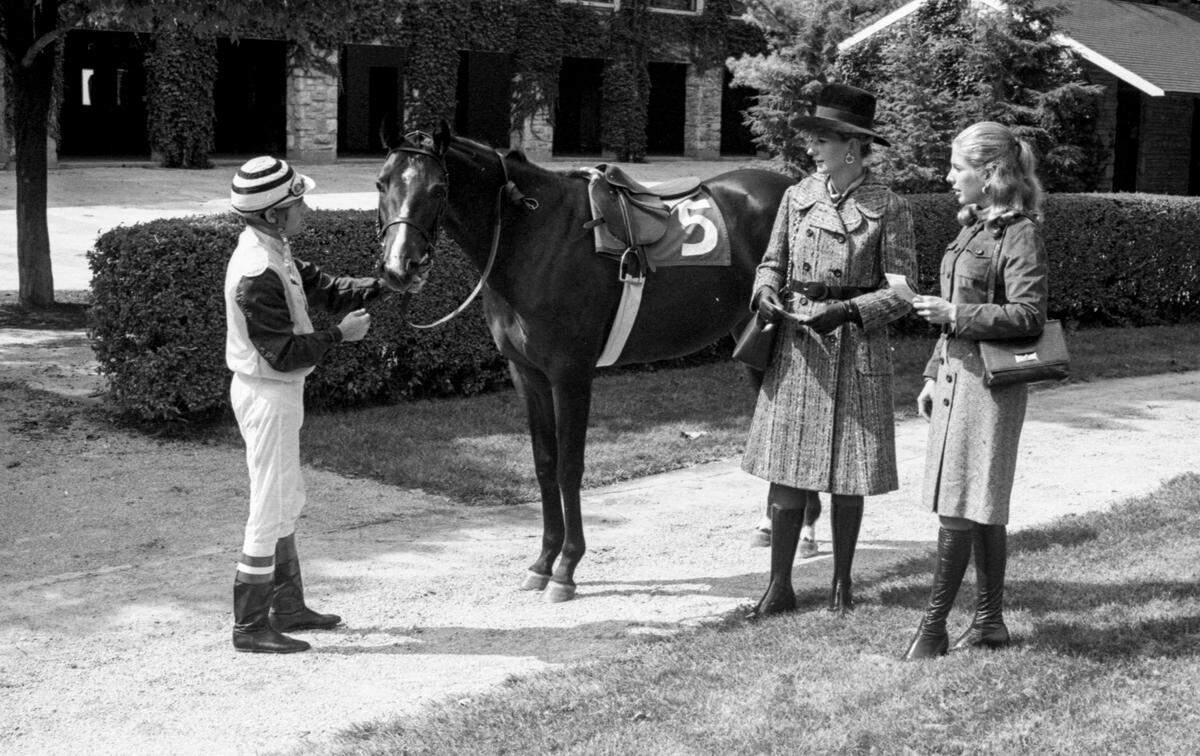
Mrs. Hal Price Headley Jr., left, wears a black and brown slate combination semi-fitted tweed coat with notched lapels and brown suede belts by John Clark of Dublin from Wolf-Wile’s. Her hat, with wide brim, is of dark brown Italian velour by Mr. D. Her brown calf bag, with gold chain handle is by Korea. For a day at the races, Miss Mason Winn selected a dress with brown tweed skirt and gold jersey top with flattering roll collar. The costume is completed with a brown suede jacket with pocket detail by Helen Matthew. The boots are by Rosetta, all from Hymson’s. With the ladies is jockey Larry Rowe holding Lady Slipper from Lazy F. Ranch.
Keeneland, the monumental contribution of a horse-loving community to the King of Sports, threw open its gates yesterday afternoon and eight thousand persons, dressed in the height of fashion, happy in the return of racing to the city that has been the cradle of the thoroughbred industry of American for more than a hundred years, celebrated the event. - Neville Dunn, The Lexington Herald, Oct. 16, 1936
The first race run over the new Keeneland course was won by Royal Raiment, owned by John Hay Whitney, ridden by Johnny Gilbert and trained by J.W. Healy. The handle for opening day (amount of money wagered in the pair-mutuels on a race) reached $74,639. In today’s money, when accounting for inflation, that would come out to roughly $1.7 million.
When talking about the jockeys of Kentucky’s horse racing history, it’s vital to recognize that many of the leading horsemen, who ran races both in Lexington and in the Derby in Louisville, were Black.
The first Kentucky Derby winner, Aristides, was ridden by Oliver Lewis (the first Black jockey to win the Derby) and trained by Black trainer Ansel Williamson.
Lewis, and a few other Black jockeys such as James “Soup” Perkins, who tied a record as being the youngest jockey to win the Kentucky Derby in 1895, and Isaac Murphy, the winner of three Kentucky Derbies, are buried in Lexington’s African Cemetery No. 2.
For more on that I suggest checking out “The Heart of the Turf: Racing’s Black Pioneers” sponsored by the Keeneland Library.
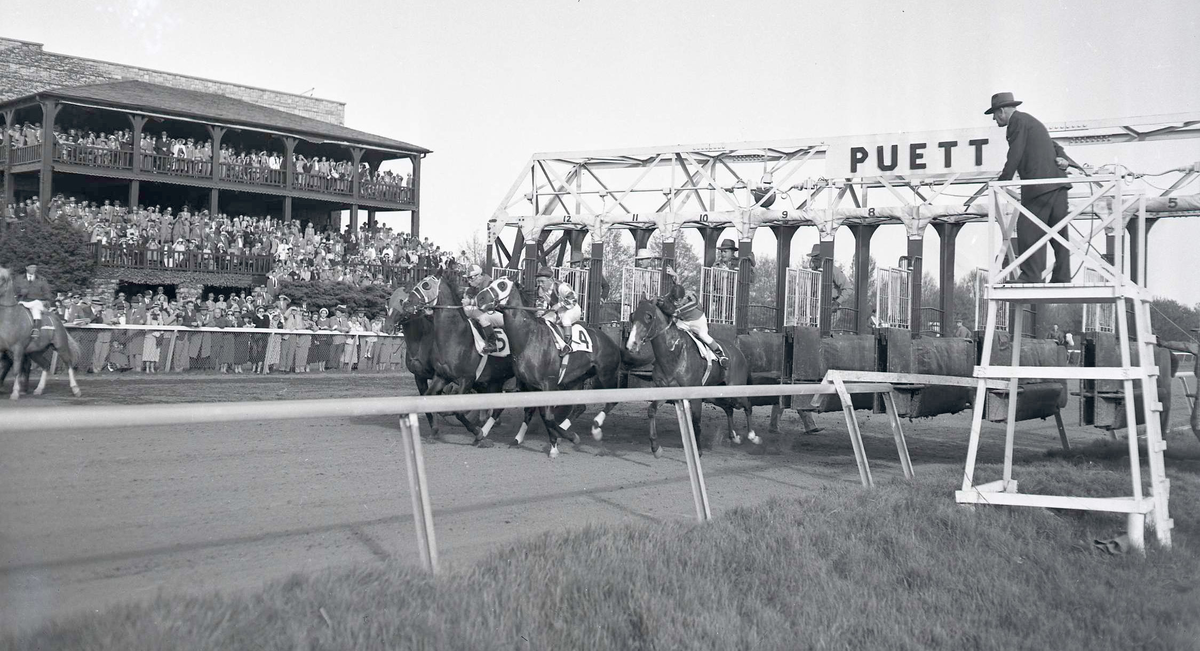
Only four horses competed in the 1949 Blue Grass Stakes on March 28, at Keeneland. Shown here leaving the starting gate are Old Rockport, far left, with Gordon Glisson up, Johns Joy (5), with Johnny Longden onboard, Halt (4) the eventual winner, with Conn McCreary in the saddle, and Wine List, with Toddy Atkinson up, on the inside.
Of course, we may not even be talking about Keeneland in present-day were it not for the ultimate closure of the Kentucky Association race track in 1933.
The Kentucky Association for the Improvement of the Breeds of Stocks was established in 1826 to “improve the breed of horses by encouraging the sports of the turf.” The association purchased ten acres at the outer edge of East Lexington, between Third and Seventh Streets where a new oval dirt track, grandstand and barns were constructed. By 1872, the association owned 65 acres where present-day William Wells Brown Elementary School now stands.
What is perhaps the most interesting wrinkle of history is that after the Kentucky Association track was torn down, the site became home to public housing projects. The race track would later turn into Aspendale, housing for only Black residents, while Bluegrass Park and Aspendale would be housing for only White residents.
Put plainly and obviously: these were segregated housing projects. An eight-foot fence separated Blacks and whites from 1939 until January 1974. The housing project on Lexington’s East End had 963 units at it’s peak and around 1990 the Lexington Housing Authority began to thin out the neighborhood by demolishing 295 units. In October 2005 they received a federal grant to demolish the remainder of the structures.
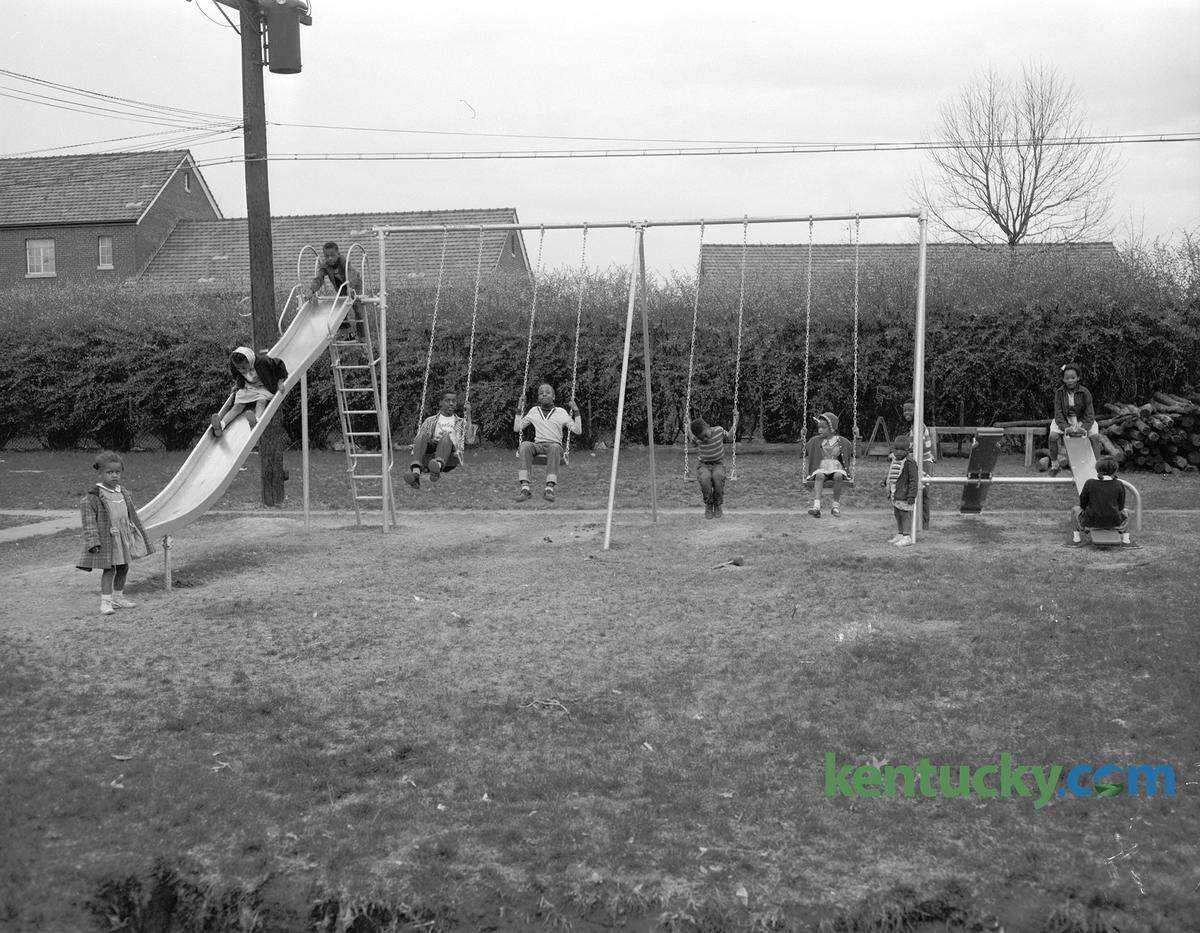
One of the playgrounds in the African American section of the Bluegrass-Aspendale housing project in Lexington’s east side in April 1954. An eight-foot fence separated blacks and whites from 1939 until January 1974. Published in the Lexington Herald-Leader April 18, 1954.
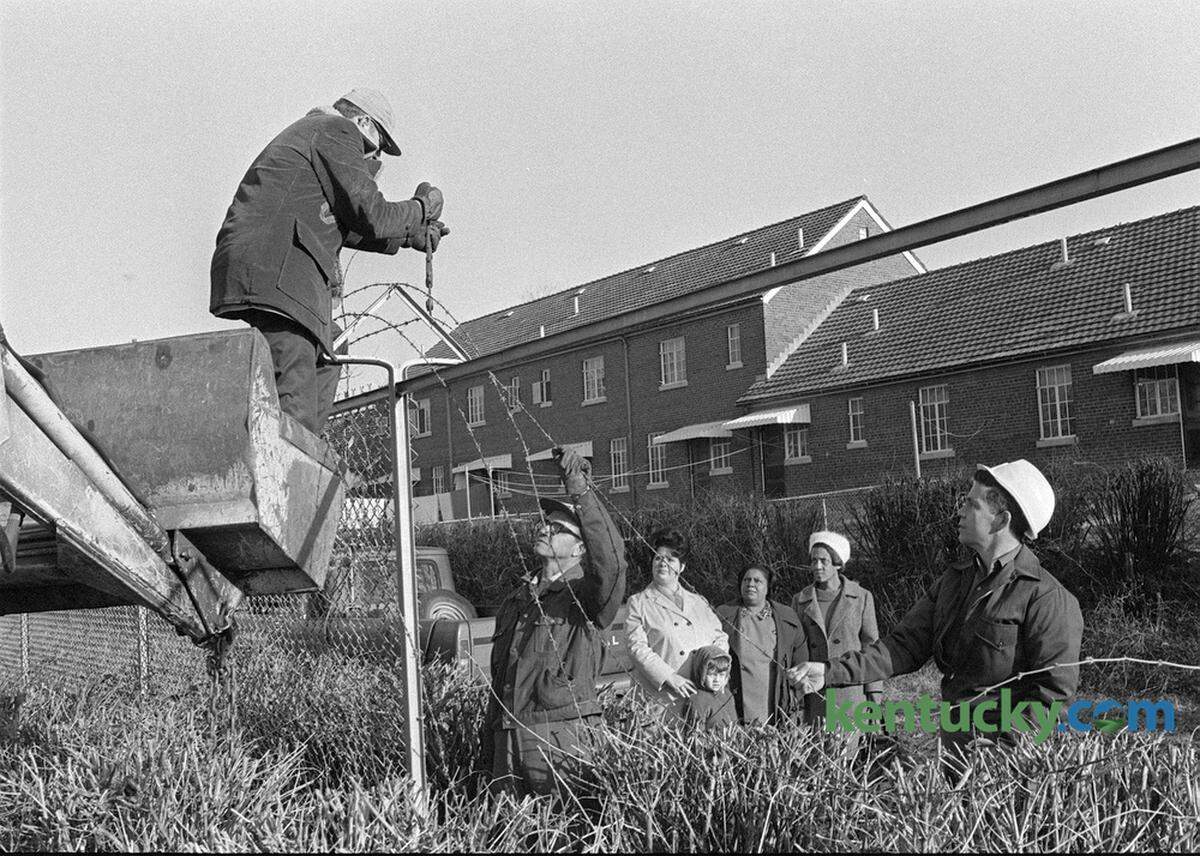
An eight-foot fence that separated blacks and whites since 1939 in the Blue Grass-Aspendale Housing Project comes down January 30, 1974. Taking down the barbed wire are, left to right, Jay Martin, Warren Gerton and Earl Osten, supervisor. Looking on are, left to right, residents, Mrs. Ruby Anderson and her son Steve; Mrs. Edith Hines, president of the Residents Council and Mrs. Lola Jones, also a council member.
Not to venture too far off Keeneland here at the end, but I found Lexington’s horse racing history too interesting to not make mention of it. If you’d like to learn more about the history of Lexington’s East End and its connections to Black horsemen then check out Phoenix Rising Lex online.
See you back here next week where we’ll go through the archives of some of Kentucky’s big NCAA wins. Just because we didn’t make it past the Sweet Sixteen this year doesn’t mean we can’t take a look back at some of the other big wins in a really outstanding basketball program.
Until next time.
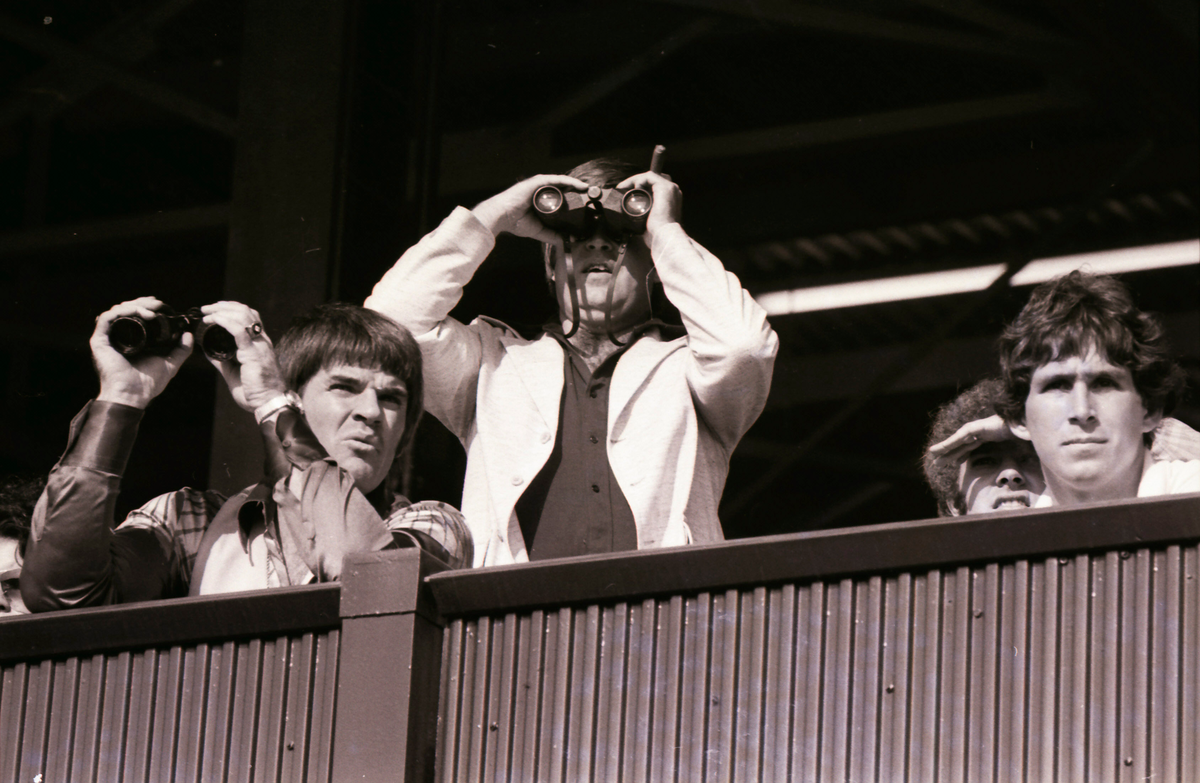
Cincinnati Reds third baseman Pete Rose, left, grimaced while watching the races at Keeneland on October 13, 1976. Rose, relaxing before the World Series, attended the races with a high school pal, Joe Kaiser with binoculars, and shared a box with sportscaster Tom Hammond, rear, and University of Kentucky basketball player Rick Robey. The Reds had won the National League Playoff Series against Philadelphia the day before.
This story was originally published March 31, 2025 at 10:37 AM.