‘Ready to pursue what we need to do.’ UK reaffirms commitment to Title IX
AI-generated summary reviewed by our newsroom.
- UK reaffirms investment in women’s sports amid evolving NCAA revenue models.
- Title IX concerns emerge as House v. NCAA settlement faces multiple appeals.
- STUNT projected for NCAA championship by 2027 following national recommendation.
University of Kentucky director of athletics Mitch Barnhart may have his hands full with revenue sharing, but he reiterated the school’s commitment to Title IX amid a flood of changes to college sports.
Though Title IX has played a significant role in guiding college athletics since President Richard Nixon signed it into law on June 23, 1972, the latest monumental shift in the evolving landscape has left many in the dark when it comes to how the amendment may be considered going forward.
On June 6, after months of anticipation, Judge Claudia Wilken approved the monumental House vs. NCAA settlement. The settlement necessitates that $2.8 billion of back damages be paid to student-athletes who — due to their participation in varsity athletics before the NIL era — could not cash in on name, image and likeness opportunities.
Among other changes, the settlement agreement affects NIL opportunities and scholarship and roster limits, calling into question the future of “non-revenue sports.”
Despite the fact that UK has confirmed it will share $18 million of revenue with student-athletes in the coming school year, Barnhart told the Herald-Leader that the revealing of “fixed numbers” when it comes to the specific allocation of those funds makes it “really difficult for you to be flexible to whatever situation you may have in front of you.”
Barnhart is confident that each of his coaches will get what they need in order to perform at the highest level, and to compete within the Southeastern Conference, regardless of whether or not they lead a revenue sport.
On June 11, Front Office Sports reported that the first appeal of the House vs. NCAA settlement had been filed.
Per the publication, the group of eight current or former Division I athletes — Vanderbilt’s Kacie Breeding (track and field), College of Charleston’s Lexi Drumm (soccer), Emma Appleman (volleyball), Emmie Wannemacher (soccer), Riley Haas (soccer), Savannah Barron (soccer) and Elizabeth Arnold (soccer) and Virginia’s Kate Johnson (volleyball) — argue that “the calculation to distribute the $2.8 billion in damages violates Title IX because female athletes would theoretically receive less money than football and men’s basketball players in damage payments and revenue-sharing.”
CBS Sports reported June 11 that, in response to the appeal, the approved $2.8 billion in back damages to former student-athletes (since 2016) are paused “until the appeals process reaches a conclusion.” However, revenue sharing plans are not expected to be affected, and will still go into effect July 1.
Another appeal levied by “four more female athletes,” is also in the works, CBS Sports reported.
Barnhart told the Herald-Leader that Wilken laid out a blueprint for several points throughout the approval — but that matters pertaining to Title IX were not among them.
“I think that the judge has given some framework for a lot of things,” Barnhart said. “She didn’t give a lot of framework, I don’t think, on that piece … we’re concerned with Title IX. We want to make sure we’re thoughtful about how we do it. There’s pieces of this puzzle that they say applies to Title IX, it doesn’t apply to Title IX, and we’ve got to be thoughtful in what we do.”
UK sponsors 23 varsity sports teams, with its most recent addition, STUNT, serving, per Barnhart, as an example of the university’s commitment to women’s sports — a 65-athlete roster competing in “one of the fastest-growing sports in the country.”
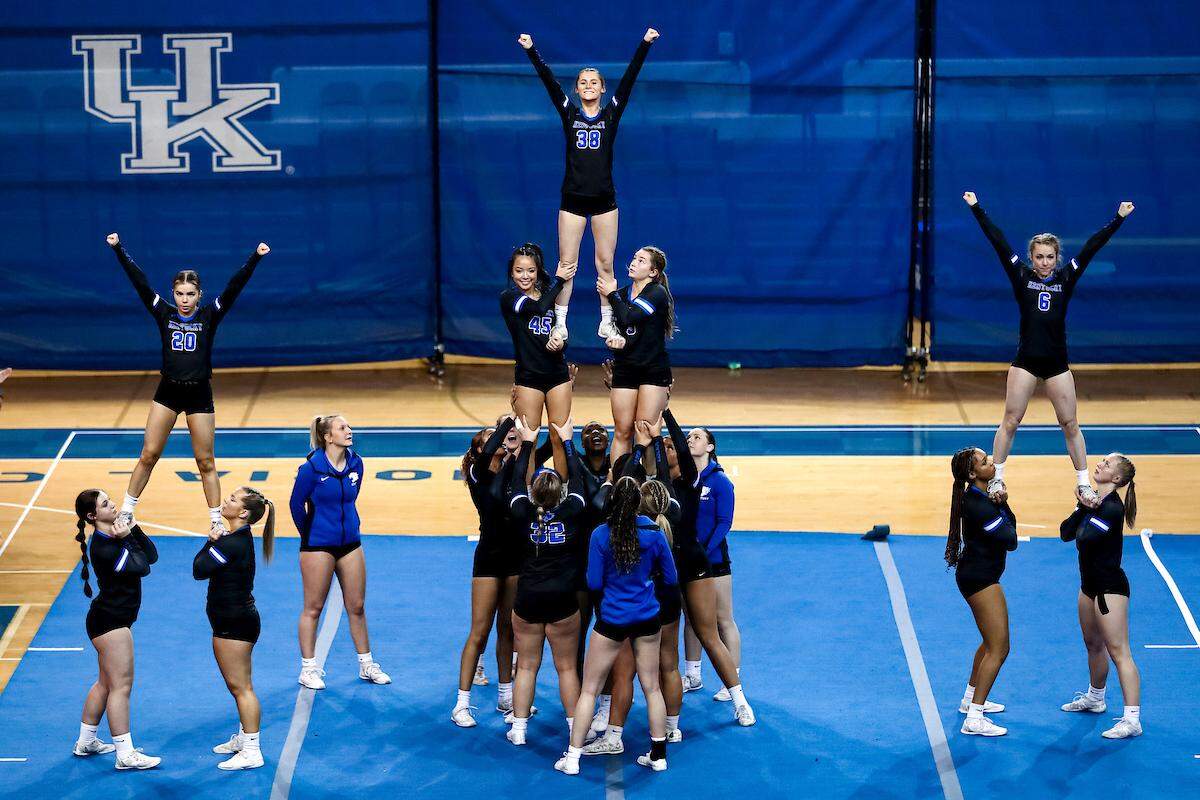
STUNT, which is not considered by the NCAA as a championship sport, is now projected to have its first NCAA-sponsored championship “as early as spring 2027,” following a May 15 vote by the NCAA Committee on Women’s Athletics.
The vote, which declared an official recommendation that “Divisions I, II and III sponsor legislation to add a national collegiate STUNT championship,” is dependent upon an NCAA-official confirmation of school sponsorship and athlete participation numbers for the spring 2025 season.
Kentucky announced the addition of STUNT to its varsity athletics program in September 2021. The sport, a four-quarter competition derived from cheerleading, is heavily championed on a national level by Sandy Bell, special assistant to Barnhart.
“I don’t think there’s been any mistaking how supportive we’ve been of women’s sports here at the University of Kentucky,” Barnhart said. “We’ve been on the forefront of that for a long time … just the development of a sport that, essentially, Sandy Bell has almost single-handedly created on a national level from STUNT, I mean, it is now going to be, one of the fastest-growing sports in the country, because of one woman here in Lexington, Kentucky, who took it upon herself to create something for young women.”
Each of Kentucky’s team national championships this decade — volleyball (2021) and rifle (2021 and 2022) — have been won by a women’s or co-ed program, while football’s sole season with more than seven wins since 2020, the 2021 campaign featuring a 10-3 record and a victory in the Citrus Bowl, has since had its wins vacated following NCAA violations.
However, athletic success, is not synonymous with revenue generation.
Around the country, non-revenue sports are being restructured, or even eliminated, in an attempt to maintain an athletic edge as financial demands grow.
Schools such as Radford, which recently announced it will cut its men’s and women’s tennis programs entirely, or Washington State, which announced significant cuts and limitations within its track and field programs, are struggling to keep up with the increased pressure on athletic departments.
Kentucky may not be issuing any “fixed numbers” with regard to revenue sharing, but Barnhart said the athletic department and university aren’t going to stop investing in women’s sports.
“We have conversations about (Title IX),” Barnhart said. “But the most important thing is that our coaches walk out of here saying, ‘We’ve been thought of. We have been given what we need to succeed to be a part of the Southeastern Conference and the national landscape.’ And our coaches, we’ve done that. We’ve invested in them, whether that’s what we’ve done in Memorial Coliseum or what we’ve done in scholarships, new scholarships we’re putting into our program. We’re ready to pursue what we need to do to continue to have our women’s programs be the best in the country.”