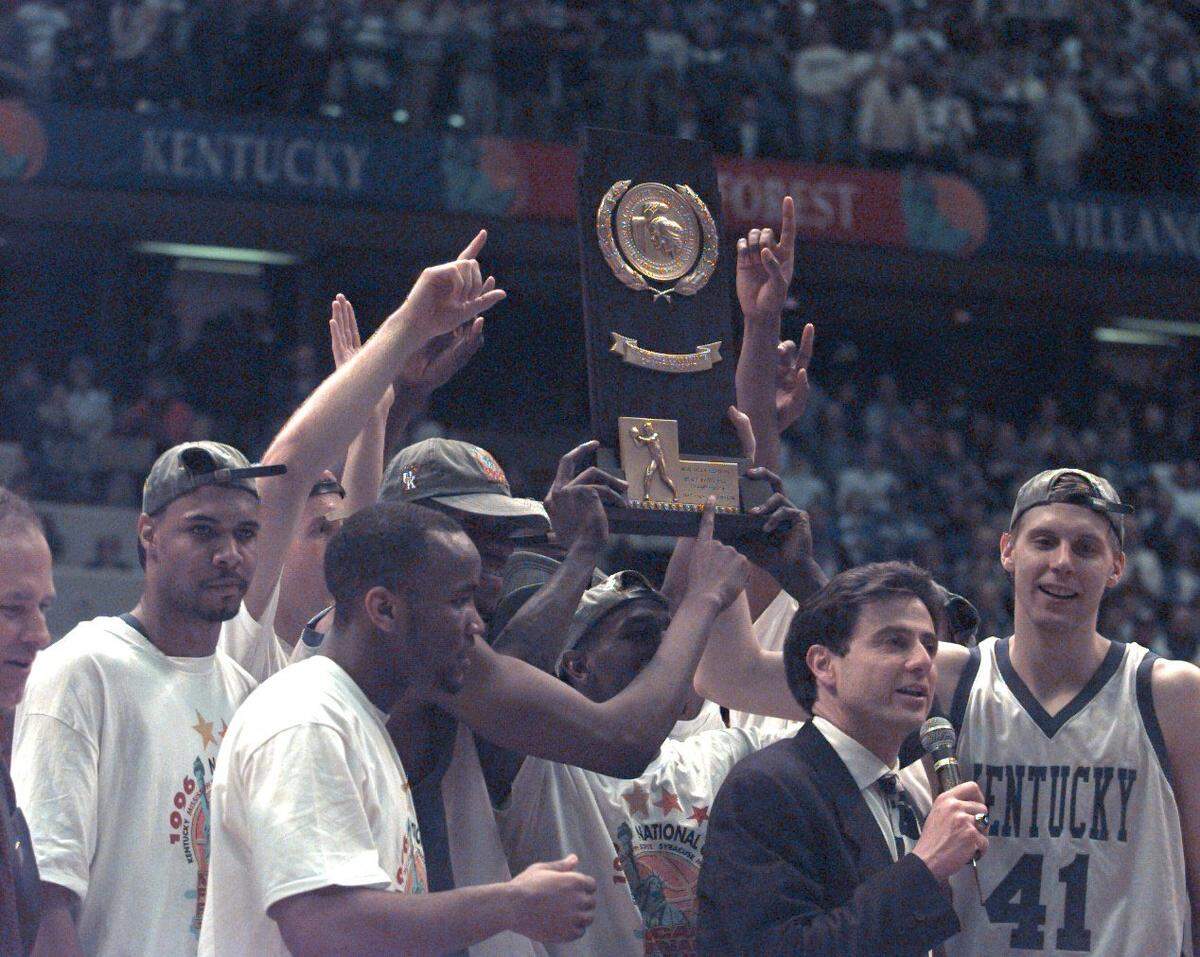
‘We had one voice’: Here’s what made that 1996 Kentucky basketball team so great
AI-generated summary reviewed by our newsroom.
- Kentucky’s 1996 team combined elite talent, depth and relentless defensive pressure.
- Coach Pitino enforced intense practices and clear authority to forge team unity.
- Most 1996 players will reunite at Rupp Arena for Saturday’s game against Tennessee.
For any college basketball team that wins a national championship, that final victory and everything about it — cutting down the nets, passing the trophy around, all the rest — remain in the memory banks forever.
The little things along the way linger, too.
On Saturday night in Rupp Arena, members of Kentucky’s 1996 NCAA title team will reunite for a 30th anniversary celebration. The former Wildcats will be feted by the UK fans during the current Cats’ rivalry game against Tennessee.
Behind the scenes, they’ll get together and reminisce about the old days. And as they get to talking, those memories will surely come pouring out. Three decades later, it’s funny the things that leap to mind.
“I think a common memory that we still laugh about is the night that we beat Georgia,” former UK guard Jeff Sheppard said with a chuckle. We were up by 20, but we only won by 13, and then we had to practice at midnight after the game.”
It’s funny now. It wasn’t then.
Coach Rick Pitino certainly wasn’t laughing about it. He was so upset about Kentucky’s 86-73 victory — or, more likely, so dead set on sending a message a month before the NCAA Tournament was set to begin — that he kept the Cats in Rupp Arena for a midnight practice.
“It says a lot about that season that — I mean, you know, what we would do right now to take a 13-point win at home — and we were disciplined because of a 13-point win at home,” Sheppard said. “But it was a different day.”
That 1996 team — one of the greatest squads in college basketball history and arguably the best to ever wear UK blue — trounced the opposition so thoroughly that the 13-point win over the Bulldogs was their slimmest win over an SEC team in Rupp Arena, where they won every single game by double digits. Those Cats’ average winning margin: 22.0 points per game, with only two losses all season long.
The bonds that formed the foundation for that greatness have endured over the decades, even if the opportunities for all the Wildcats to get together in great numbers have been few. That’s what makes weekends like this so special.
“We do a pretty good job,” Sheppard said. “We’ve got some group messages that we are able to stay in touch with each other, but there’s nothing like seeing each other and laughing and reminiscing with one another and catching up on family and life.
“So it’s exactly what most reunions are about. You know, a lot of laughs, exaggerated stories. And we just have a lot of fun.”
How many of those “exaggerated stories” revolve around the man who was in charge of the Cats? Sheppard didn’t hesitate.
“Most of them are,” he said, matter-of-factly. “Because (Pitino) pushed us to the limit, physically and mentally. Those were the days of no cell phones, no social media, no agents, no NIL. We had one voice in our head, and it was his. And so things were simple. And there were all kinds of stories, in regards to how hard he worked his staff, how demanding he was in practice, in the offseason, during the games. …
“And so, yeah, a lot of the stories are about funny things now that he said during practice or in the games. Decisions that he made to have midnight practice — after winning a game — and just whatever he could do to motivate his team to get the very best out of them, so that he gave himself and his team a chance to win a championship.”
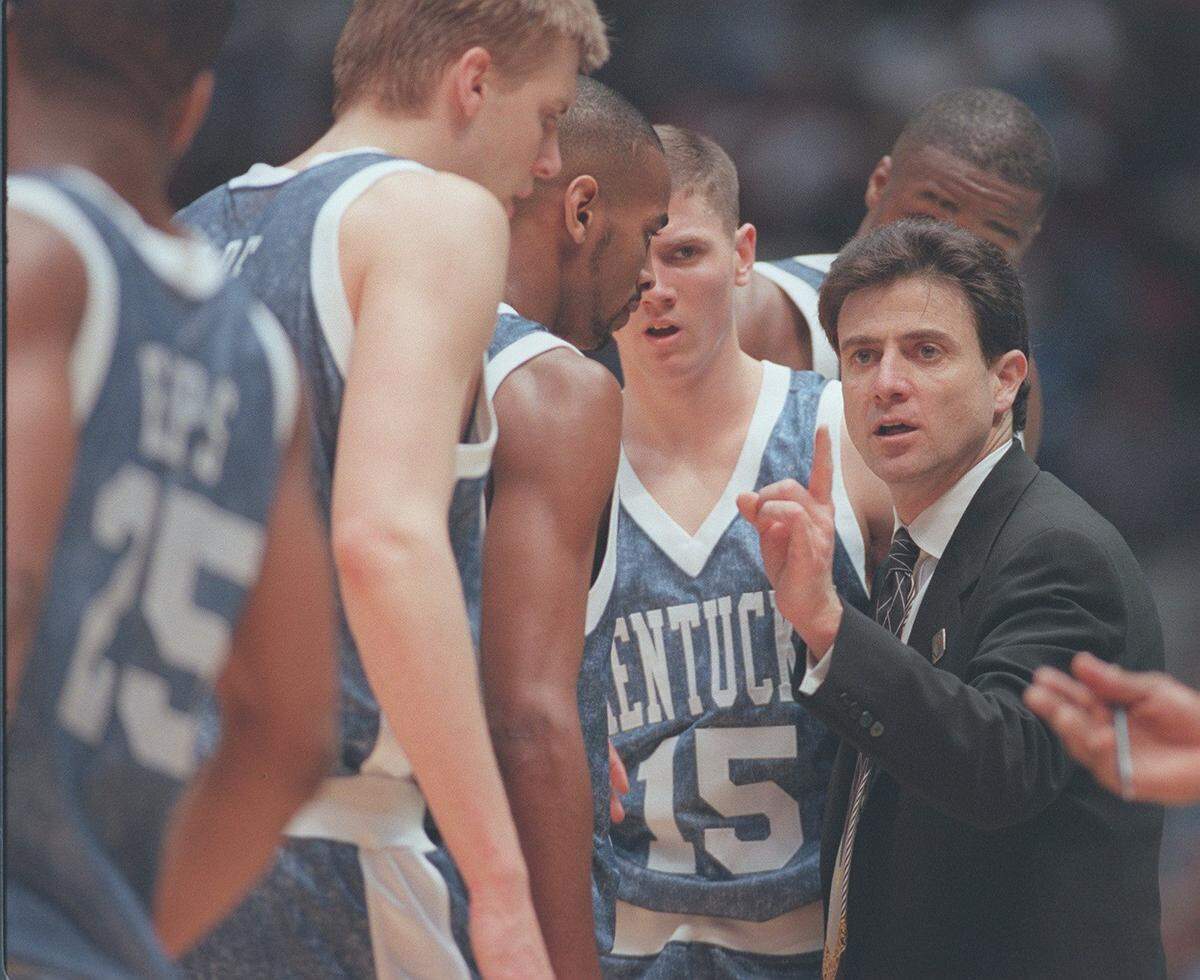
The senior co-captains on that squad were Tony Delk, Walter McCarty and Mark Pope, who’s now the head coach of the Wildcats. The group featured three future NBA lottery picks — Derek Anderson, Ron Mercer and Antoine Walker — and ran more than 10 deep at times, with guys like Anthony Epps, Wayne Turner, Allen Edwards and Sheppard playing key roles (and the latter three all winning another national championship in 1998, playing for Tubby Smith).
Nazr Mohammed was a little-used freshman then, but he was an integral part of the Cats’ 1998 title team and played 18 years in the NBA. Cameron Mills appeared in only seven 1995-96 games as a walk-on, but he, too, played a major role on the ’98 team. Jared Prickett was limited to only five games due to knee issues, took a redshirt year and came back to help UK advance to the 1997 title game in Pitino’s final year as UK coach.
Delk was the team’s leading scorer and the Final Four’s Most Outstanding Player in 1996, the closest thing to a star amid the unreal collection of talent that season. Delk’s obligations as an NBA scout won’t allow him to attend this weekend’s reunion, but he joined Pope’s weekly radio show Monday night to talk about the glory days and what made that team so great.
“We had a connection. I think we had a real brotherhood,” he said. “Everyone enjoyed playing with each other. We knew how hard it was to compete every day, but Coach Pitino got us to compete at the highest level. … We really got to a high level of competition, and we just really wanted to go out there and showcase it, because we competed so hard at practice.
“And Mark can tell you this — we always thought about game days being days off. And practices were 10 times harder than games, but that’s where Coach Pitino elevated our games.”
The Cats’ current coach has never been shy about giving Pitino credit for that ’96 title run.
“Coach was so masterful at putting us into a little bit of a bubble where all the noise around us — you certainly heard it — but Coach’s voice was so strong,” Pope said. “He was so intimidating at times — so demanding, pushed us so hard — that everybody kind of leaned on each other to survive. And I think that was one of the beautiful things that happened there is just the brute force of his will forced us all to kind of band together.
“I felt like it was harder for us to deal with Coach than it was to deal with the opponents just about every single day, right? And that was a gift that he gave us. It was very intentional, and it was a masterful way of taking a bunch of prima donnas that we all were and getting us to all be in this together.”
That Kentucky team started the season at No. 1 in the AP Top 25 poll but lost to John Calipari’s UMass squad in game two. The Cats then ran off 27 wins in a row — absolutely decimating their foes in many of those matchups, earning the nickname “the Untouchables” along the way — before falling to Mississippi State in the SEC Tournament title game.
UK won its first four March Madness games by an average of 28.3 points — an 83-63 victory over Tim Duncan and Wake Forest in the Elite Eight the closest of the bunch — before winning the rematch against UMass in the Final Four and beating Syracuse for the national title.
Obviously, talent had a lot to do with the success. Those Cats had plenty of other things going their way.
“It starts with a great leader, and Coach Pitino was a great leader, with a great style of play that was different,” Sheppard said. “And so it gave us the ability to score a lot of points. It gave us the ability to create a lot of easy baskets off of our defense and our style of play, with the speed that we played and the pressure that we put on teams, defensively. We had the depth to be able to substitute a lot of players. And so we were fresh most of the time.”
Kentucky averaged 91.4 points per game and forced 22.2 turnovers per game, a deadly combination of versatile scoring ability and relentless defensive pressure. The Wildcats’ size and sheer numbers led to mismatches all over the court, all game long.
Perhaps the most important ingredient for success came from something that is so rare in college basketball these days: continuity.
“You put time as an ingredient, meaning we spent years together,” Sheppard said. “So you mix a bunch of time in there, and now all of a sudden, that leads to relationships. And friendships. And that makes it easier for us to sacrifice for each other, and compete for each other. …
“There are a lot of off-the-court memories that we have. We bowled together. We played laser tag together. We even wrestled each other — six against six wrestling matches. There were just so many things that we did together. We lived together. We went to study hall together. We traveled together. We played cards together. At night, we were watching movies together. Everything we did, we did together. And you multiply all of that time together — year after year after year — and it spills over on the court.”
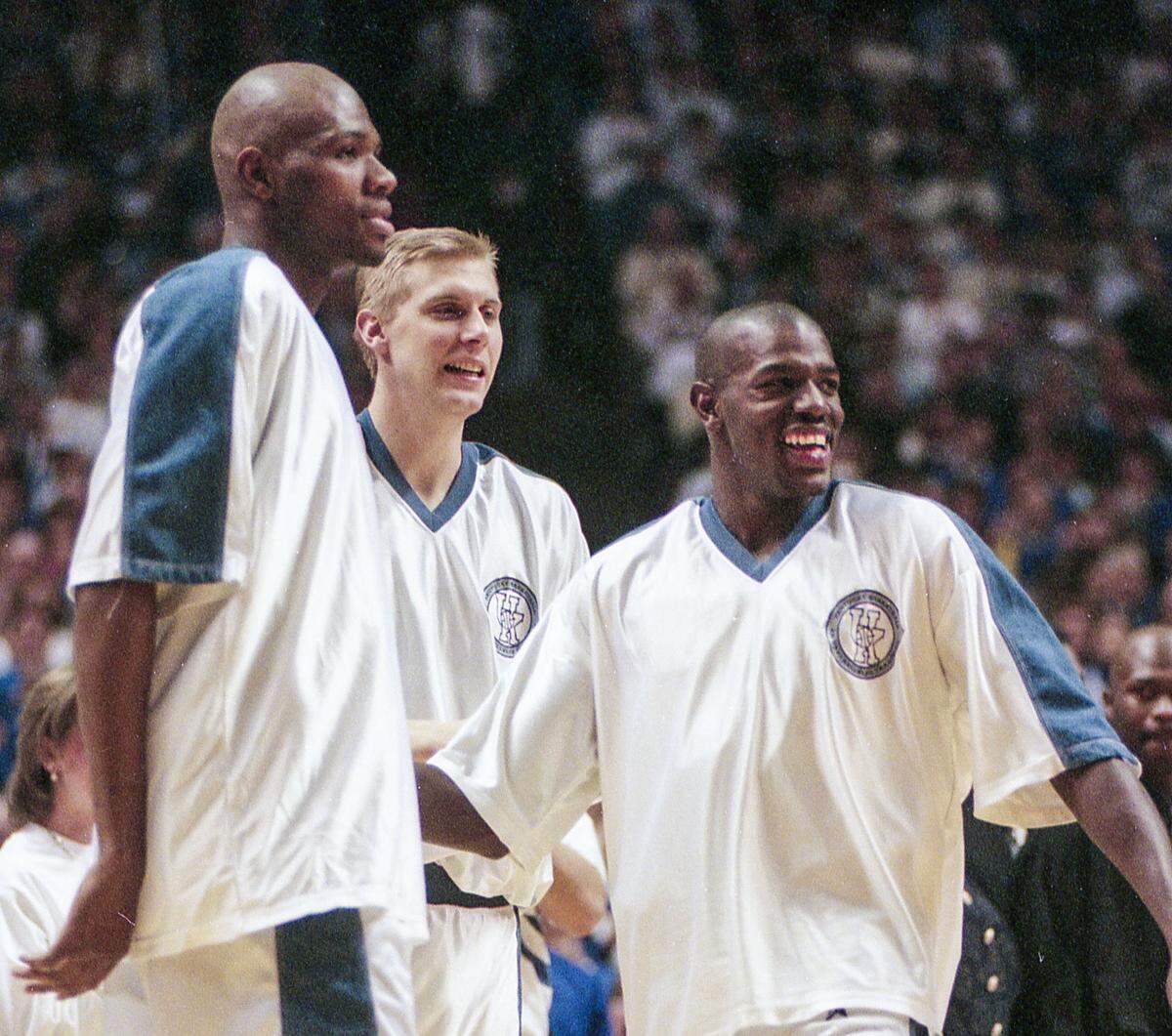
He pointed out that Pitino built the foundation for Kentucky to have a realistic chance to win a national title every single season throughout the 1990s, starting with the 1992 team that lost to Duke in the Elite Eight — the first year the Cats were eligible for the postseason after two years of probation that Pitino inherited — on through the coach’s final season in 1997, when UK lost to Arizona in the national title game in overtime, and then the following year, when Smith led the Wildcats to the 1998 championship in his first season as coach.
While Delk won’t be able to make it this weekend, nearly all of the rest of that ’96 roster is planning to be in Lexington for the festivities. The architect of the team will be coaching his St. John’s squad against No. 3 UConn in Madison Square Garden on Friday night in a game that could ultimately decide the Big East title. St. John’s plays again Monday night, so another Pitino appearance in Rupp — after his rousing return at Big Blue Madness in 2024 — seems unlikely.
But even if he’s not there in person, the former coach will be a topic of conversation.
Pope still gets a kick out of sharing Pitino stories, as all of his former Wildcats do. Those tales typically have competing narratives. They often include Pitino being upset with a player, or a player being upset with Pitino — many times, it’s both — and end with a declaration of love and respect for the Kentucky coach.
“You can say it this way. We loved him, and he loved us,” Sheppard said. “But, at the same time, there were definitely moments where we didn’t like him, and he didn’t like us.”
Delk told a story this week of the Mardi Gras Miracle — when the Cats came back from 31 points down to win at LSU in 1994 — and Pitino cussing them out during the game. Delk was a sophomore that season, and it was so difficult — at the beginning of that night, especially — that he actually considered transferring.
“Because I already knew what the next day of practice was gonna be like,” Delk said. “Coach Pitino said, ‘It’s gonna be the worst day of your life.’ And in the back of my mind, I was like, ‘Man, I felt like every day was the worst day of my life.’ I’m like, ‘It can actually get even worse?’”
Delk was laughing as he recalled that memory. And Pope was laughing on the other line.
“So, long story short, we end up coming back, winning the game, and it ended up being one of the best days that I can ever remember — just seeing the smile we put on Coach Pitino’s face,” Delk said. “So it was always the pressure of losing and knowing how Coach was going to react the next day. I think that was the fear factor that we had, and that was the reason why we won so many games.”
Fast forward two years to that 13-point win over Georgia in Rupp, a game that got too close for Pitino’s liking, to the point that he made his future NBA players — a team with a 21-1 record at that stage in the season — stay in the arena and practice at midnight.
A quick glance at the schedule shows that the game happened on Valentine’s Day.
Sheppard didn’t remember that fact, but he laughed out loud at the mention of it.
“Oh, even better,” he said of Pitino’s special valentine to his players.
And, three days later, the Cats went to Knoxville and beat Tennessee by 40 points.
Sheppard chuckled at that fact, too.
“There you go,” he said. “So I guess he knew what he was doing.”