
Why UK’s search for a Mitch Barnhart replacement may end with multiple hires
AI-generated summary reviewed by our newsroom.
- UK may hire multiple people to replace longtime athletic director Mitch Barnhart.
- Athletic department management models under review include multiple hires.
- Search for Barnhart’s successor remains vague as it enters month three.
Two months since longtime Kentucky athletic director Mitch Barnhart announced his retirement plans, specifics about the search for his replacement are hard to come by.
But as the search enters month No. 3, it has become increasingly apparent that UK might not actually be looking for one replacement.
Various models for athletic department management under consideration would see the school hire multiple people to replace Barnhart.
“In this new environment, the organizational structure may have to change,” UK president Eli Capilouto told the Champions Blue board of governors at its meeting last week. “We have an incredible team, and they will continue to do great work, but we must examine what other organizational and structural models — many of those you’ll find similarities in business, professional sports and other entities — are necessary.”
The first two months of the search have been dedicated to Capilouto’s listening tour, on which he has met with more than 70 people to hear feedback about the new challenges facing college sports in the wake of the NCAA’s House legal settlement, which opened the door for schools to distribute up to $20.5 million in revenue directly to athletes. The revenue-sharing cost has led UK and most other schools to an intense search for new revenue streams.
The ability of athletes to transfer without sitting out a season combined with the need for coaches recruiting those athletes to negotiate contracts outlining revenue-sharing payments and potential outside endorsement deals have brought many of the skills needed to run a professional sports organization to the college level.
Capilouto’s listening tour has come with homework for people interviewed to gain a better understanding of that landscape. Included in the assigned pre-interview reading is a breakdown of four proposed organizational models for Champions Blue, the nonprofit LLC created last year to manage the athletic department. The proposals were developed by consulting firm Deloitte for UK.
Each of the proposals involves the creation of new administrative positions in the department, but they are presented in a sliding scale of change from the current leadership structure. The two proposals that would bring the most change include the hiring of a chief commercialization and growth officer that would share leadership responsibilities with the athletic director. (Specific titles could be altered to satisfy human resources requirements)
The chief commercialization and growth officer would be “responsible for all revenue operations,” according to Deloitte. In one model, that position would oversee a marketing analytics position. In the most drastic change to the current structure, the new marketing analytics position, a fractional chief financial officer and all athletic department general managers would report to the CCGO instead of the athletic director.
That proposal, which Deloitte calls the “enhanced commercialization and growth model,” would leave the athletic director in charge of operations and competition.
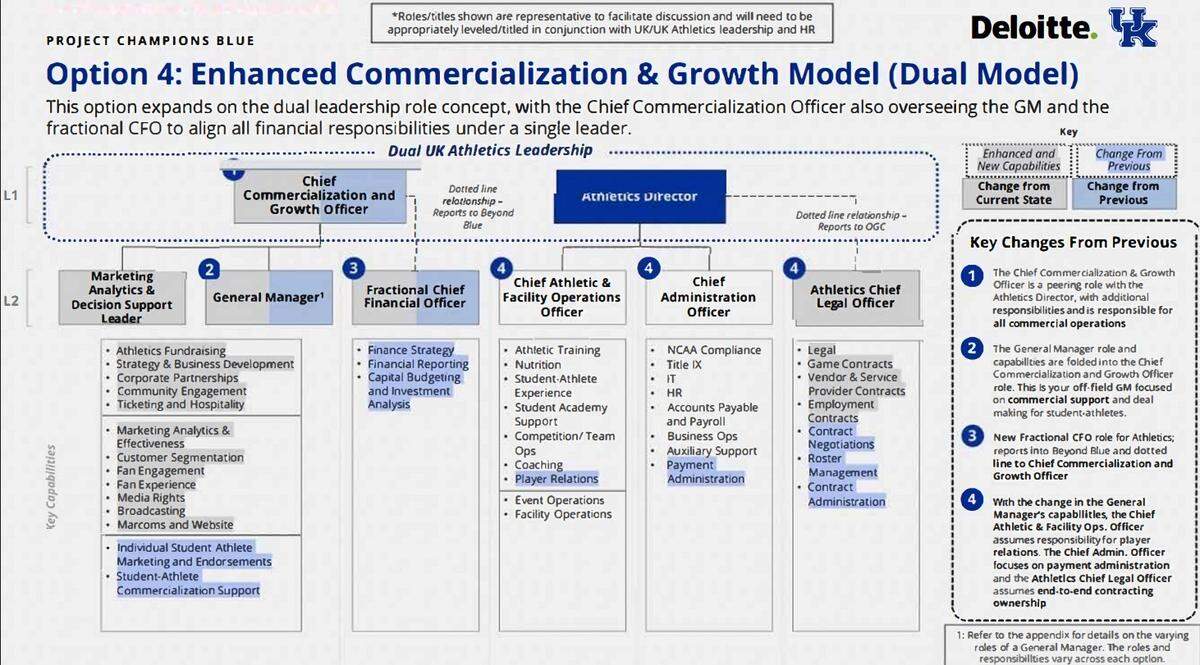
Deloitte’s study includes a list of benefits and constraints of each proposed model.
The model that essentially keeps the status quo “doesn’t support development of the financial capabilities needed,” according to Deloitte’s analysis. The other model that leaves the athletic director position as the sole leader of the department, “limits the dedicated focus needed for both athletics operations and revenue growth,” according to Deloitte.
Deloitte’s study highlights the revenue generation capabilities of the two dual-leadership proposals but acknowledges the models would necessitate drastic changes to the way the department’s current employees are accustomed to operating.
The amount of change needed for such a model cannot be overlooked.
“It has to be governed with somebody that knows what the hell they’re doing, because it could be a big liability if you do not surround yourself with people that understand the culture that is higher education,” Northern Illinois athletic director Sean Frazier, the president of the National Association of Collegiate Directors of Athletics, told the Herald-Leader in March.
Kentucky is not the only school considering new athletic leadership structures.
Last week, Notre Dame named football administrator Ron Powlus as its first chief operating officer for athletics. LSU announced a new structure in March that saw new athletic director Verge Ausberry assign new responsibilities to multiple administrators for the management of individual sports and hire former McNeese State athletic director Heath Schroyer in a role that would oversee the men’s basketball program.
Capilouto told the Champions Blue Board he still has not decided what the organizational structure of the athletic department will look like after Barnhart’s retirement June 30. The Deloitte analysis includes a note that an interim or hybrid solution could be implemented July 1 with a plan to transition to a more permanent structure as future hires are made.
It remains possible — perhaps even likely — that Capilouto picks a structure that blends two or more of the Deloitte proposals together.
Whatever the structure looks like moving forward, the challenges of running an athletic department are vastly different than they were when Barnhart was hired 24 years ago. In his final years on the job, Barnhart acknowledged he was able to spend less time focusing on actual competition because he was forced to spend more time focusing on adapting to the constant rule changes in college sports.
Splitting his duties among multiple administrators would seemingly better position UK to hire someone from a professional sports or business background to focus on generating the revenue needed to bring the department back to profitability, but it would lead to more questions, too.
Can you really separate the finances from competition? If the men’s basketball team struggles next season, which administrator makes the decision on coach Mark Pope’s future, the one in charge of “competition” or the one in charge of finances? When a coach pushes for financial investment in a program to improve the product on the field, does the athletic director give approval or the CCGO?
“We have a lot of even athletic administrators as well as presidents and chancellors that are stuck in this role of, ‘OK, maybe we can do it differently by maybe splitting duties or changing or bringing something in,’ instead of addressing the major component of it, which is you’ve got to be sensitive to all of the different changes that must be satisfied,” Frazier said. “And doing that by bifurcating it or changing or giving different people titles, that’s not going to get it done.
“What’s going to get it done is really knowing your institution and really saying to yourself, ‘Hey, I’ve got to do these things better, because I never did them in the old regime better. But I got to get it right now, because the investment is so large now.’”