
New cost-of-attendance payments to athletes not as large at Kentucky as some of its competitors
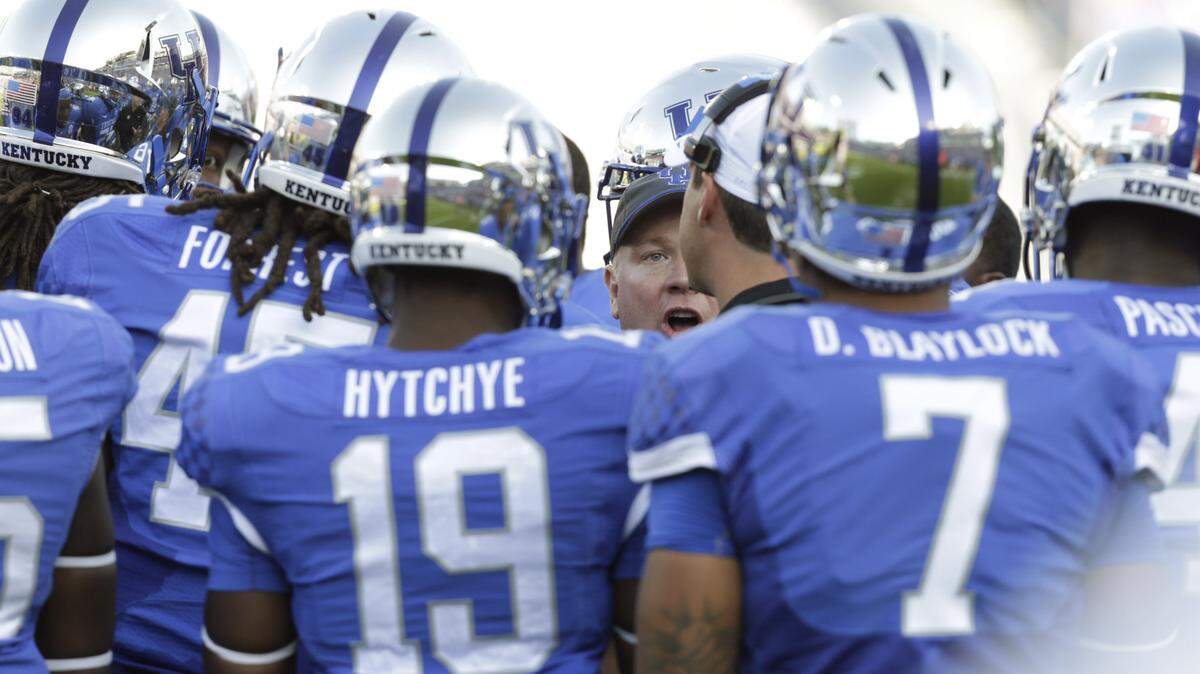
Imagine pulling up to a drive-through and seeing a Kentucky football player waiting there with your shake and fries.
Blake McClain ponders that scenario regularly.
"I think about it all the time," the UK defensive back said, "maybe just work at McDonald's for two days a week or something, then maybe I'll have some money in my pocket for extras."
A decision this spring by UK Athletics officials will put a bit of extra money in the pockets of McClain and every other scholarship athlete at the university starting in August.
The decision is not to be confused with the "Pay to Play" debates that have been floating around athletics circles for years.
The new money available for athletes — between $3,330 annually for in-state students and $3,598 for students from outside Kentucky — is similar to what already comes as part of academic scholarships and loans that other students on campus receive.
A vote in January by the 65 schools in the "power five" conferences — ACC, Big 12, Big Ten, SEC and Pac-12 — paved the way for athletes at those schools to be eligible for the extra money meant to cover things like travel and personal expenses.
The basic athletic scholarship now only covers tuition, room and board, books, fees and supplies. It does not cover any kind of travel or personal expenses, but it will starting in August.
"It's something we think is very important," UK Athletics Director Mitch Barnhart told the Herald-Leader in February.
The additional money ensures players will "be able to get home and see their families a couple times a year, for them to be able to have some recreational dollars to go see a movie, to have some money for toiletries or personal expenses," he said.
Several UK athletes, who only had a vague knowledge of the additional money coming next school year, said it could put additional food in the refrigerator and help pay for cellphones among other things.
"We're students as well, not just athletes, and we still need money," UK sophomore guard Linnae Harper said recently. "Not to just blow it, but we all have bills and stuff we have to pay for. We're adults with expenses, too."
Having some extra money is a big help for the current athletes, and it is a topic that has come up regularly during in-home recruiting visits, several coaches said.
"The kids just can't go out and get a job," women's basketball coach Matthew Mitchell said. "They just don't have time. They don't have time to put some extra money in their pocket. They certainly are not lazy people.
"At Kentucky, they are up early every day. They go to class, they work real hard academically; we are very demanding basketball-wise, so there is just not a lot of time to have a part-time job."
The financial infusion will mean putting less of a burden on his family, said receiver Jeff Badet, who has to travel 1,600 miles round trip to go home to Orlando, Fla.
That's rarely a cheap trip.
"I will be able to go home more; my parents don't have to pay for plane tickets and stuff," the wide receiver said. "I can pay it myself. It should be a huge benefit."
Some schools can offer athletes more than others
The U.S. Department of Education sets the guidelines for figuring a "cost-of-attendance" total at each school. It's a complicated formula with many variables, and the figures change slightly from school year to school year.
Under the new rules, how much each school is allowed to distribute to its athletes will be based on that cost-of-attendance total.
Since every school has its own unique cost of attendance, some athletic programs will be able to provide more money for athletes than others — which could become a selling point in recruiting.
The annual cost of attendance at UK for the 2015-16 school year will be $26,700 for an in-state student and $40,300 for one coming from out of state, according to university officials.
And while there is a base formula, schools are given some leeway in how they factor their numbers.
Some schools do regular student surveys about personal expenses and travel to set their numbers. Other institutions rely on a national company to help set their cost-of-attendance total.
At UK, officials go through the IRS's personal bureau statistics and use those figures for clothing and personal items, and then the number is raised or lowered based on inflation.
There are strict guidelines.
"We have to be able to justify it if the federal government walks in our door and asks us how we got to this figure while distributing federal funds," said David Prater, associate director of financial services at UK. "You better have a good way of justifying how you got to the numbers."
There is no national cap on schools' cost-of-attendance figures, but in general Barnhart noted that it "behooves a school to keep that number lower for the general student body.
"It's in a university's best interest ... because as they recruit students for this campus, they don't want to say the cost of coming here outside of the tuition is way up."
Each school's financial-aid office, not its athletic department, uses the national formula to set the cost-of-attendance figure for the school year. Institutions have been instructed not to tinker with their numbers in an attempt to provide extra incentive for athletes, officials said.
"I can't imagine any federal financial-aid office allowing any kind of athletic department to influence that, ours certainly would not," UK's Prater said. "They would not even attempt to come over here and say, 'Tennessee's higher or someone else is higher. Fix it.'"
A recent Chronicle of Higher Education article does in fact show that several of UK's Southeastern Conference brethren are offering higher payouts to athletes.
Three of the top four highest-paying programs according to the Chronicle's report are from the SEC in Tennessee ($5,666), Auburn ($5,586) and Mississippi State ($5,126). Louisville has the third-largest figure at $5,202. At least 10 athletic departments nationally would be offering $4,000 or more in additional aid via the new guidelines.
That same Chronicle of Higher Education report noted that UK would allot $2,284 extra per full scholarship athlete, but several university administrators said that number was not accurate, most likely because outdated figures were used in the report.
Cardinals athletics spokesman Kenny Klein confirmed the $5,202 figure for Louisville was accurate.
Barnhart acknowledged that it "would be to our advantage if the number were a little higher," but added that overall Kentucky is in the range of other comparable schools.
The payout numbers UK provided to the Herald-Leader ($3,330 in-state and $3,598 for out of state) were significantly lower than the aforementioned schools, but they would put UK in the middle of the pack in the SEC.
Schools like Alabama ($2,892), Vanderbilt ($2,780), Texas A&M ($2,706) and Georgia ($2,598) all will have payouts to athletes that are less than $3,000 annually, if their numbers in the Chronicle report are up to date.
When the amounts are broken down into monthly allotments, they aren't that dramatically different, Barnhart said.
"I want people basing decisions to come to Kentucky on the great people we have here, not on the 300 extra dollars we can put in their pocket for a year," he said.
"It doesn't mean someone's not going to try to use that against us, but I'm going to work really hard on the relationship side and see if we can't make that work."
Just knowing that UK is one of the schools that will provide the extra money as a part of its athletic scholarships was a boost on the recruiting trail, football coach Mark Stoops said.
"As you can imagine, nothing but smiles there from the prospects because they're coming into it at a very good time," he said.
Where will the money come from?
Once the money is handed over to an athlete each month at Kentucky, there are no stipulations on what he or she can do with it.
If a volleyball player wants to get a new tattoo, that will be her prerogative.
"It's their money," Barnhart said. "If a young person opts not to go home, that's their call and that'd be OK. But that's not a requirement. There's nothing like providing receipts. It will be their money."
The athletics director is hopeful that his department will be able to provide some form of financial literacy as part of this new benefit.
"I don't know that handing anyone a round check of money, 'Hey, here you go' is our wisest thought," he said. "We have to think our way through it, how we want to implement that."
Barnhart's department has had to do its own share of budgeting to plan for how it will take on the added cost of the stipends for each athlete.
He explained the rough arithmetic, which includes an extra $3,000 to $4,000 annually for roughly 300 athletes on full rides as well as proportionate payments for those on partial scholarships.
"Anyone can do the math," Barnhart said. "It's more than a million dollars in expense that you're going to have to find some money for that. We'll figure that out."
Kentucky saw this change coming and already started to budget for it. Most likely, revenue from the SEC Network and other lucrative contracts signed by the university and the league will help offset some of the costs.
It may require dialing back in a couple of areas, too.
"We're fortunate that we've got a really good, strong fan base," Barnhart said. "We're in a great conference and we have resources."
This story was originally published April 18, 2015 at 4:08 PM with the headline "New cost-of-attendance payments to athletes not as large at Kentucky as some of its competitors."