
What makes NBA Draft stocks rise and fall? Here are tips UK players should know.
When the clock strikes midnight Sunday night, college underclassmen can no longer enter their names in this year's NBA Draft. Those who met the NBA’s deadline — six Kentucky players in this group — will continue the process of trying to improve their draft stock.
So how does a player do that? What are the do's and don'ts associated with enhancing how you are perceived by NBA scouts and general managers?
One enduring truism involves the need to show at least one exceptional basketball skill.
"Whomever you’re looking at has got to have at least one, and hopefully two, hooks that you can say he does that, at least potentially, at the NBA level," said Del Harris, a longtime NBA coach.
It can be shooting. Or rebounding. Or passing. Or defending. Or rim protecting.
“He has to have something that can make him be a factor in an NBA game,” Harris said.
Former UK All-American Kenny Walker likened one of the Kentucky players who put his name in this year’s draft, Wenyen Gabriel, to ex-Cat Jules Camara: long, willing defender, enthusiastic player.
“But we haven’t seen him be dominant in one particular thing ...,” Walker said of Gabriel. “I think he needs to ... find something he can be really dominant in. I think he made a lot of strides from his freshman year to his sophomore year.
"Obviously, if he can come back one more year and make improvement, maybe put on a little weight, we know for sure he'll be more than ready at that time.”
Gabriel announced he would not hire an agent, which leaves open the possibility of returning to UK next season.
Harris, who is now vice president of the G League’s Texas Legends, acknowledged that it can be difficult to determine if a freshman has such an NBA hook. Many freshmen are not far enough along in the developmental curve.
“That’s where experience (as a scout) comes in, the eye test ...,” Harris said. “That’s why there’s still scouts out there.”
For examples of players who had that hook although still not fully developed players, Harris cited such ex-Cats as Anthony Davis (shooting, rim protecting), Malik Monk (shooting), De’Aaron Fox (penetrating and finishing) and Willie Cauley-Stein (athleticism for a center/forward).
Yes, athleticism is a hook. But is athleticism more important than basketball skill? Or less important?
“It’s a skill game now,” said Kevin Grevey, a former UK All-American who now scouts for the Los Angeles Lakers. “Athleticism sure helps. But we need to see a guy who’s skilled.”
To support his point, Grevey cited Steph Curry, who is highly skilled but no one’s idea of an athletic marvel.
“Great athleticism is not a highlight we’re looking for anymore,” Grevey said. “We want a high (basketball) IQ guy who can play the fast space-and-pace game.”
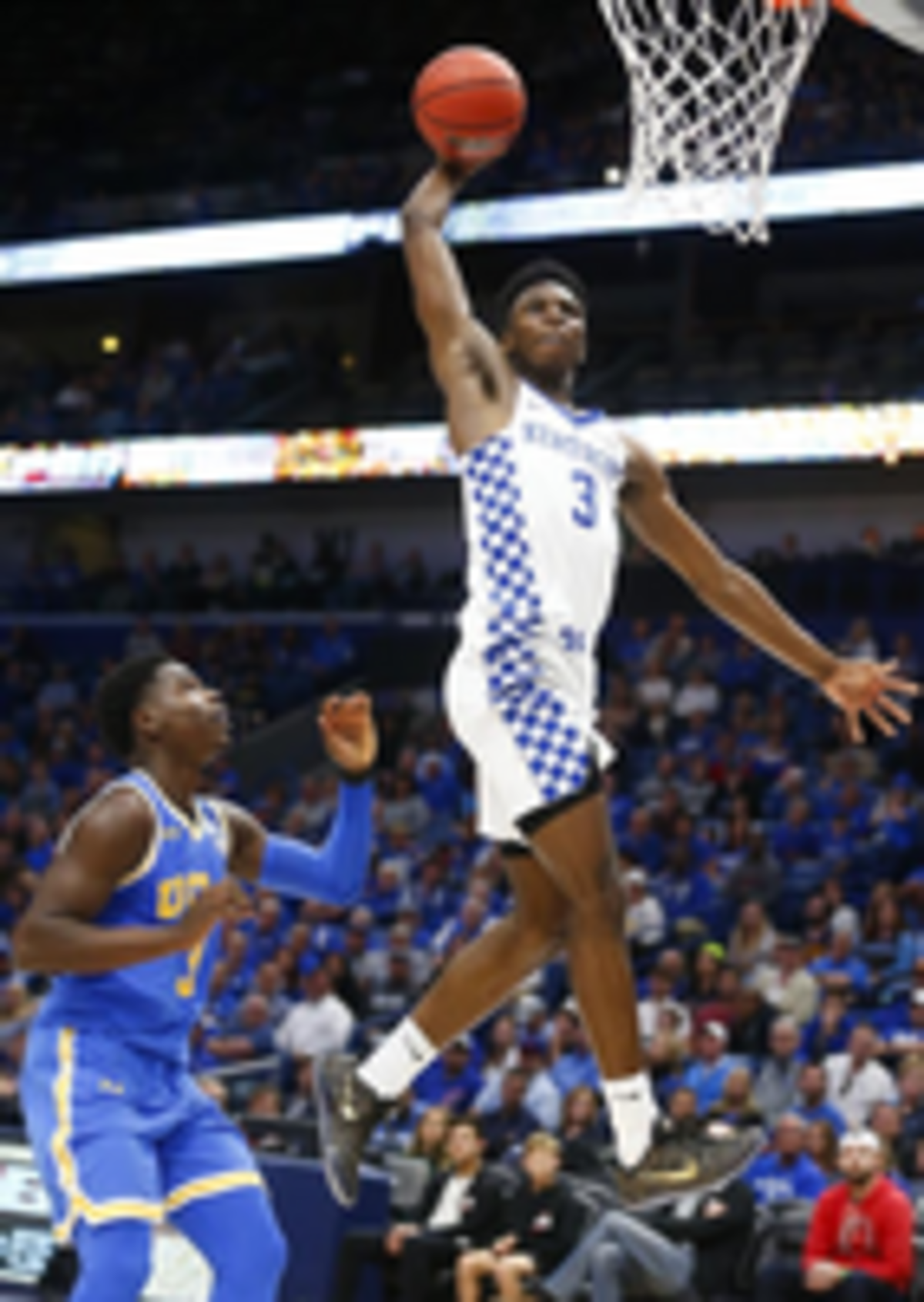
Another of the Kentucky players in this year’s draft, Hamidou Diallo, came to mind. He made a bit of athletic history last year. He had the second-highest vertical leap ever recorded at an NBA Combine. But basketball skills — shooting, passing, ball-handling — are important, too.
When asked if athleticism was one of those NBA hooks, Harris said, “athleticism alone? No. Those (kind of players) are easy enough to find. You have to have athleticism with something. ...
“There are so many athletic kids between 5-10 and 6-7 that you better be able to something besides (being athletic).”
If that basketball skill is missing, “go out for track and field,” Harris said.
Stay in shape
When asked, Del Harris gives draft advice to players and people in their support group. High on his list of recommendations: Stay in shape. Take 24 hours off after a long season, he said. “But after that, he better keep his butt in shape.”
There might be fewer secrets in NBA scouting than you think.
“If that guy comes in and already he’s out of shape, boy, I’ll tell you,” Harris said. “That word gets around so fast. There’s a lot of conversation going on between those scouts.”
Job insecurity among scouts and NBA front office personnel feeds this underground communication.
“They’re helping each other out a little bit,” Harris said. “There’s a brotherhood involved. There'll be some calls made. ‘How did Joe Bob do at your workout?’”
Duke and UNC
Both Duke and North Carolina will be on Kentucky’s schedule next season. The Cats play Duke on Nov. 6 in Indianapolis (Champions Classic) and UNC on Dec. 22 in Chicago (CBS Sports Classic).
History buffs will want to know that this will be the fourth time UK played Duke and UNC in the same regular season. It also happened in 2001-02, 1969-70 and 1963-64.
Kentucky won both games in 1963-64 and 1969-70. In 2001-02, UK beat North Carolina 79-59 in Rupp Arena and then 10 days later lost to Duke 95-92 in overtime in East Rutherford, N.J. In the latter game, future ESPN analyst Jay Williams led Duke with 38 points. He made seven of 10 three-point shots.
Transfers made easy?
Headlines will be made this coming week when the NCAA panel chaired by Condoleeza Rice releases its recommendations in the wake of an ongoing FBI investigation of corruption in college basketball.
Meanwhile, another NCAA panel charged with finding a way to reduce the number of athletes transferring from one school to another announced recommendations last week. Its members will vote on the proposals at a June meeting in Indianapolis.
John Niyo of The Detroit News said the transfer issue boils down to ownership of a college career. “The athletes want freedom and justice for all,” he wrote. “And the folks in charge of this multibillion-dollar industry are clinging to the status quo.”
The Big 12 Conference has offered what Niyo called a sensible path forward. The Big 12 called for removing restrictions that coaches, schools and conferences can place on transferring.
Recently, Pittsburgh tried to stop Cameron Johnson from transferring to North Carolina, Nick Saban objected to the graduate transfer of Maurice Smith to Georgia. And Kentucky did not look good in 2002 by trying to prevent Marvin Stone from transferring to Louisville.
The Big 12 called for removing the requirement for sitting out a season as a transfer if a player leaves a program hit with a postseason ban for NCAA rules violations.
Niyo asked if the same should apply for players transferring when the coach that recruited them leaves for another job or gets fired.
Meanwhile, Loyola Chicago Coach Porter Moser offered a cautionary word at the Final Four. If restrictions on transfers are eased, mid-major programs are “just going to be a farm system” for high-major programs, he said.
Judging coaches
How should we judge coaches? The regular season gives a coach much more of a chance to impact his or her team and players. But success or failure in the NCAA Tournament is what people remember.
Going into the Final Four, Villanova Coach Jay Wright noted how Bill Self-led Kansas had won the Big 12 regular-season championship for a record 14th straight year.
“That’s the mark of a great coach,” Wright said. “What you do in the tournament is not really a mark of your ... talent as a coach. But it’s matchups. It’s who’s healthy. You know, it’s a break here or there. It’s a call by a referee.
“So in coaching, we understand that you don’t have as much control of that tournament. You have control of your regular season a little bit more. But you are going to be evaluated on what you do in the tournament.”
Happy birthday
To Scott Padgett. He turned 42 on Thursday. ... To Ryan Harrow. He turns 27 on Sunday (today). ... To Fred Cowan. He turns 60 on Monday. ... To Bob McCowan. He turns 69 on Monday. ... To Father Ed Bradley. The priest on call during Rick Pitino’s time as UK coach turns 75 on Tuesday. ... To Dillon Pulliam. He turns 23 on Wednesday. ... To Todd Bearup. He turns 51 on Wednesday. ... To former UK assistant coach David Hobbs. He turns 69 on Wednesday.
This story was originally published April 21, 2018 at 2:58 PM with the headline "What makes NBA Draft stocks rise and fall? Here are tips UK players should know.."