How Kentucky coach John Calipari’s own recruitment shaped his basketball future
If John Calipari walked into a gym out on the recruiting trail today and saw an 18-year-old version of himself, he probably wouldn’t take a second look.
“Like I say, I was small but I was slow,” Calipari says, repeating his oft-spoken line about what he was like as a player.
These days, of course, the University of Kentucky head coach recruits only those projected to be the best of the best in college basketball. More than 40 years ago, Calipari was just looking to belong. And he was a lot more than his own “small but slow” self-evaluation would suggest.
“He made everyone else better,” said Joe DeGregorio, the head coach of Clarion State when Calipari was a high-schooler in the nearby Pittsburgh area. “John knew the game. In other words, he knew where everybody was on the floor. He was a good enough player that, if you left him alone, he could shoot the ball well enough. But he was just like a general out there. And he had all the sergeants and privates and corporals below him. And he could make them into one.”
Bill Sacco took over as head coach at Moon High School in 1974. The team hadn’t won many games the previous season, Sacco said, and he ended up with a tight-knit group of younger players looking to turn things around. It didn’t take long for an infectiously energetic teenager to emerge as a natural leader.
“That first summer there, John and those guys took the reins, and John kind of took control and got the guys together,” Sacco said. “We traveled everywhere. We went everywhere we could and played and played and played. We probably played close to 50 games before the beginning of the season. And all of a sudden, we went from maybe five wins (the season before) up to 17 wins. And everybody goes, ‘How’d that happen?!’ Well, there’s no secret in how it happened. It’s called work. They put the work in, and they reaped the benefits.”
That’s a theme that has persisted throughout Calipari’s basketball life. He certainly was never the biggest or the fastest on the court, but Kentucky’s coach — reflecting on those days more than 40 years later — set aside his standard, self-deprecating assessment of his own abilities and offered up a more honest, and telling, reflection on his game.
“I was a gym rat. I was in the gym all the time,” he said. “And I found ways to bring our team together. I was just into it. And I wanted to see how good I could be.”
Recruiting Calipari
“We had quite a few people look at him, actually,” Sacco says of the college recruiters who stopped by Moon High School — not far from the Pittsburgh airport but not close to much anything else — to check out the Calipari kid.
There was no real AAU ball in those days, certainly not anything on the level of the current recruiting scene. No Peach Jam. No Top 100 Camp. Showcases and camps were few and far between, especially in western Pennsylvania.
Calipari did compete in the Sharon Hoyle tournament — “which the people in western PA will tell you was bigger than anything,” he says — but it was the Five-Star Basketball Camp that he has always credited as his big break.
The high school point guard played in the showcase — it would later help launch his coaching career — and started to get more looks from Division I programs. His father, Vince, was a fueler and baggage handler at the airport. His mother, Donna, sold ice cream in the school cafeteria to help out the family. Calipari started to see basketball offer up a new experience, possibly a path to something else. Going through the recruiting process was his first real glimpse at those possibilities.
“We never went on a vacation,” he said. “This was the first time I ever went on an airplane. And we’re talking like ’78. We’re not talking 1951! And so it was a new world. When your mom works at the cafeteria selling the ice cream and your dad’s a fueler at the airport for the airlines, you don’t have these visions of, you know …” Calipari says, trailing off before reminiscing about something that his mother often said.
“My mom would tell me, ‘Dream beyond your surroundings,’ all the time. ‘This is not what you are. It’s where you live, it’s where you were born, but it’s not who you are.’ … So I always say Five-Star kind of got me to look at things in a different light. Got me to look and say, ‘Wow! Maybe I can do this. What would hold me back from doing this?’”
Calipari’s parents wanted to meet the coaches who were coming in to recruit their son, but they left the college decision entirely up to him. Sacco was there if Calipari had any questions, but he didn’t try to influence his star player.
It was an exciting time. And it was a different era of recruiting.
“You know, back then you got mail,” Calipari said. “And I can remember having boxes of mail. It was like a big deal. I’d run home, ‘Who wrote today?!’”
Looking back on it, he now knows that “half of them were form letters,” but there was still plenty of legitimate interest. Sacco recalls thinking that Calipari’s best offer came from Army, where he could have played basketball and then had some financial security after graduation. “I thought, ‘Well, that’s a pretty good deal.’”
The Army head coach at the time was Mike Krzyzewski, who didn’t leave for Duke until a couple of years later. Krzyzewski coaching Calipari would have been quite the alternate history, but West Point never made it to the top of his list.
Calipari said he didn’t recall meeting Coach K as a high-schooler — “I think the assistant coach came in” — and Army didn’t make his group of finalists.
Calipari’s final four
When it came time to make a college decision, there were four programs at the top of Calipari’s list: Division I schools UNC-Wilmington and Vermont, along with smaller, in-state options Indiana University of Pennsylvania and Clarion State.
Bill Whitmore, an assistant coach at the time, was Vermont’s lead recruiter. IUP sent assistant coach Tom Beck. For Clarion State, head coach Joe DeGregorio took over Calipari’s recruitment himself. He had come to Clarion from a stint as an assistant coach at Niagara University a few years earlier and made several trips to see Moon High’s point guard.
“He had leadership qualities and abilities. He was a good student. And he came from a very nice family,” DeGregorio said. “He came from that kind of a family that worked hard. He wasn’t handed a lot of things.
“I saw that little stinker play about six times, and I knew I wanted him to come to Clarion. I didn’t have a lot of money to spend — we didn’t give full rides or anything like that — but I could give you X-amount of (scholarship) dollars plus a campus job. And you better show up for the campus job or you get your tail fired. That’s the way it was.”
UNC-Wilmington was also making regular visits, and, by that point, Calipari had his sights set on Division I basketball. It came down to those two schools, and he decided to head south.
Calipari acknowledged that the financial aspect probably played a role in his college choice — a full ride vs. a partial scholarship was a notable difference for him and his family — and there were other factors. The warmer weather had an appeal, Calipari says now, and Wilmington was also the home of Joe Miller, a close family friend.
And there was the obvious.
“I wanted to go Division I,” Calipari said. “And you never looked at rosters back then. You didn’t know who was coming in — you didn’t know until you got there. It was a totally different time.”
‘The crap hits the fan’
It wasn’t long before Calipari found out what playing Division I basketball was all about.
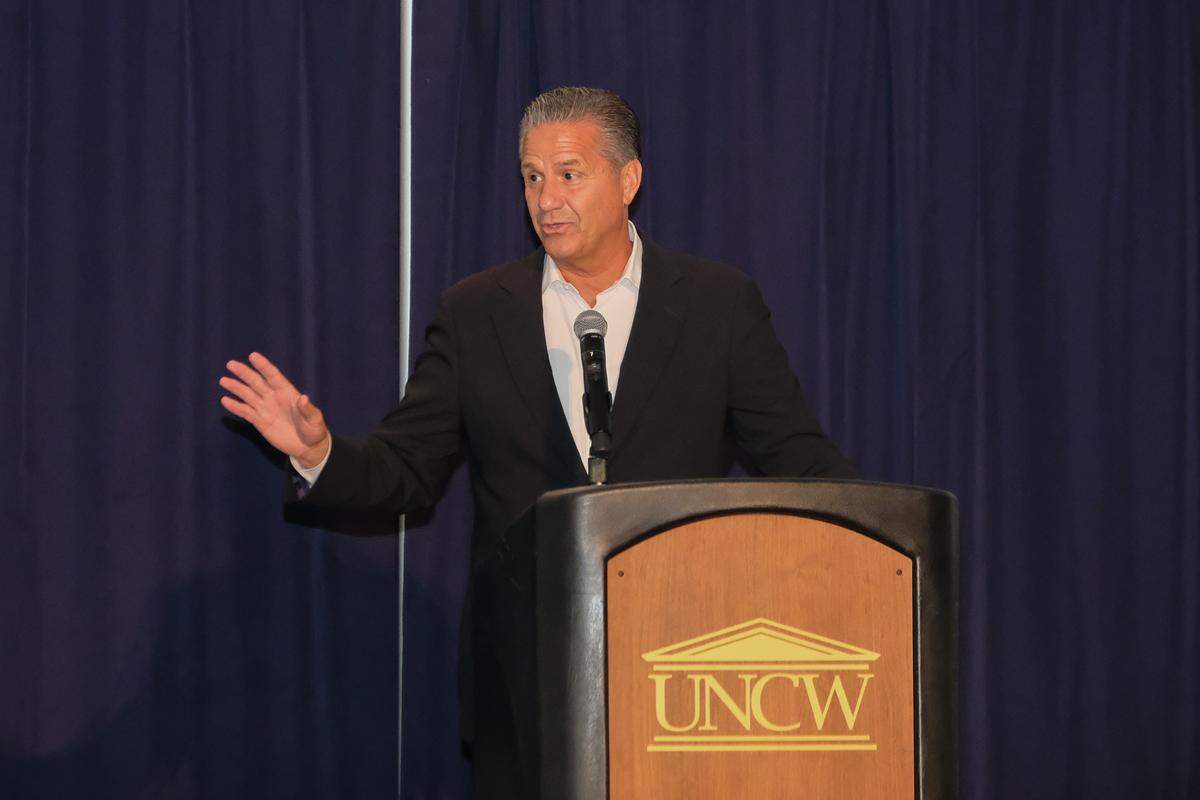
The UK coach laughed as he recalled walking into the UNCW gym for the first time as a college freshman. He paints the picture of the team’s preseason locker room, listing off the names of several players standing around 40-plus years ago before getting to his first a-ha moment in college basketball.
“All of a sudden I’m looking at this kid. He’s about 6-3 and he weighs about 185, 190. The guys on that level — if you were 6-6, 6-7 you were probably one of the big men. And he was 6-3, I’d imagine. And I looked at the guys, and I’m like, ‘Who’s that guy over there? He looks like a big forward, strong kid.’”
Calipari’s roommate, Dennis Tobin, responded: “He’s a point guard.”
This was young Cal’s competition. “I went, ‘What?! He’s a point guard?!’”
The point guard was Barry Taylor, who had come to UNC-Wilmington that season as a junior-college transfer and, of course, beat out the 6-foot, 165-pound Calipari for the starting job.
Calipari scored a total of 29 points in 25 games his freshman season. The next year’s media guide referred to him as “a reliable backup to point guard Barry Taylor” that was dispatched off the bench “usually as a short-term reserve.”
In assessing that freshman season, Calipari paused to tell the story of a UNCW teammate who had just texted him a few days before. They reminisced that they sat next to each other at the end of the Seahawks’ bench. Calipari said — between a couple of belly laughs — that they traded jokes about who played more and concluded that neither played much at all.
“We can laugh now,” Calipari concluded. “It wasn’t funny back then. But now you can laugh about it.”
A few minutes of spot duty off the bench just wasn’t enough for the eager Calipari, who showed up at UNCW for his sophomore year but realized before that season began that he wanted more time on the basketball court.
Calipari decided to transfer. His parting with UNCW head coach Mel Gibson has been described as one with no hard feelings. “I never wanted Coach Gibson — there was probably awkward times there — but I didn’t want him to feel anything other than I respected him and I appreciated the work that he put in. And I always will say to him, ‘I don’t know if I could coach me back then.’”
In the end, it was a learning experience.
“You know, you’re 18 and you’re ready to go and you want to play every minute and you think you’re better than you are. And, all of a sudden, the crap hits the fan and you learn, ‘Oh, man, there are players out there better than me, stronger than me.’”
Going back home
There was no second recruitment. No list of transfer options. Nothing but a phone call.
Calipari, who turned 61 this year, Sacco, 77, and DeGregorio, 85, had some differing recollections on various points of Cal’s early playing days — it was more than 40 years ago, after all — but they all had the exact same memory of the series of events that brought Calipari home.
The UNCW sophomore called Sacco out of the blue.
“Coach, this isn’t gonna work,” Calipari told him.
“I didn’t question what was happening,” Sacco recalls. “I said, ‘What do you need? Tell me what you need.’”
Calipari asked if Sacco still had a way to get in contact with DeGregorio, and Sacco told his former player to sit by his phone while he placed the call to the Clarion coach.
“I’ve got a point guard for you,” Sacco told DeGregorio.
“If it’s Calipari, I’ll take him!” the college coach responded.
“And Coach D welcomed me with open arms and was terrific to learn from,” Calipari says now. “Terrific coach.”
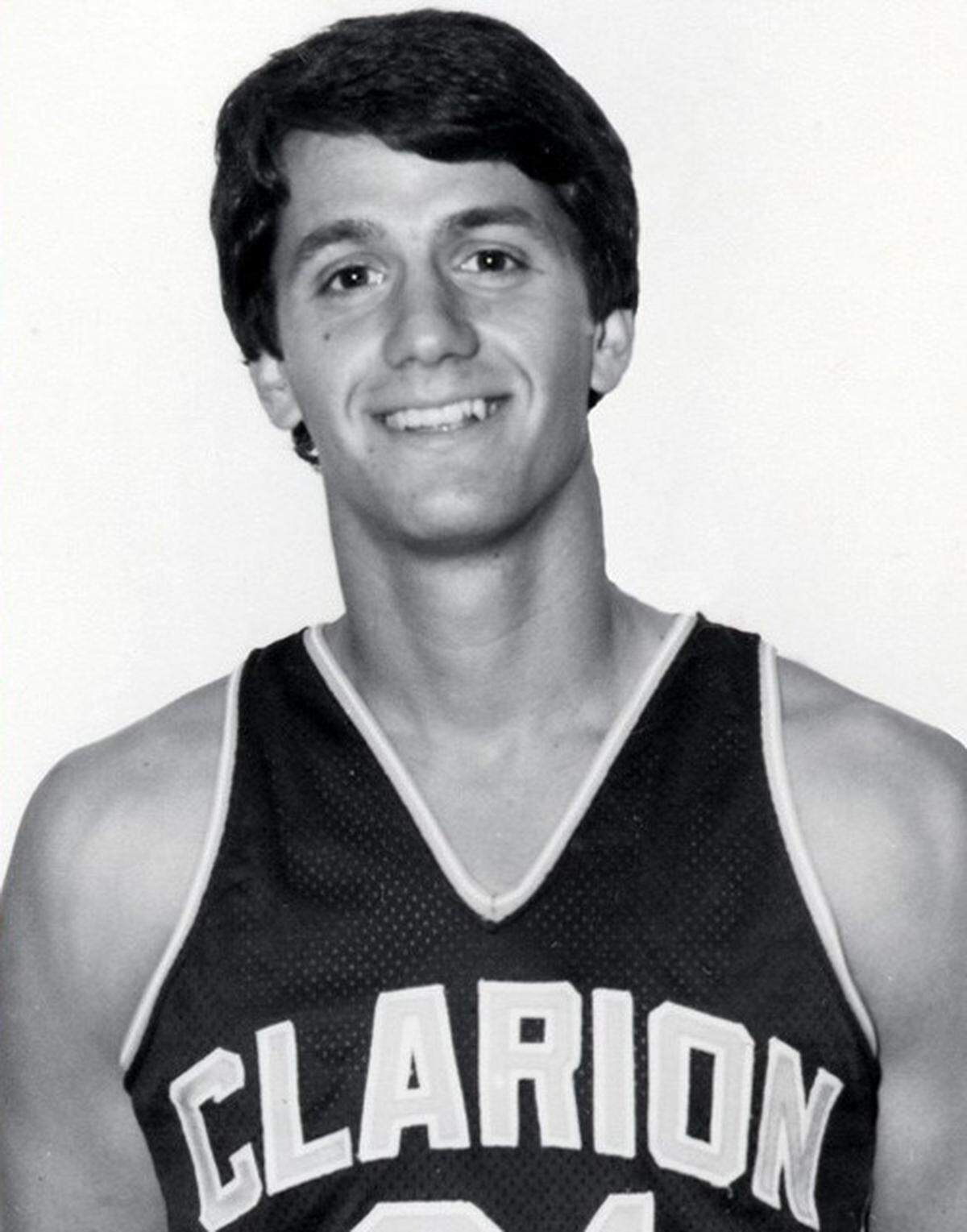
The two teamed up to have some pretty good success, including a trip to the quarterfinals of the Division II national tournament in Calipari’s first season there. The next year, he led Clarion in assists. And he picked up some good stories along the way, along with the experience of what it’s like to scrape by while trying to make it in college basketball.
Clarion players had campus jobs to help pay their way, remember, and Calipari’s was far from glamorous.
“I worked with a guy named Bucky, and I was sweeping the gym floor,” he said gleefully. “So I was sweeping the floor, mopping, doing whatever Bucky wanted me to do.”
The resources were so little that — on road trips — DeGregorio had to stretch the meal planning as far as he could. That meant no orange juice when they stopped for breakfast. “Orange juice costs as much as the meal,” DeGregorio would tell him. The athletics director kept all the extra shoes in his office, and — if a player needed a replacement — he had to come and personally clear it with the AD and show him the current pair of shoes before getting a new set.
The department — filled with great coaches and a terrific AD, Calipari says — operated, quite literally, on a shoestring budget.
“I almost fought the equipment guy,” Cal offers up with more glee. “I almost got thrown out of school.”
He said he was tying his shoe one night and one of the shoestrings broke. It was late, so he just tossed it in the trash. “I’ll get a shoestring tomorrow,” he thought to himself. He went back the next day to ask the equipment guy for a replacement.
Forty years later, his voice kept getting higher and higher — in typical Calipari fashion — as he became more amused with the retelling of the story.
“I need a shoestring,” Cal says, matter-of-factly, showing the guy the shoe. “I broke the shoestring.”
“Where’s the shoestring?” the guy responds curtly.
“I threw it out last night,” Cal told him.
“Well you’re going to have to go get it. I’m not gonna give you a shoestring unless you give me the broken one,” the guy says.
Calipari’s voice reaches a crescendo — laughing now, ready to throw down then: “I said, ‘I’m gonna jump over this cage! Give me a shoestring — I gotta be in practice in five minutes!’”
Origin of Coach Cal
Alongside the notes in that 1979 UNCW media guide that made it clear Calipari didn’t see the floor much as a freshman was one snippet that foretold where basketball would eventually take him.
“Possesses great ability to work with youngsters,” the media guide said, listing off some examples of basketball instruction that Calipari had already performed as a young man.
When Calipari was still in high school, he and Sacco started a basketball camp for young kids in the Moon area. As a senior, Calipari coached a middle school team in the district. As a college freshman in Wilmington, he created the “Little Seahawks,” a troupe of kids that performed ball-handling tricks at halftime of the games.
He worked as an instructor at the same Five-Star Basketball Camp that catapulted him to Division I recruiting status as a player. He has repeatedly told the story of Howard Garfinkel calling him down to lead a work station at one of the camps, which led to greater connections and opportunities in the future.
Those experiences might have broadened his horizons as to what was possible in a coaching career, but none of them were the origin for the dream itself.
When Cal was just a kid — “7, 8, 9 years old,” he says — he started traveling with the Moon High School baseball team. The Calipari family lived right across the street from the school’s sports fields, so he was always hanging around anyway. His father played softball with the school’s baseball coach, Ray Bosetti, and that was Calipari’s first connection with coaching.
“I was the bat boy. And I’d get on the bus with the team, and they’d let me out of school 15 minutes early,” he said. “The grade school was right near the high school, and I’d jump on the bus and go.”
From there, Calipari started a gig as the ball boy for the basketball team. And he started to notice a theme among the Moon High coaches. Ray Bosetti. Bill Sacco. Skip Tatala. Mark Capuano. With a little John Calipari running around after them.
“The reason I was getting into coaching was I thought that’s what Italians did,” he said. “Everybody at the school that was Italian was coaching.”
At the time, he didn’t dream he’d be a college basketball coach, certainly not a Hall of Fame one. Later on, Five-Star camp and Wilmington and the rest would lead him to dream bigger.
“I thought I’d be a high school coach and teacher, because that’s who I looked up to,” Calipari said. “… And I still look up to them today.”
Recruiting and relationships
Few people have been around John Calipari for as long as Bill Sacco, and the former Moon High School coach — still a highly successful coach in the Pittsburgh area, by the way — swears his famous pupil has never changed. There has been the Hall of Fame success, a national championship, several coaching stops around the country, good times and bad. But the essence of Calipari has always been the way he’s dealt with people throughout his basketball journey.
“He never changes. He’s the same,” Sacco says. “This guy remembers everybody and remembers all their names. He never has to turn to someone and say, ‘Who is that guy?’ … And I don’t know how he does it.”
People often ask Sacco if he always knew Calipari would be a coach. Sacco chuckles.
“Well, I always thought,” he pauses for a quick laugh, “Maybe a car salesman. He was good with people. He was always a talker.”
Calipari’s success as arguably the greatest recruiter in college basketball would’ve been impossible for anyone at the time to predict, but the qualities were always there. Back to his schoolboy days in Moon, and his standout days as a high school recruit, and even his days at the end of the UNCW bench.
“The crazy thing in all of this stuff is you create relationships along the way,” Calipari said. “People ask me about recruiting: ‘How do I do it?’ I enjoy meeting people. I enjoy hearing stories. I enjoy seeing what their hopes and desires and what they want for their children and what the young people want for their lives. I’ve been blessed.”
In a nearly 30-minute interview recapping his own career as a player and various success as a coach, Calipari was clearly at his proudest talking about the people he met along the way. He stays in regular contact with his teammates from Moon High, UNC-Wilmington and Clarion. They have active text groups. They talk on the phone. Players from all three places have come to see his Kentucky teams play. Just last fall, he spoke at UNCW’s tip-off dinner and caught up with Coach Mel Gibson and his former teammates.
“I will say this: at every place, the relationships that were created — even 40 years ago — are still there today,” he said. “And that tells you I was around good people. The coaches were good people, which meant they recruited good people. And, literally, I’ve stayed in touch with just about every guy.”
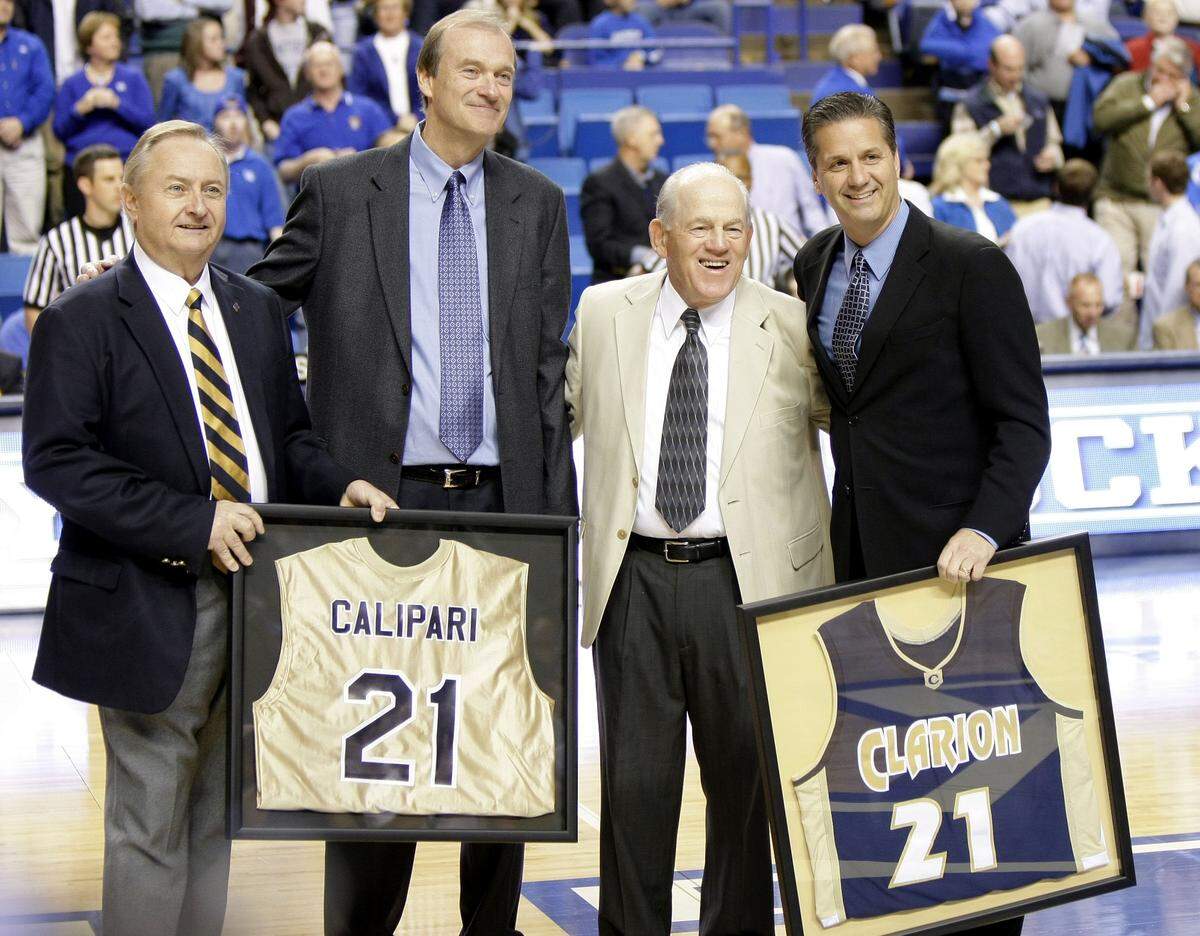
He’s almost incredulous when he talks about how he has even kept in touch with the college recruiters who unsuccessfully came after him as a player. Bill Whitmore went on to be the head coach at Vermont. He tried to hire Calipari as an assistant — Cal went to work for Larry Brown at Kansas instead — and they’re still in contact. He still exchanges text messages with IUP’s Tom Beck. And, of course, there’s DeGregorio, who ended up as an assistant coach at Pitt after leaving Clarion. He was already on staff when the Panthers hired Calipari away from Kansas for his first full-time coaching job. The two were colleagues for one season.
Calipari called DeGregorio beforehand to ask if it would be OK with him if he joined the Pitt staff.
“Why would I mind?!” DeGregorio responded, adding it was nice of Calipari to call. The coach still likes to needle his former player. “I think Kentucky is very fortunate to have a young man — I shouldn’t say young anymore — like him,” he said.
DeGregorio and Sacco both say the UK coach is still in contact every week or two — “Never more than two,” Calipari says — to check in on them and their families. He tries to get the former coaches together whenever he’s in the Pittsburgh area. Without Sacco’s knowledge, Calipari flew up to Pennsylvania in late February — during the stretch run of UK’s own season — to see Sacco’s team in a playoff game. A couple of weeks ago, Calipari welcomed DeGregorio’s grandson, Isaac, into the Wildcats’ program as a preferred walk-on. Isaac, a standout high school point guard — small, but determined — wants to be a coach someday. Sound familiar?
Toward the end of the conversation about his younger days, Calipari steers off course to say that he had just spoken earlier that day to Johnny Juzang, who recently announced that he was transferring from Kentucky after one season. The 19-year-old was looking for a little advice from his former coach.
“He asked me my opinion on a couple of things,” Calipari said. “And I told him, ‘Hey man, I enjoyed coaching you. You’re a great kid, and you know I wish you well, and I’ll help you however I can help you.’ … And that’s how this is supposed to be.”
This story was originally published April 15, 2020 at 7:41 AM.