
‘A hell of a coach who wasn’t perfect.’ Eddie Sutton, who once led UK, dies at 84.
Eddie Sutton, whose four seasons at Kentucky showed that the combination of an acclaimed coach and an elite program does not guarantee success, died on Saturday. He was 84.
Sutton’s 806 victories made him one of only 11 coaches who have won 800 or more Division I men’s college basketball games. He became the first coach to lead four schools to the NCAA Tournament: Creighton, Arkansas, Kentucky and Oklahoma State.
Yet his trouble-filled time as UK coach and a subsequent acknowledgment that he was an alcoholic were cited as reasons it took so long for him to be elected to the Naismith Memorial Basketball Hall of Fame. Some considered this unfair.
“Nobody in the history of the game has taught one-on-one team defense like Eddie Sutton,” one of his former players, Doug Gottlieb, said in 2017 for a planned documentary on Sutton. “It’s awful we judge him basically upon one or two bad moments.
“The man is an alcoholic. The man is a great basketball coach. Those two things can coincide and be true.”
Last month, after seven times being named a finalist. Sutton was at last chosen to the Hall.
His family released the following statement upon his death Saturday:
“Our beloved Dad and Papa Coach Eddie Sutton, age 84, passed away peacefully of natural causes the evening of May 23rd at his home in South Tulsa. He was surrounded by his three sons and their families, which include his nine adoring grandchildren. He is reunited with his number one assistant, his bride Patsy Sutton, who passed away in January of 2013 after 54 years of marriage.”
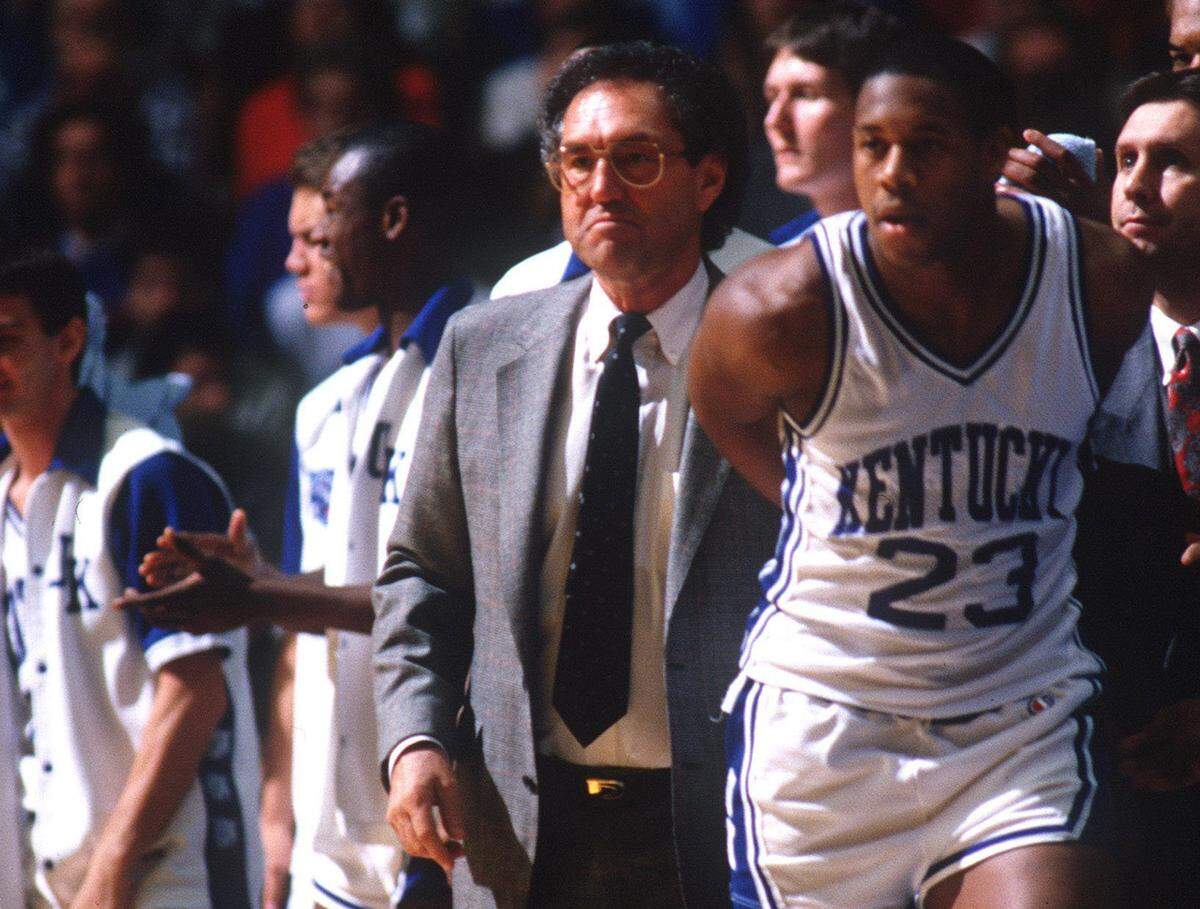
From the very start, controversy clouded Sutton’s four seasons as Kentucky coach. He angered fans in Arkansas, where he was a coaching icon, by saying at his introductory news conference in the spring of 1985 that he would have “crawled all the way to Lexington” to become Kentucky coach.
Moreover, Sutton took over a program that had been the subject of a Herald-Leader series the previous fall that looked into rule breaking. The series would win a Pulitzer Prize.
“Eddie sort of walked into a buzz-saw,” iconic play-by-play announcer Cawood Ledford said in his memoir, “Hello, Everybody, This is Cawood Ledford.”
The Herald-Leader series led to increased scrutiny of the Kentucky program. Then only months after the NCAA reprimanded UK for conducting an inadequate internal investigation of the Herald-Leader’s findings, another scandal exploded. The Los Angeles Daily News reported that $1,000 had been found in an Emery Air Freight package sent from UK to the father of prized recruit Chris Mills.
The NCAA later charged UK with academic fraud in connection to the college entrance exam taken by another recruit, Eric Manuel.
Meanwhile, rumors swirled of Sutton having a drinking problem.
In an interview for the documentary, Rex Chapman recalled a harrowing moment. “Down at the very end of the hall, it looked like someone was dead,” Chapman said. “It was Coach. He was so drunk. We freaked out. We didn’t know what to do.”
Dwane Casey, the UK assistant coach whose name was on the Emery Air Freight envelop sent to Claud Mills, said Sutton was “one of the great college coaches in the history of the game.” That Sutton was not able to lead Kentucky to greatness was a matter of poor timing, Casey said.
“It was almost a I’m-going-to-get-you mentality,” Casey said of the environment during Sutton’s four seasons as UK coach. “And I don’t care what program you are, you have someone chasing after you 24/7, watching over your shoulder, you’re going to make mistakes and stub your toe. I thought he was a victim of that more than anything else. More than it getting away from him or doing something outrageous or outlandish. … If he had been 20 years later or 15 years later, I don’t think he would have had the scrutiny he coached under at Kentucky.”
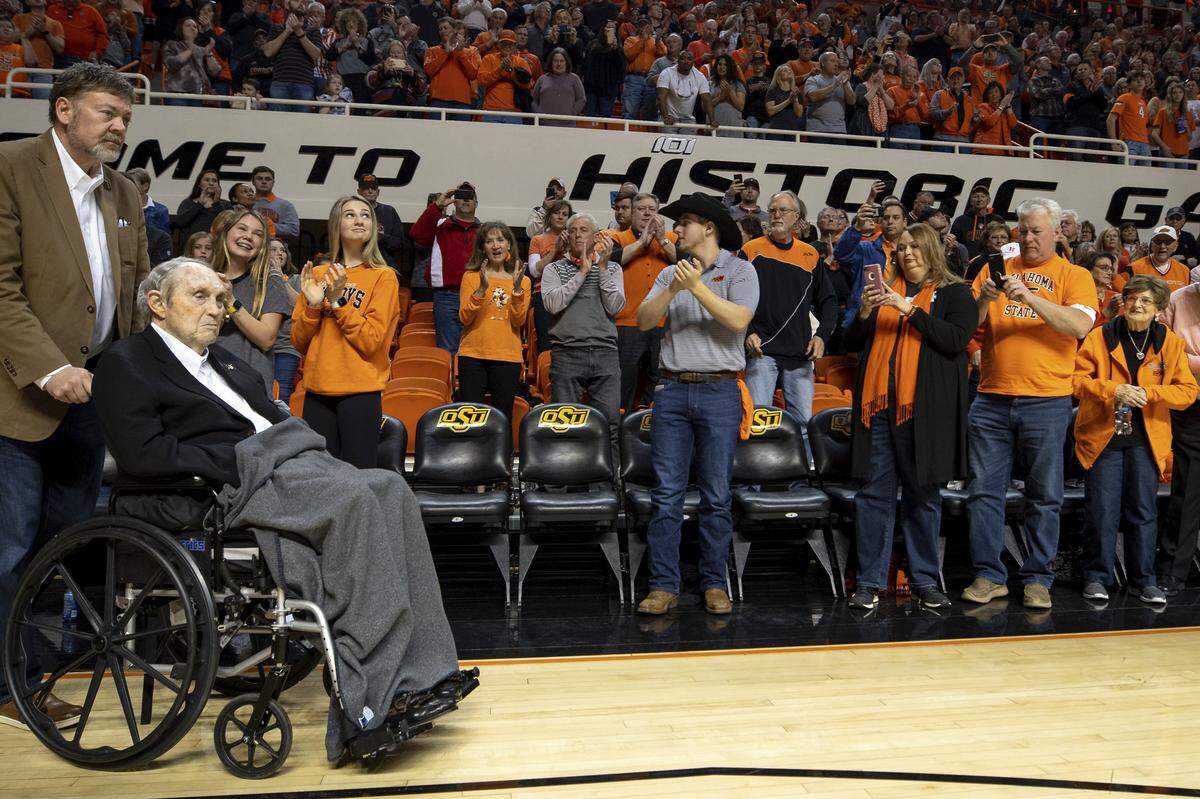
Edward Eugene Sutton was born on March 12, 1936, in Bucklin, Kan. He was the only child of Orville and Beryl Sutton. His father was a farmer and electrician. His mother worked as a cook at a public school.
On a court outside their rural home, Beryl Sutton served as a rebounder as her son practiced shooting. Eddie Sutton became known for his shooting.
Sean Sutton, the middle child in a family of three sons, said his father dreamed of playing for Phog Allen at Kansas.
“Dr. Allen came in there and spent four hours on a Sunday,” Sean Sutton said of a trip the Kansas coach made to recruit Eddie Sutton. “He told them of bringing in a player from Philadelphia. ‘You’ll get a lot of great shots because of him.’”
That recruit was Wilt Chamberlain.
But Allen also said he would retire from coaching in two years, or after Eddie Sutton’s sophomore season.
Eddie Sutton decided to sign with Oklahoma State to play for another giant of coaching, Henry Iba.
As for what led Eddie Sutton to go into coaching, Sean Sutton said there was no gripping fork-in-the-road career choice. His father simply loved basketball and wanted to remain part of the game.
Eddie Sutton began his head coaching career at Tulsa Central High School, where he compiled a record of 119-51 in six seasons. From there, he was hired to start a program at Southern Idaho Junior College (83-14 in three seasons).
After Sutton compiled an 82-50 record in five seasons at Creighton, Arkansas Director of Athletics Frank Broyles made a great effort to hire Sutton.
“(Broyles) flew through a snowstorm to hire Eddie because Duke was going to offer him,” said Wally Hall, the longtime columnist and sports editor of the Arkansas Democrat-Gazette.
Thanks in no small part to the arrival of the famed Triplets (Sidney Moncrief, Ron Brewer and Marvin Delph), Sutton was an almost instant success at Arkansas. Sutton and the Triplets advanced to the 1978 national semifinals, where they lost to Kentucky.
Sutton’s 11-season win-loss record at Arkansas was 260-75, In that time, the school expanded Barnhill Arena seating from 5,200 to 9,000.
“He was kind of the Adolph Rupp of Arkansas,” said Doug Barnes, who worked on Sutton’s staffs at Arkansas and Kentucky.
Kentucky won the news conference, as it’s said, with the hiring of Sutton the day after Villanova’s famous upset of Georgetown in the 1985 national championship game, which was played in Rupp Arena.
In a prepared statement, his predecessor as UK coach, Joe B. Hall, said, “In stepping down, I didn’t want to let the program down. But with Eddie, I see nothing but great days ahead.”
It was not to be. But the torturous unraveling of the UK program was not immediately apparent.
His first team had a 32-4 record and advanced to the Elite Eight, where it lost to LSU in the teams’ fourth game of that 1985-86 season. Having inherited a team that finished with an 18-13 record the previous season, Sutton was named National Coach of the Year by both The Associated Press and the National Association of Basketball Coaches.
Ledford’s memoir recalled how after the season former Kentucky Gov. A.B. “Happy” Chandler sending Sutton a one-word note: “Unpack.”
After a re-tooling 1986-87 season in which a freshman (Chapman) played a starring role, Kentucky compiled a 25-5 record in Sutton’s third season.
“I learned from the master,” Barnes said of his time as a Sutton assistant. Sutton had a knack for knowing how to motivate a player and a feel for game strategy, he said.
“He’d make decisions you’d really question at the time,” Barnes said. “Ninety-some percent of the time, he was right. I learned quickly not to question coach’s decisions even though they may not look like the right thing to do. … I was just amazed at his ability to come up with the right move the majority of the time.”
Added Casey: “Coach had a sixth sense. … I don’t know how to put an adjective on ‘it.’ But he had ‘it.’ We’re imperfect people, but he was a perfect coach.”
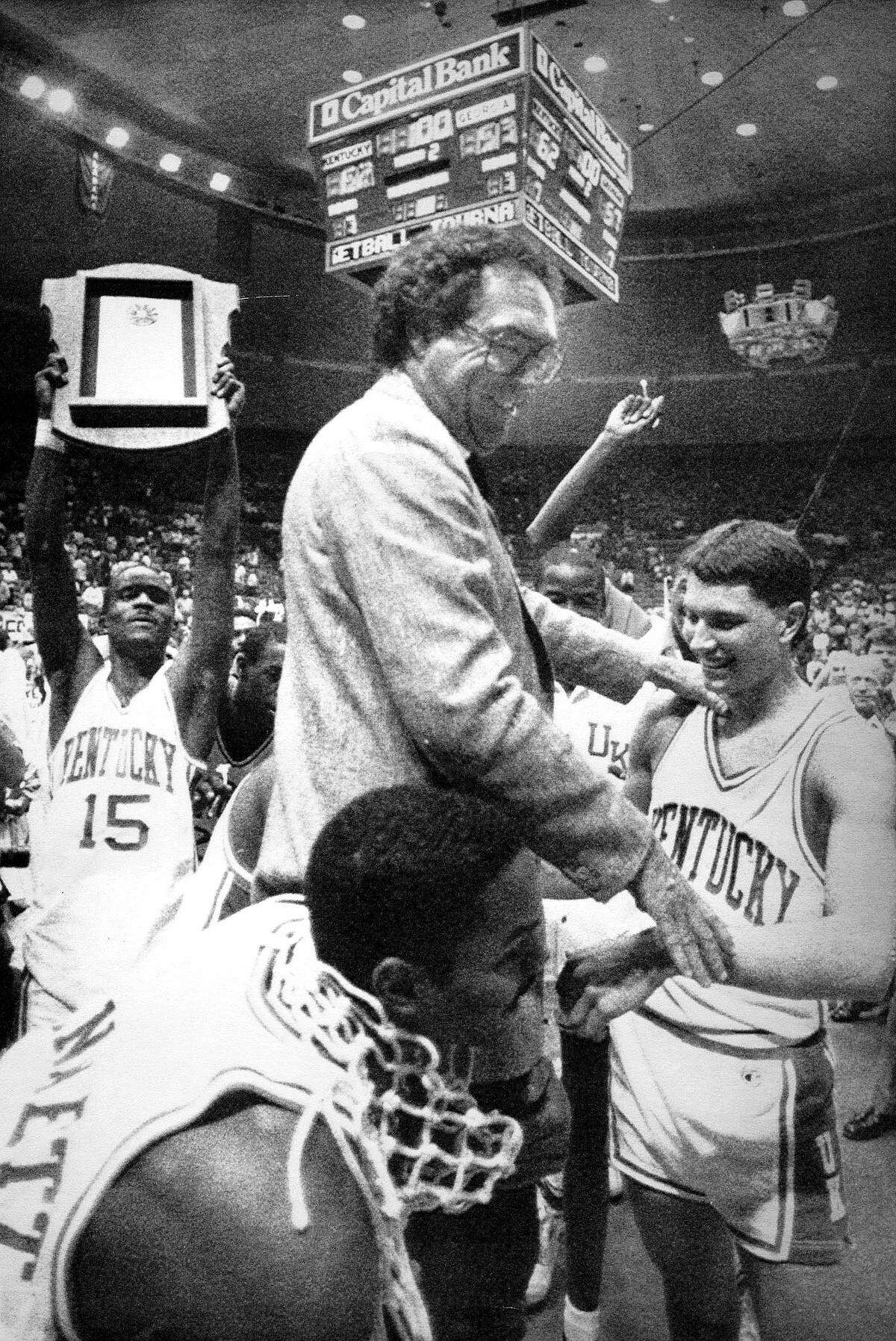
Two Southeastern Conference regular-season and tournament championships in the first three seasons led UK to proclaim Sutton’s hiring as a success.
Sutton’s biography in the 1988-89 media guide began with, “If his first three seasons are any indication, Sutton has met the challenge with flying colors.”
But in October of 1988, the NCAA announced 18 charges of wrongdoing. With the reprimand of an inadequate investigation still fresh in mind, then UK president David Roselle hired a retired judge, James Park, to investigate the program. Rumors of Sutton’s resignation or firing circulated.
That final season was a disaster. Before the opening game, ESPN commentator Dick Vitale called for Sutton to resign. That Sean Sutton played instead of Richie Farmer, an incoming freshman who had reached almost legendary status as a Kentucky high school player, fed fan disgruntlement.
Kentucky finished with a 13-19 record, the school’s first losing season since 1926-27.
“The happiest moment of the season was when it was finally over,” Ledford said in his memoir. “The program seemed to be totally ashes.”
Sutton resigned on March 19, 1989, and told CBS-TV that his resignation was not an admission of guilt. “Not at all,” he said. “I am innocent.”
Sutton said he resigned “for one reason: the love I have for the University of Kentucky, for the Kentucky basketball program and the people of the commonwealth.
“I know how important basketball is to the people of the state. And I’ve decided for the good of the program, for the fans, for the players and most of all for my family, I should resign at this time.”
Choosing his words carefully, Barnes alluded to Sutton’s addiction to alcohol as the reason the great coach did not lead Kentucky to basketball glory.
“I just think his problem was the major factor,” Barnes said. “And it affected all his decisions off the court. … His personal problem made it difficult for him to have the control you have to have to have the success that’s demanded at Kentucky.”
The seesaw between great success and poignant setback in Sutton’s coaching career did not end. A year after he resigned at Kentucky, Sutton was hired by his alma mater. In 16 seasons, he led Oklahoma State to 13 NCAA Tournament appearances. His record of 368-151 included teams advancing to the Final Four in 1995 and 2004.
Tragedy struck in 2001 when 10 members of the Oklahoma State basketball program died in a plane crash on the flight home from a game at Colorado.
“I think Eddie was clean and sober for several years, then that plane crash,” said Hall, the sportswriter with the Arkansas Democrat-Gazette. “He sat at the airport — and at 7 o’clock in the morning — he personally called every parent, every wife. He did all the phone calls, all the notifications that their loved one was dead.
“Then just a few months after that, he fell down an escalator in Los Angeles, and I thought, uh-oh.”
On Feb. 10, 2006, Sutton was cited for driving under the influence. That effectively ended his coaching career at Oklahoma State.
“He started out, like a lot of people, just a social drinker,” Sean Sutton said. “And over time he started to develop a habit. It started to get away from him his last couple years at Arkansas.”
After his second season as UK coach, Eddie Sutton sought treatment for his alcoholism at the Betty Ford Clinic. Sean Sutton said that back pain contributed to his father’s relapse at Oklahoma State.
“I don’t know what possessed him to buy a bottle of vodka and decide it was time to start drinking again,” Sean Sutton said. “Because he’d never done that — ever — at Oklahoma State.
“I love my dad. But sometimes with a lot of guys, the success he had, they think they’re invincible and use poor judgment.”
Christopher Hunt, the director of the documentary with the working title of “EDDIE!,” said he believed the rise-and-fall nature of Sutton’s career would make for a riveting story.
“He was a hell of a coach who wasn’t perfect,” Hunt said.
This all-too-human storyline allowed Hunt to win the Sutton family’s approval for the documentary.
“He’s been to the top of the mountain; he’s been at the bottom,” Sean Sutton said of his father. “He kind of endured and survived it all. So (Hunt) thought it’d be a pretty fascinating story.
“One thing they agreed upon. If you tell the good, you have to tell the bad, too. Because that’s who he is.”
Eddie Sutton is survived by three sons — Steve, Sean and Scott — and nine grandchildren.
This story was originally published May 24, 2020 at 1:59 AM.