The 2021 NCAA Tournament was unlike any other. Could future editions look similar?
Mitch Barnhart’s role in the preservation of college athletics’ most significant event went overlooked during the 2020-21 basketball season.
The entirety of last year’s NCAA Division I Men’s Basketball Tournament was held in Indiana; a single-state gauntlet was deemed to be a more responsible way to conduct the organization’s signature championship, from which about 90 percent of its annual revenue is generated. The NCAA would quickly cease to exist without “March Madness,” which was canceled in 2020 at the advent of the COVID-19 pandemic.
“There was pressure from a lot of different fronts to try and find a pathway forward,” Barnhart said during an interview with the Herald-Leader this week. “ ... The Herculean effort that the staff put together to get it done? It was amazing. They were remarkable.”
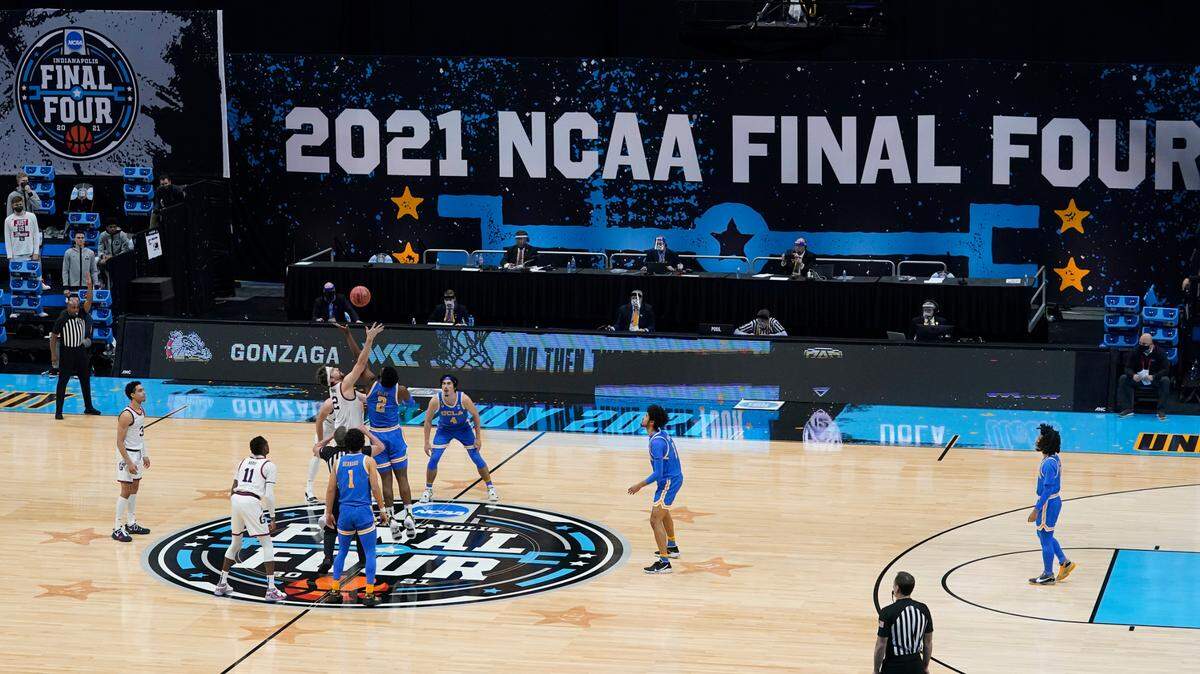
Barnhart, the University of Kentucky’s athletics director, was the chair of the Division I Men’s Basketball Committee, a group last year tasked with figuring out the viability of actually staging a tournament in the midst of a continuing global pandemic, and then determining the logistics of holding that tournament in a manner it had never done before. Almost every game was played — only one, a first-round bout between Oregon and VCU, was declared a no contest due to health-and-safety protocols within VCU’s program — and a champion was declared soon after a Final Four that featured an all-time memorable contest (Gonzaga’s 93-90 win over UCLA).
All things considered, it could not have gone much better nationally. Of course, on a personal level, Barnhart would have liked for his own school to be in the mix at the end. Kentucky failed to qualify for the tournament.
“In the dream, when you draw it up in your mind, the great picture is you handing your team the trophy, and it didn’t quite work out that way,” Barnhart said with a laugh. “There was a lot of talking back and forth and just trying to get through those difficult times. It was just a really, really tough six months.”
With the benefit of hindsight — which includes knowledge of the $1.15 billion generated in revenue last year by the NCAA thanks to a closer-to-normal March — it’s easier for Barnhart to reflect on those six months as “fulfilling professionally” and “pretty cool” based on what he and his team were able to put together. Four of the six venues were in Indianapolis proper while two others were in Bloomington and West Lafayette about an hour or so away. All but 12 games were played within a span of less than 20 miles in Indianapolis, including all of the tournament from the Sweet Sixteen onward.
This year’s tournament will return to the pre-pandemic distribution of games dotted across the country, spanning from Portland, Ore., to Greenville, S.C. The Final Four for the first time since 2012 will be held in New Orleans, which among modern host cities will have hosted the final weekend of games the most times, six, after April (only New York and Kansas City, Mo., rank ahead of it, and they haven’t hosted a Final Four since 1950 and 1988, respectively).
Future sites for all rounds have been distributed in a traditional manner out to 2026. Barnhart won’t be influencing the decision — his time on the committee ended with the 2020-21 season — but he believes the “single-city” version of March Madness was successful enough that it’s something that could make a comeback in the future.
“It was certainly unique, and I gotta admit that on some level it was a lot of fun to have that energy going around at all the different places at the same time,” Barnhart said. “There’s also a really cool piece to spreading it out in all parts of the country, and there’s stuff going on everywhere. So I wouldn’t say never, but I wouldn’t say always; those are two ends of the spectrum. I’d say maybe you look at it and see if it works, and maybe try it occasionally.”